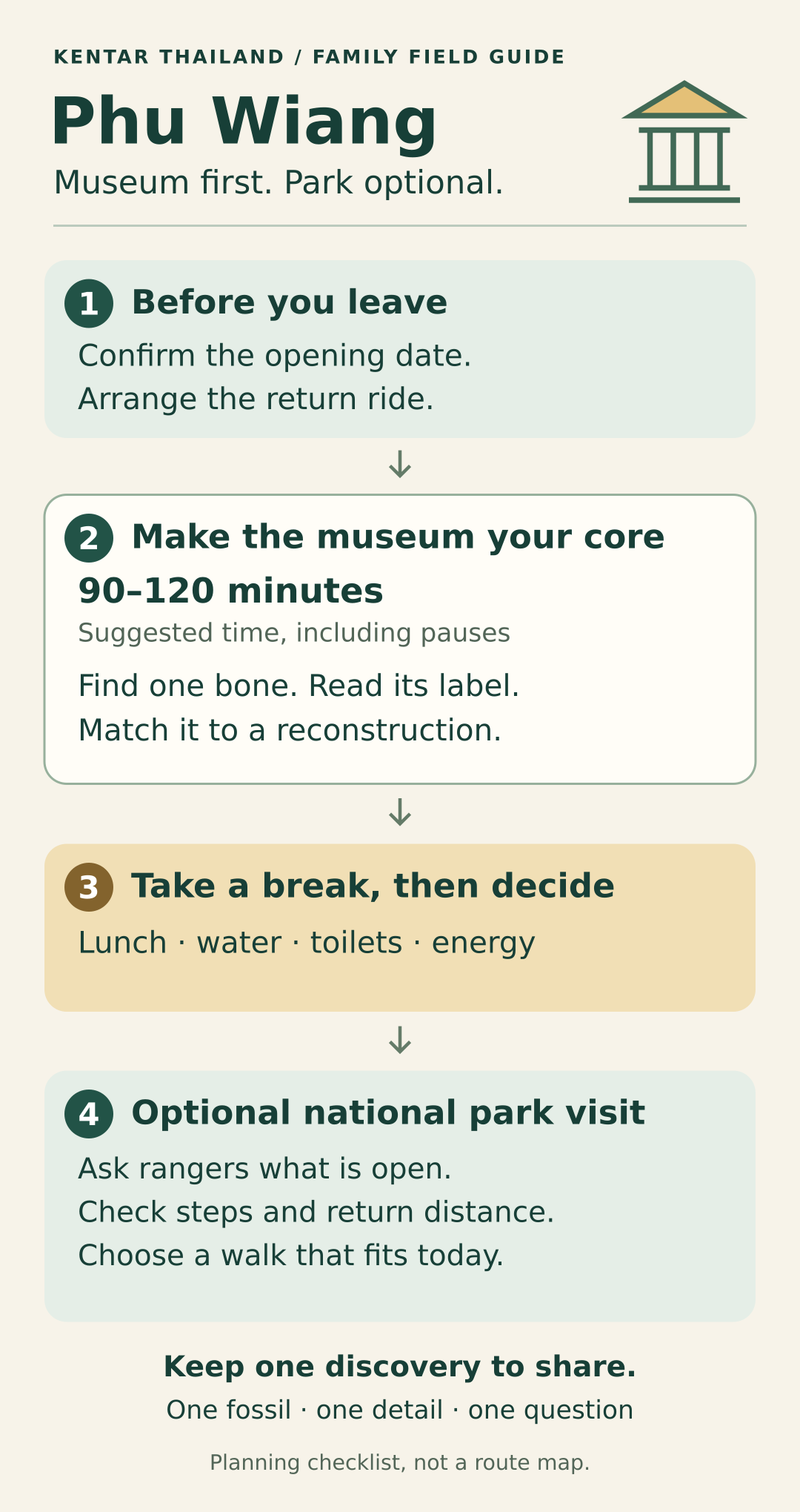
Make Phu Wiang Dinosaur Museum the centre of your family day, then decide whether everyone still has the energy for an excavation site in the national park. The museum gives children something specific to look for outside: the shape of a bone, where it lay in the rock, and how researchers worked out what it belonged to.
This is a day to build into a stay in Khon Kaen. Keep the museum, lunch and the return journey in your firm plan; leave the outdoor walk flexible. You can have a worthwhile visit without completing a circuit of fossil sites.
First, separate the museum from the national park
Phu Wiang Dinosaur Museum, also called the Fossil Research Center and Dinosaur Museum, is in Nai Mueang, Wiang Kao district, Khon Kaen province. The Department of Mineral Resources (DMR) describes it as standing outside Phu Wiang National Park, about 3 km before the park on the approach road. The excavation sites are a separate park visit. DMR’s description of the Phu Wiang area.
Think of the two stops this way:
- Museum: start with the exhibition building and the story of local discoveries. Add the outdoor garden if it suits the weather and your children.
- National park: visit the landscape where discoveries were made. This adds another admission decision, a transfer and an outdoor walk.
Save both destinations separately when arranging transport. A booking that says “Phu Wiang” should specify whether it includes the museum, the park headquarters and waiting time at both.
Why this place matters
DMR traces the local discovery story to 1976, when geologist Sutham Yaemniyom found a fossil during uranium exploration. Examination identified the find as the lower end of a plant-eating dinosaur’s thigh bone. Serious Thai–French exploration followed in 1981. DMR museum history.
One name to remember is Phuwiangosaurus sirindhornae, a plant-eating dinosaur associated with discoveries at Phu Wiang. DMR’s account identifies bones from excavation sites 1 and 2 and records the publication of its scientific name in 1994. DMR’s account of the discoveries.
For a child, the useful starting question is simple: “How can part of a leg tell us about an animal?” It gives the visit a thread to follow from a small fragment to a much larger reconstruction.
Three things to look for in the museum
Allow about 90 minutes to two hours, including pauses. This is a suggested family pace, not an official tour duration. Ask at the entrance which displays and activities are available that day. If your family needs English explanations or a scheduled activity, check availability before travelling.
1. A fossil fragment and the animal it came from
Start in the section about dinosaurs from the Phu Wiang mountains. DMR describes a display about Thailand’s first dinosaur fossil discovery, together with local finds and an excavation plan. Museum exhibition outline.
Choose one labelled bone. Ask your child to describe its shape before reading the explanation: long or short, broad or narrow, curved or straight? Then find out which body part the label identifies. If there is an accompanying skeleton or reconstruction, look for where that piece fits.
Check the label for “fossil,” “cast” or “model,” or ask staff. A reconstructed skeleton helps explain the animal’s overall shape; the label tells you what evidence is being shown. Avoid assuming that every bone in a complete-looking display is an original fossil from one animal.
2. A body shape you can compare
Find a clearly labelled dinosaur reconstruction and follow its outline from head to tail. Compare the neck with the body, then the front and back limbs. Let each child pick one feature to sketch rather than trying to copy the whole skeleton.
A good question is, “What can you see for yourself, and what did the label tell you?” The shape of a leg is visible. The dinosaur’s name, age and interpretation come from research. Younger children can simply match a bone shape to a picture; older children can record the specimen name and discovery location.
3. The work between discovery and display
DMR’s museum description includes a view through glass into a fossil laboratory. If that viewing area is open, look at the tools and workspace without expecting researchers to be demonstrating a task. DMR museum information.
Ask what happens after a bone is found: how is its position recorded, how is it protected, and how is it compared with other finds? Staff or the display may answer some questions; leaving with one unanswered question is fine. It can become something to look up together later.
Finish by returning to the object your child liked most. One remembered fossil is a better outcome than a rushed attempt to read every panel.
A special exhibition to ask about
A DMR announcement published 29 September 2026 advertises a special exhibition marking five decades of Thai dinosaur discoveries, beginning 21 July 2026 in the rotating exhibition hall. The notice says this exhibition is free and does not give an end date. Ask whether it is still available for your visit; this notice does not establish free admission to the entire museum. Read the exhibition announcement.
Treat workshops, simulated excavations and guided activities as things to confirm for your date. An event advertised on an older page is not a promise of a daily drop-in programme.
After lunch, choose the outdoor version that fits
The useful decision is how much walking everyone wants after the museum. Take a proper break before adding the park.
Nai Mueang Municipality describes a sandstone clearing with traces of uranium exploration about 300 m along the approach from park headquarters towards excavation site 3, Huai Pratu Ti Ma. This does not establish the full distance to the excavation site. Its visitor page also describes a wider nature trail of roughly 3 km around the headquarters area. Municipal visitor information.
For a shorter family outing, ask rangers whether site 3 is open and suitable that day. Ask for the actual start point, return distance, steps and surface before setting off. Choose the wider walk only after you have that information and enough time to return comfortably.
At an excavation display, use the museum visit to guide your attention. Look for how the bones are arranged and what the explanatory plan identifies. Where the viewing position allows, notice the surrounding rock as well as the fossil. Follow barriers and signs, leave everything in place, and take a sketch or photograph only where permitted.
Current access matters: this research did not establish the condition or opening of each outdoor trail on 11 October 2026. A published trail description is not a same-day clearance. Rain, a closed section or tired children are good reasons to shorten the visit.
Indoor and outdoor effort are different
The exhibition building lets you focus the visit on a smaller number of displays. The museum garden and national park add outdoor exposure and walking. Neither an attractive brochure nor a short distance establishes a step-free route.
If you use a wheelchair or stroller, ask the museum about access to the rooms you want, and ask park staff separately about the precise trail. Check toilets and resting places before you leave the entrance area. Avoid committing to the longer walk until the route has been explained.
Bring water, sun protection, rain protection and closed walking shoes for the park. Keep snacks for permitted eating areas. With young children, leave time for a toilet stop and a calm return to the vehicle before the next drive.
Opening hours and admission to check before setting off
Phu Wiang Dinosaur Museum
The museum’s 5 September 2025 DMR notice lists Tuesday–Sunday, 09:30–16:30, closed Mondays. The banner on its current official homepage repeats these hours. Older DMR material still shows 09:00–17:00; use the newer museum notice when planning, and check holiday arrangements for your exact date. Its listed mobile contact is 081 846 2760 within Thailand, or +66 81 846 2760 from abroad. DMR opening hours and contact notice.
DMR’s general museum page publishes these standard admission rates:
- Foreign visitors: THB 60 adult / THB 30 child
- Thai visitors: THB 20 adult / THB 10 child, before applicable exemptions
The museum’s current exemption notice includes Thai-national children aged 12 or under and Thai nationals aged 60 or over, among other categories. Check eligibility, child classification and any required evidence with the museum. The Thai-national child exemption should not be assumed to cover every visiting family. Published museum rates · Current museum notices.
Phu Wiang National Park
The Tourism Authority of Thailand lists visiting hours of 08:30–16:30 daily. Check your proposed excavation-site visit with park staff; the listed park telephone is 043 438 333. TAT park information.
TAT lists national park admission at THB 200 adult / THB 100 child for foreign visitors. Check Thai-visitor rates, children’s ticket categories, exemptions and any vehicle fee directly with park staff before paying. TAT park admission information.
These are separately published museum and park charges, not a combined ticket. Add transport, waiting time, lunch and any optional activity separately. Our Thailand budget worksheet helps keep shared car costs separate from per-person admission.
Getting there from Khon Kaen
DMR places the Phu Wiang area about 87 km west of Khon Kaen, approached via Highway 12 towards Chum Phae, then Highway 2038 towards Phu Wiang. Use the museum’s full name and Wiang Kao address for the final destination. DMR road approach.
For this two-stop family plan, a pre-arranged driver or a suitable self-drive car is a practical choice. Agree on the return journey before leaving Khon Kaen, including the optional park stop, driver waiting time and your latest departure time. Confirm suitable child restraints with the vehicle provider.
This guide has not verified a current direct public-transport timetable to the museum and excavation sites. If you plan to travel by bus, have your accommodation or the operator confirm the final connection and return service before committing. Do not build the return around an unconfirmed app-taxi pickup.
A 10:00 museum arrival is a useful planning target: it leaves room for the displays, lunch and a decision about the park without relying on the final opening hour. Work backwards using the journey estimate for your actual pickup point and that day’s conditions.
For lunch ideas, our Isan meal guide explains how to combine grilled chicken, sticky rice and som tam, with ingredient and spice questions. Choose the actual restaurant around your route and your family’s needs.
Save a four-line family field card
- Our return: pickup place _____ / time _____ / driver or service contact _____
- Our museum find: object name _____ / one visible detail _____
- Our outdoor decision: site confirmed open _____ / return distance _____ / turn-back time _____
- Our question for later: _____
Let each child choose one discovery to explain on the way home. A fragment, a skeleton and the place where a fossil was found can become one connected story, even on a short visit.
Source review: 11 October 2026 (UTC). This is a researched family itinerary, not a report of an on-site visit. Time allowances and the suggested order are editorial recommendations. Prices, holiday arrangements, activity availability and outdoor conditions should be checked again with the responsible venue before travel.