For two people who want to try an Isan meal, start with three choices: a particular som tam, the restaurant’s grilled-chicken portion, and the amount of sticky rice you want. Confirm the sizes and ingredients before turning those choices into an order.
This is a flexible starting plan, not a fixed traditional set or a claim that three orders will feed every pair. It is an Isan-focused English companion to our Japanese guide to ordering a shared meal, with a restaurant-menu example checked on 10 October 2026. It is researched guidance, not a firsthand tasting review.
Know what each part adds
Isan is northeastern Thailand. The Thailand Foundation identifies sticky rice as the region’s staple and names som tam, or papaya salad, and gai yang, or grilled chicken, among its familiar dishes. It also describes pla ra as a fermented-fish ingredient associated with the region’s cooking. These are starting points for reading a menu, not complete recipes for every restaurant. Read the Foundation’s Northeast Thai Cuisine overview.
For this proposed meal, the salad is the flavour choice, the chicken is the cooked main dish to size, and sticky rice is the staple to count separately. The aim is to choose a manageable first order with contrasting elements. You do not have to add another meat dish just because it appears beside them on the menu.
1. Choose the actual som tam, not just “papaya salad”
Point to one named version and ask what is in it. Decide separately about chilli, fermented-fish seasoning and any meat or seafood additions. Saying that you want less heat does not answer the other two questions.
A useful real-menu example is Somtum Der Bangkok’s official menu. At our check it listed a papaya salad with salted egg, another with cockles and fermented fish, and another with rice noodles, Vietnamese sausage, fermented sausage and pork rind. These are different orders, not interchangeable translations of a single salad.
That example is for recognising menu differences. It does not establish today’s stock, portion weights, cooking methods for every ingredient, or suitability for your diet. Ask the restaurant you actually visit to explain its version.
- Flavour: “Can this be made with less chilli?” Ask whether the adjustment is possible for that item.
- Fermented seasoning: “Does this contain pla ra? Has that ingredient been cooked?” If you want it omitted, ask whether the kitchen can do that.
- Additions: “Does this version have crab, prawns, cockles, sausage or other additions? Which are raw and which are cooked?” The list is a prompt, not a complete ingredient declaration.
Ordering without pla ra does not establish that the salad is fish-free, vegetarian or suitable for an allergy. Ask about the complete preparation, including the dressing, rather than inferring an answer from one ingredient you have removed.
2. Check the chicken’s cooking method and selling unit
Look for grilled chicken, then ask what one order means. Is the listed item a particular cut, a half chicken, a whole chicken or another serving? These are questions to resolve from that menu, not a promise that all those options exist. Ask staff to describe or show the portion before choosing the quantity.
Do not silently substitute a similarly named chicken dish. For example, Somtum Der’s menu describes its chicken-thigh item as deep-fried. That is a different cooking method from gai yang. The restaurant’s food introduction discusses portions intended for trying several dishes, but does not give a universal two-person serving size.
For the chicken you choose, ask what comes with it and whether its dipping sauce can be served separately. A separate dip lets you decide how much to use; it does not remove ingredients already in a marinade. Confirm the marinade and sauce independently if either matters to you.
3. Count the sticky rice once
Check whether rice is included in the chicken order or any set you selected. If it is separate, ask how much comes in the smallest available serving and decide how many servings you want between you. A basket in a photograph is not a reliable measure.
Somtum Der’s menu lists steamed sticky rice as its own item. This is a concrete reminder to look for the rice line on a menu, rather than assume it arrives with another dish. It is not evidence of the inclusions at a different restaurant.
Before ordering, agree whether both people will share everything. If one person wants only the chicken and rice, do not count them as eating half the salad. If you hope to add food later, first check that the kitchen allows another round and that you are not close to its last order.
Your two-person order card
Use this sequence with the menu in front of you. Leave quantities undecided until the restaurant has explained its portions.
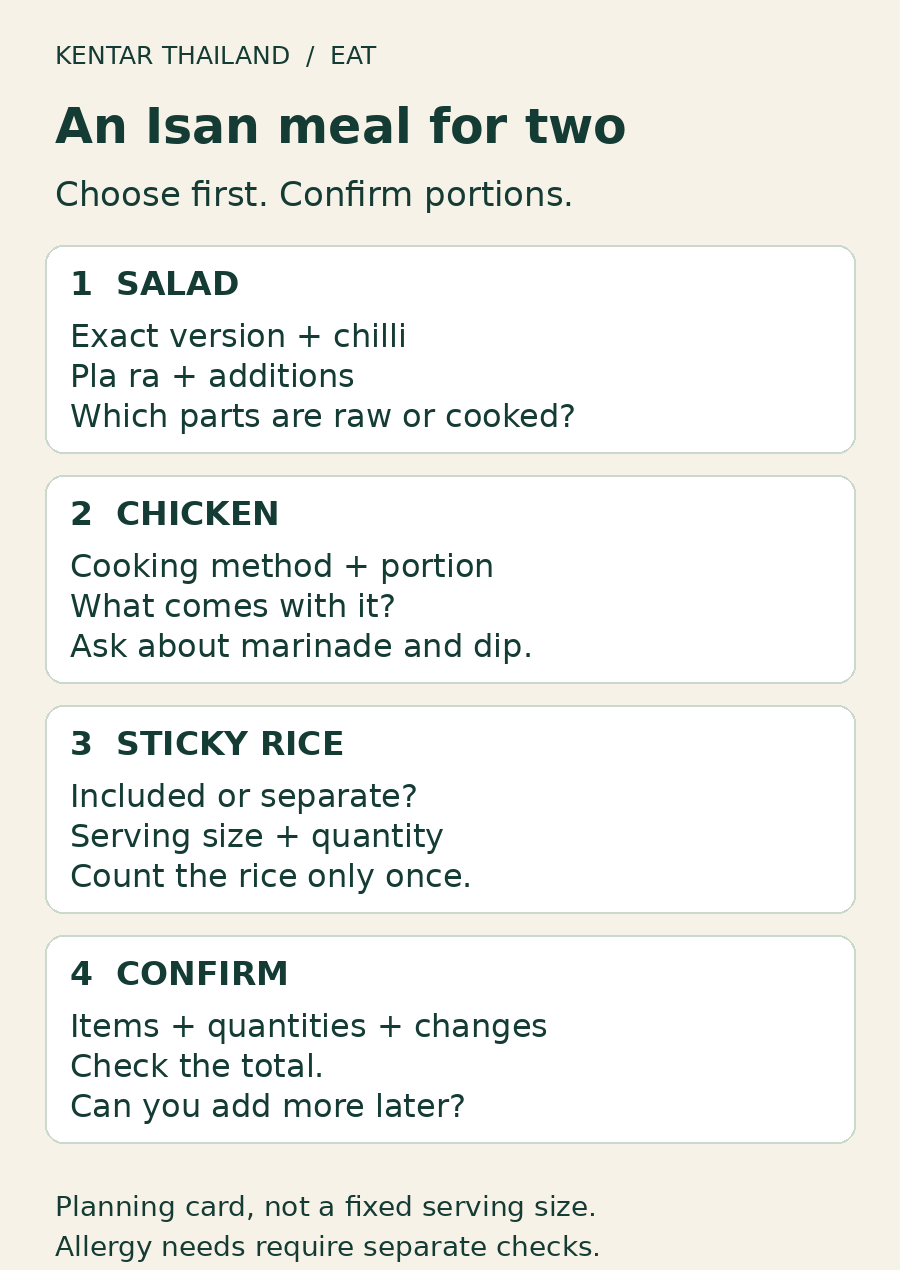
- Salad: Choose the exact version. Check chilli, pla ra and additions. Ask which ingredients are raw or cooked.
- Chicken: Confirm grilled or another method, the cut or size, what comes with it, and the dipping sauce.
- Rice: Check included or separate, the serving size, and the number of servings you want.
- Before confirming: Read back the item names, quantities, agreed changes and total. Ask whether you can order more later.
Useful English prompts: “We would like to share.” “Could you show us the portion size?” “What is included?” “Can the dipping sauce come separately?” “Can we start with this and order more later?” These are editorial question prompts, not Thai translations or an assurance that staff can accommodate every request.
Keep raw, fermented and cooked separate
Do not use “fermented” as the answer to “has it been cooked?” Ask both questions where relevant. A cooked fermented-fish ingredient also does not turn a raw-vegetable salad into a cooked dish.
The CDC’s travel food guidance advises avoiding raw salads and raw or undercooked meat and seafood, and choosing hot food served hot. If you are following that guidance, replace the som tam with a thoroughly cooked option rather than treating a change of dressing as a safety solution. This meal plan does not require you to eat the salad.
For an allergy, the card above is not enough. Explain the specific allergen and ask the kitchen about ingredients and preparation, including shared equipment and preparation surfaces. Do not assume that removing a visible topping resolves the concern. The CDC recommends carrying a locally translated allergy card and not eating an item when its ingredients remain uncertain. Read its allergy-travel advice.
A good first order is one you understand
Finish with one clear read-back: the salad version you selected, the chicken portion and cooking method, and the rice quantity, plus any changes the kitchen has agreed to. Check the total before confirming. If a dish has not arrived, ask whether it is still coming before ordering it again.
For the broader seasoning background, our Japanese pla ra guide covers fermented fish in more detail. If you meant northern Thailand rather than the northeast, use our first Northern Thai meal guide; its noodle-bowl and shared-dip choices belong to a different regional introduction.
Information checked: 10 October 2026. Restaurant examples illustrate menu wording, not current prices, stock or guaranteed ingredients. Portion planning and English questions are editorial suggestions. No Thai-language ordering phrases or pronunciation lesson are included.