Prepare money for your first journey and a backup way to pay before you arrive. Then compare what you will receive or be charged, including fees, rather than choosing from an exchange-rate sign or a familiar currency symbol alone.
Three questions solve most of the confusion:
- How many baht will I actually receive or spend?
- Which fees come from the local service, and which come from my card issuer?
- Who is converting the currency?
Separate your spending plan from your payment plan
Use the Thailand budget worksheet to decide what the trip costs. This guide concerns how you pay that amount.
For arrival, write down the costs you still need to pay locally: your chosen transfer, any immediate purchase and a small reserve you decide is appropriate. Check each provider's accepted payment methods. A prepaid hotel does not mean your first day needs no money, and a card in your wallet does not establish that every business accepts it.
Keep a backup separate from your main wallet. Save your card issuer's official contact details and make sure you know the card's overseas-use conditions and withdrawal limit. Do not put a PIN in the same note. Mastercard directs travellers to the issuer for ATM eligibility, PIN questions and issuer fees. Mastercard cardholder FAQ
At an exchange counter ask for the net amount
Use an authorised bank or money changer. The Bank of Thailand explains that foreign-exchange transactions must go through licensed providers. Bank of Thailand exchange rules
Tell the counter which currency and banknotes you want to exchange. Ask:
- Is this rate for buying these banknotes?
- What unit does the displayed rate use?
- Is there a separate charge?
- How many baht will I receive for this exact amount?
- What identification do you need?
Confirm the final amount before handing over the money. Count the received notes discreetly at the counter and keep the receipt. If denominations matter for your immediate purchases, ask what is available.
A higher displayed rate can still produce fewer baht
The following numbers are fictional arithmetic, not current rates or actual offers. Suppose you exchange 100 units of the same foreign currency:
| Illustrative quote | Calculation | Net baht |
|---|---|---|
| A: 35 baht per unit, with a separate 40-baht charge | 100 × 35 − 40 | 3,460 |
| B: 34.8 baht per unit, no separate charge | 100 × 34.8 | 3,480 |
In this example, B produces 20 more baht despite the lower headline rate. Real quotes may handle charges differently; use the counter's final amount, not this example's numbers. Compare the same currency, amount and eligible banknotes. The time and travel cost of reaching another counter can also matter.
Know the two layers of ATM fees
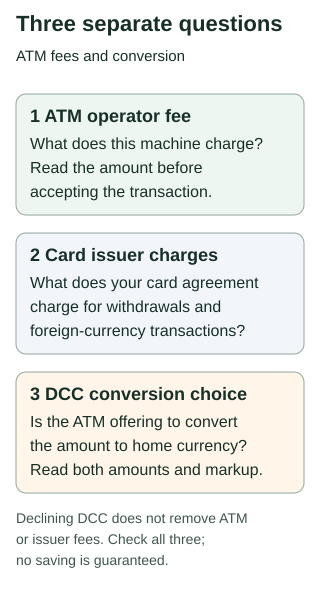
An ATM withdrawal can involve both a charge from the machine's operator and charges under your own card agreement. A currency-conversion offer may add another decision.
Mastercard says the ATM owner's fee is disclosed when the transaction is initiated and the customer can discontinue if they do not accept it. It also advises checking the issuer's fees separately. A local ATM notice therefore may not be the whole cost. Mastercard ATM fee explanation
Do not assume that every Thai ATM charges one universal amount. Bangkok Bank's own Japanese-language FAQ describes a range for foreign-issued cards and notes that issuer charges depend on the card agreement. This does not establish the price for your particular withdrawal. Check the machine and your issuer. Bangkok Bank FAQ
Before using a credit card to withdraw cash, check the issuer's cash-advance charges and interest terms. Cash withdrawal is not necessarily priced like an ordinary card purchase. Do not assume that a debit, prepaid and credit card from the same network have identical conditions.
Treat DCC as a separate conversion choice
Dynamic Currency Conversion, or DCC, is an offer to convert a transaction into your card's home currency at the ATM or merchant. Visa says that the local and home-currency amounts, conversion rate and extra fees or markup should be shown, and that the customer must be able to accept or decline. Visa DCC guidance
Read the meaning of the options, not their colour or size. Ask yourself:
- Is this screen asking me to accept the ATM service fee?
- Or is it asking me to accept a conversion into my home currency?
Declining DCC does not make the ATM operator's fee disappear. It also does not remove charges under your card agreement. If you proceed in THB without the offered conversion, check how your issuer handles that foreign-currency transaction.
Visa states that accepting or declining DCC does not in itself prevent international purchases or withdrawals. It recommends declining the conversion if the required information is missing or you are pressured. If you cannot identify what the screen is asking, stop and seek help from your issuer rather than choosing blindly. Visa explanation
Use an ATM without rushing
Choose a well-lit location where you are comfortable using the machine. Check the supported card logo, protect your PIN from view, and do not accept hands-on help from a stranger. Keep the receipt for checking the transaction later. These precautions follow Mastercard's ATM guidance. Mastercard ATM safety
Work through these checkpoints:
- Choose an amount within your card and machine limits.
- Read any local fee and conversion offer separately.
- Continue only if you understand the charges and currency choice.
- Collect the card, cash and receipt; check that the session has ended.
- Put everything away before leaving, then compare the record with your account when it is safe to do so.
Do not repeatedly guess a PIN. If the card is rejected, retained, lost or apparently misused, contact your issuer through its official app or verified contact details. For a retained card, record the ATM operator, location and machine identifier if safe, and ask the operator about the process. Do not assume the card can be returned immediately or that an on-screen failure means no debit occurred.
Save this payment check
- Arrival payments still due and accepted methods:
- Main card overseas-use rules:
- Issuer withdrawal and foreign-currency charges:
- Withdrawal limit:
- Backup payment kept separately:
- Verified issuer contact:
- Exchange quote: foreign amount → final baht received:
- ATM record: baht withdrawn / local fee / conversion choice:
Source review: 4 October 2026, Thailand time. This guide develops the site's Japanese exchange and ATM guide for travellers using different home currencies. It contains no live exchange quote, universal ATM fee, guaranteed saving or recommendation for a financial product. Your issuer's terms and the specific transaction determine the actual cost.