For a first indigo visit in Sakon Nakhon, choose the part that interests you most: making a dyed piece, learning how cloth is woven, or comparing finished textiles. Then arrange the day around that choice. A shop visit can be easy to fit into a trip; a particular craft activity needs its own confirmation.
Sakon Nakhon is in northeastern Thailand, in the Isan region. The city's weekend Indigo Street and the province's working textile communities offer different ways into the craft. You do not need to visit every stop to come away with a better understanding of what you are buying.
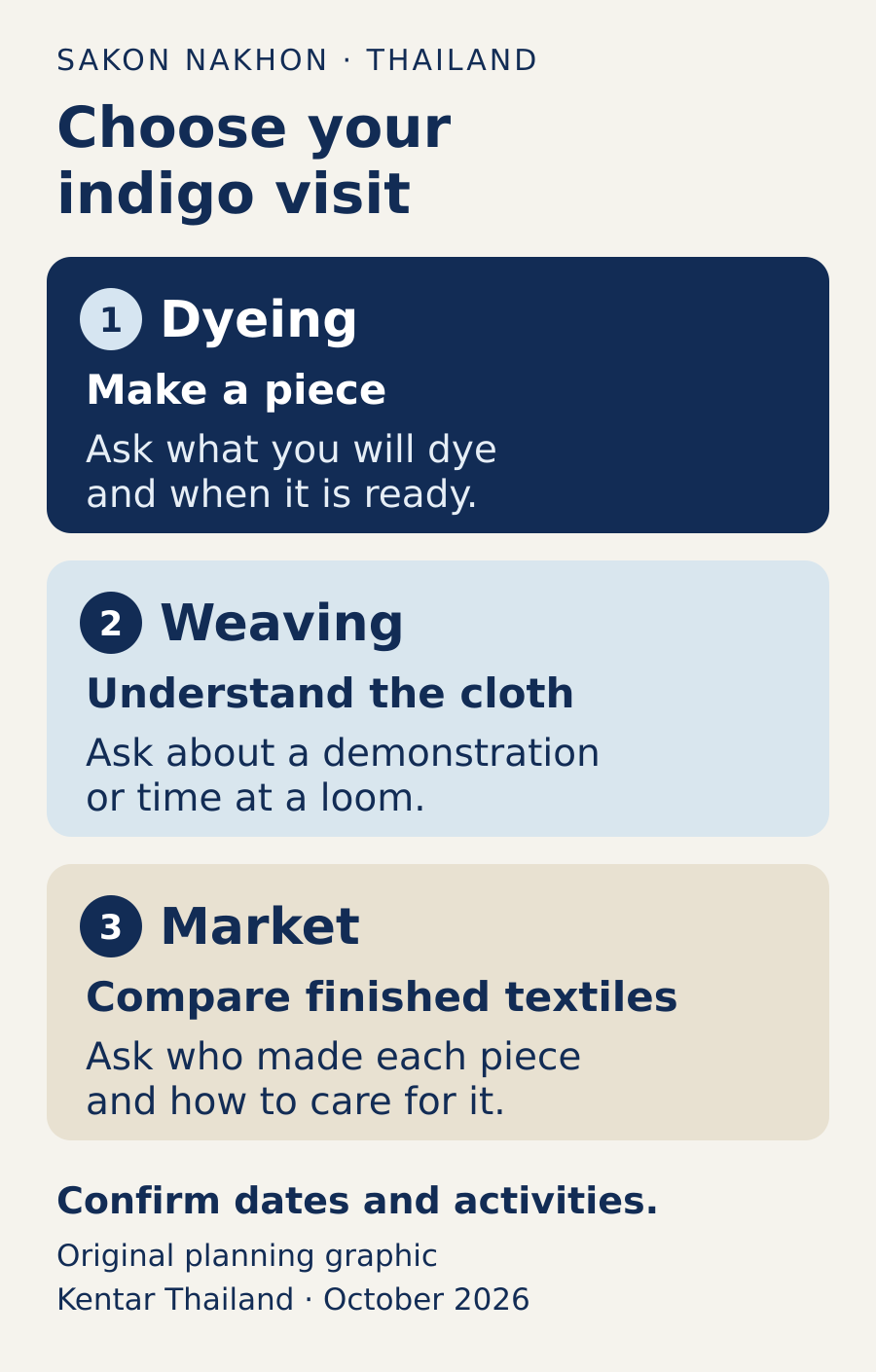
Choose the experience first
- Choose dyeing if you want to make something. Ask exactly what you will dye, which steps you will do yourself, and when the finished piece will be ready to carry.
- Choose a weaving-focused visit if the making process interests you. Establish whether you will watch a demonstration, discuss a finished textile with its maker, or have supervised time at a loom.
- Choose the market if you mainly want to browse and buy. Compare like-for-like products and ask each seller about the origin and process of the particular item you like.
If you want both a workshop and shopping, secure the workshop first. Add the market only if its operating day fits your trip.
Understand three different craft terms
Dyeing adds colour to yarn or cloth. Weaving makes cloth by interlacing threads. A hand-dyed item may use fabric woven by machine; the word “handmade” alone leaves that question open.
For a tie-dye activity using an already woven scarf or bag, the cloth exists before you begin creating its dyed pattern. Mudmee, also written mat mii or mut mii, is an ikat technique: selected parts of yarn are tied to resist dye, then the patterned yarn is woven into cloth. Thailand's SACIT craft archive explains that sequence. Dyeing a ready-made bag and making a mudmee textile involve different work.
Use the distinction when enquiring: “Will we work with yarn or finished cloth?” and “Will we watch weaving or try it?” These two questions are more useful than asking whether a visit includes “everything”.
For a dyeing enquiry: start with Kramsakon
Kramsakon, also written KramSakon, is a shop in Huai Yang, Mueang Sakon Nakhon district. TAT's Sakon Nakhon itinerary, on its second page, identifies a DIY indigo-dyeing activity there as well as shopping. This is a documented place to ask about making your own piece.
The TAT Japan listing for Kramsakon gives the address as 212 Moo 2, Tambon Huai Yang, Amphoe Mueang Sakon Nakhon, 47000, and lists 092-515-9455. The page also links to the shop's social account. Use it as a contact starting point and request the exact meeting location for your activity.
Before travelling, confirm your date, participant count, the available item and the full price. Ask whether English instruction or interpretation is available and whether it costs extra. A published shop listing does not establish a workshop slot, a minimum group size or the language of your session.
Ask when you can leave with your work. The advertised activity time, finishing time and time needed before packing it may differ. Avoid placing the workshop immediately before a flight or intercity departure until the host has confirmed those details.
For weaving and production: ask about Ban Don Koi
Ban Don Koi, often written Donkoi, is in Sawang subdistrict, Phanna Nikhom district. This is a village textile visit outside the city-centre market setting.
There is recent evidence of learning activity. The district Community Development Office reported a study visit on 7 May 2026, with explanations of weaving, indigo and other natural dyes at the Ban Don Koi learning centre.
That report makes Don Koi a useful lead for a production-focused visit. It does not advertise a daily public weaving class. Ask the group or your local host to confirm whether individual visitors can be received, what work will be happening and whether an explanation can be arranged in your language.
If loom time matters, request that explicitly. Watching a skilled weaver, trying a prepared loom and making a complete textile are three different possibilities. Ask what your session includes and what, if anything, you would take home.
TAT also identifies Ban Kham Pramong in Sawang as an indigo-weaving learning centre. It is another enquiry lead; this guide does not establish current visitor hours or an individual booking programme there. Choose one confirmed community appointment rather than assuming you can arrive unannounced at several villages.
For browsing: Indigo Street by Wat Phra That Choeng Chum
TAT's indigo guide, published on 1 December 2025, lists Indigo Street / Phakram Road in front of Wat Phra That Choeng Chum Worawihan, in Mueang district, on Saturdays and Sundays, 16:00–20:00. Treat that as the published weekly pattern and reconfirm locally before making a special journey.
The market is the clearest choice if you want to compare finished pieces without organising a craft lesson. Go with a purpose: a scarf to wear, a length of fabric for sewing, or a small gift. Check dimensions, material and construction before comparing prices.
Do not assume every seller made every item on their stall. Ask who dyed it, who wove it and where those stages took place. A retailer may have a useful relationship with several makers; what matters is getting a clear answer for the product in your hands.
The temple is a separate place of worship. If you also plan to enter, check access and observe its dress and conduct rules. Our first temple-visit guide explains how to prepare.
Ask six questions before buying cloth
Use these questions as a small comparison card. They are editorial English prompts, rather than a certification test or a promise that every seller speaks English.
- Fibre: “What is this made from?” Ask about the main cloth, lining and other components. “Indigo” describes the colour or dye context; it does not identify the fibre.
- Dye: “What was used to dye this piece?” If natural indigo matters to you, ask specifically about the dye used on this item. A blue colour, a rustic label or an uneven surface cannot establish its production history.
- Weaving: “Was the cloth handwoven?” Ask separately whether the yarn was handspun and whether the pattern was made in the yarn, during weaving or on the finished cloth. You can value any of these processes while knowing which one you are paying for.
- Origin: “Who made it, and where?” Ask for the maker or group name and the place of dyeing and weaving. With permission, save the label and the maker's account of the piece.
- Care: “How should I wash, dry and store it?” Ask about the first wash, colour transfer, shrinkage, detergent and ironing. Request instructions for this item rather than applying an internet recipe to every textile. For workshop work, ask whether it has finished rinsing and is ready to pack.
- Price and size: “What exactly does this price cover?” Confirm the dimensions and whether cloth is priced per piece or per metre. For clothing, check the fit, seams and fastenings, then ask about any agreed alterations or return conditions before paying.
For a gift, write down those answers while you are still with the seller. The care instructions and maker's name can be as useful to the recipient as the place where you bought it.
Build a day that leaves room for the craft
A shopping-led visit: confirm the market is operating on your date, leave time to compare products, and keep any temple visit separate from the shopping plan. On a weekday, enquire with a shop instead of relying on the weekend market.
A making-led visit: choose one confirmed dyeing session. Arrange transport around its meeting point and collection time, then decide whether you still have time for other stops. Ask where you can wait while finishing work is completed.
A weaving-led visit: arrange one community visit and a return journey. Send the driver the confirmed destination, host's name and contact number; ask about waiting time and the complete return fare. Do not use the name “Sakon Nakhon” alone as a pickup or drop-off instruction.
For either craft option, ask about the route from the vehicle to the work area, seating, toilets and any access needs before committing. A shop address does not describe the layout of a dyeing area or a village workshop.
Confirm the session in one message
Before accepting a booking, make sure you can answer:
- Which place, host, date and starting time are confirmed?
- Are you watching, dyeing finished cloth, working with yarn or trying a loom?
- Which item, materials and take-home work are included?
- What is the total for your group, and are there minimum numbers or extra charges?
- What language will be used, and who provides any interpretation?
- What clothing and protective equipment does the host recommend or provide?
- When is the piece ready to carry, and what happens if it needs longer?
- What are the cancellation terms, payment arrangements and return-transport plan?
At the session, follow the maker's instructions around vats and equipment, ask before touching work in progress, and request permission before photographing people or close-up designs. You are visiting a working craft setting as well as learning a skill.
If you are taking purchases abroad, use our food and craft souvenir checks for the item and your destination, especially where decorations or packaging add other materials. For a meal between visits, our first Isan meal for two helps with portion and ingredient questions.
Information checked: 11 October 2026, Thailand time. This is a source-based planning guide; no firsthand visit is claimed. The named places are documented in the sources linked above, but individual workshop dates, fees, language support, accessibility and current market operation require confirmation with the host. The choice framework and question cards are Kentar Thailand editorial guidance.