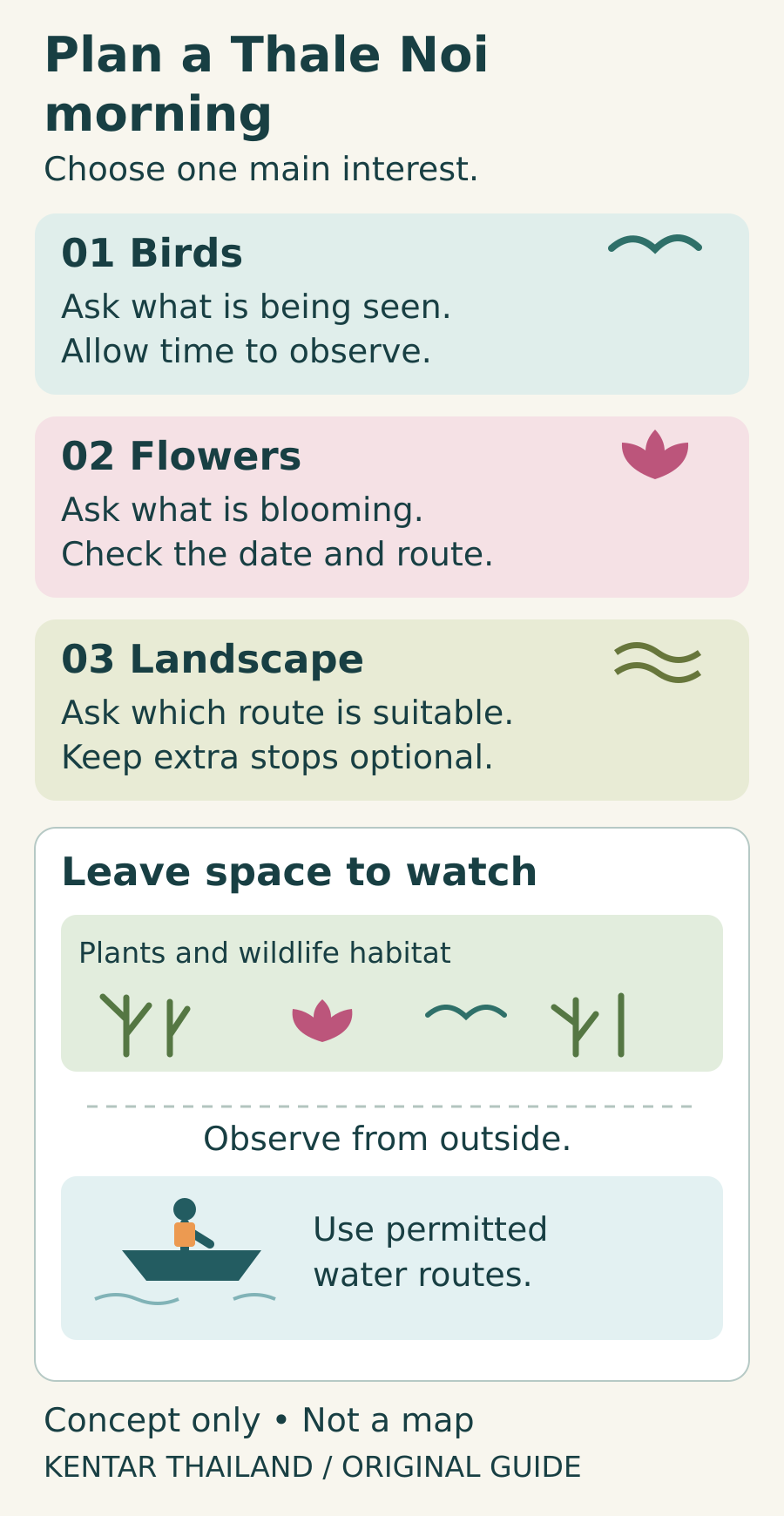
For a first boat trip at Thale Noi, choose one main reason to go: birds, flowers or the wetland landscape. Tell the boat operator that priority before agreeing a route. You will have a more useful conversation than simply asking for a trip that includes everything.
Thale Noi is a freshwater lake in Khuan Khanun district, Phatthalung, in southern Thailand. The Ministry of Tourism and Sports visitor listing places it within a protected non-hunting area. The appeal is a changing wetland with resident and migratory birds, flowering water plants and local livelihoods. A particular photograph is something to hope for, rather than something a booking can secure.
Choose your priority before choosing a boat
Birds: allow time to watch
Ask what the operator has seen recently and whether the outing can allow patient observation from an appropriate distance. If identifying birds matters, ask whether the person accompanying you can help with identification in your language. Boat transport and a specialist bird guide are different services; establish what the quote includes.
Bring binoculars if you have them. A distant bird may be rewarding to watch even when it is too small for a phone photograph. Choose time spent observing over a promise to approach a named species.
Flowers: ask about the beds this week
If the pink or red flowers often advertised as the “red lotus sea” are your main reason for travelling, ask whether there are currently flowering beds on the proposed route. Request a dated recent photo if the operator has one, and check that it shows the area your boat can visit.
Ask what departure time they recommend for flowers on your date. If the display is sparse, decide before paying whether you would still enjoy the outing for birds and scenery.
Landscape: keep the route flexible
For a landscape-led outing, ask which accessible parts of the wetland suit the available time and conditions. Say whether your interest is open water, vegetation, local fishing activity or distant views of buffalo. Keep any extra stop optional.
“Quiet morning” describes the pace you are seeking. It is worth asking about other boats and engine use, but the phrase does not promise silence, an empty lake or an engine-free trip.
When to go: separate the season from the day
The Tourism Authority of Thailand’s Thale Noi feature, published on 19 February 2026, suggests December–February for a bird-focused visit and March–April for the fuller flower display. These are planning windows, not hard boundaries or a forecast for your date. The same feature describes an early boat outing of around two hours, with departures from about 06:00 adjusted around sunrise.
Use that account to start an enquiry. Confirm the actual meeting time, route and duration with your operator. Do not treat 06:00 as a universal timetable, or two hours as a standard package sold by every boat.
If your travel dates are fixed, ask what is worth seeing then. Avoid building the whole morning around an old seasonal photograph. If your dates are flexible and flowers matter most, ask about current flowering before making a special journey.
Check the Thai Meteorological Department’s Phatthalung weather page and current weather warnings near your visit and again before departure. Check the timestamp and location on any forecast; if the province page does not display current data, use TMD’s latest bulletin and seek local advice. A seasonal recommendation does not establish safe boating conditions on a particular morning.
Understand the buffalo landscape
FAO recognises the Thale Noi wetland buffalo pastoral agro-ecosystem as a Globally Important Agricultural Heritage System, designated in 2022. Its account describes a landscape shaped by seasonal flooding and by the long relationship between people, buffalo and wetland biodiversity. Local livelihoods include herding, fishing, farming and craft work.
That context is useful when choosing a route. Buffalo here belong to a working pastoral system; swimming buffalo are not a scheduled performance. Their location and activity depend on conditions and herding. Ask whether viewing them is realistic on the day, and accept a distant view or no sighting rather than asking a boat to chase or crowd them.
Confirm the pier, route and return journey
The Phatthalung Provincial Administrative Organisation’s Thale Noi page describes arranging a sightseeing boat at the pier. Treat this as a place to enquire, not evidence that an appropriate boat will be waiting at your preferred time. For an early start, arrange the details beforehand.
Get the exact departure pier, a map pin and the operator’s name. The label “Thale Noi tour” is not enough for your driver. Ask whether the trip includes the Pak Pra area, where the TAT feature describes fishing-net scenery, or follows a different route. Do not assume every departure covers the same sights.
If you are staying in Phatthalung town or travelling from farther away, agree the early pickup and return with your accommodation or transport provider. Confirm waiting time, the return pickup point and the full transport price. Leave space between the boat’s expected return and any onward connection.
Ask about boarding before booking if anyone needs extra assistance. A pier address does not establish step height, handholds, seating, shade, toilet availability or wheelchair access. Describe the assistance you need and ask for current details or photos of the actual boat and boarding point.
Send one clear boat enquiry
Use this English template with a boat operator or ask your accommodation to help relay it. It is a set of booking questions, not a confirmed reservation or a promise of English-speaking service.
Hello. We would like to ask about a Thale Noi boat trip on (date) for (number of people). Our main interest is (birds / flowers / landscape).
- What is worth seeing on your route at the moment? Are flowers currently blooming, and what wildlife have you seen recently?
- What departure time and trip length do you recommend for our priority? Please send the exact pier, meeting point and a map pin.
- Is the boat private or shared? What is its passenger limit, and how many people will be on our trip?
- What is the total price for our group? Please list any separate admission, guide, transport or other charges, the deposit and the payment method.
- Are suitable, properly fitting life jackets available for every passenger? What boarding assistance and seating can you provide?
- Can we observe without approaching nests, chasing animals or entering restricted areas? Can you help identify birds, and in which language?
- Who decides whether weather and water conditions allow the trip? What happens to our payment if you cancel or change the route, or if we cancel?
- What time and place will we return to, and whom should we contact if arrangements change?
Ask for answers to any unresolved point before sending a deposit. When comparing quotes, compare the same duration, passenger arrangement and inclusions. Our Thailand budget worksheet helps separate shared boat and transport costs from per-person spending.
At the pier: check before boarding
The Marine Department’s safety notice of 20 April 2026 reminds passengers to put on life jackets before departure and wear them while on board. Check your own jacket’s fit and fastening before departure, and ask the crew to show you how to use it.
Confirm that the boat, passenger count and route match what you agreed. Ask the operator about the morning’s weather, water conditions and any access restrictions. If suitable safety equipment is missing, conditions appear unsafe or you cannot get a clear explanation, postpone the outing.
Wear footwear that stays secure when boarding, keep a hand free, and follow the crew’s boarding and seating instructions. Carry drinking water, sun protection and a light rain layer; protect your phone and camera from splashes. Keep loose items contained and bring your rubbish back. These are preparation suggestions, not a guarantee that a particular boat or trip is safe.
Watch without changing the scene
Agree a low-disturbance approach before leaving. Stay on the permitted route and follow the area’s current instructions. Ask the boat operator to leave space around feeding birds, nests and buffalo; do not request a closer approach just to fill a photograph.
- Use binoculars or a camera zoom. Keep your voice low and avoid recorded bird calls.
- Do not feed, bait, handle or chase wildlife, and do not pick flowers.
- If animals become alert or move away because of your approach, stop approaching and give them more space.
- Keep clear of fishing gear and working people. Ask before taking close-up photographs of anyone.
- Do not leave the boat or enter vegetation for a better angle unless the operator confirms an authorised, suitable landing.
There is no universal viewing distance in this guide. The appropriate separation depends on the animals, habitat and local instructions. The illustration is a conceptual reminder to observe from outside sensitive habitat; it is not a navigation map or permission to use a particular channel.
A simple morning plan
- The day before: reconfirm the operator, pier, pickup, conditions, your main interest and cancellation arrangements. Pack only what you can manage comfortably on the boat.
- Before departure: check the forecast and local advice, put on your life jacket, and agree which part of the plan is optional.
- On the water: give your main interest time. If flowers or wildlife are absent, enjoy the permitted route without pressing the operator to find them at any cost.
- After returning: leave time for breakfast or another confirmed local stop. Keep a long road transfer or time-critical connection separate from the boat’s expected finish.
If the trip is cancelled, ask your accommodation about a suitable land-based alternative or try another morning. A cancellation can be the right outcome. Good planning gives you the freedom to accept it.
Information checked: 11 October 2026, Thailand time. This is a source-based planning guide; no firsthand visit is claimed. Current boat operation, prices, capacity, life-jacket provision, access, bloom conditions and wildlife sightings have not been verified with an operator. Confirm them for your date. The priority planner, enquiry template and observation guidance are Kentar Thailand editorial guidance.