Two nights in Kanchanaburi work well when you want time to understand the railway’s history and still enjoy an unhurried evening by the river. The useful shape is simple: arrive and settle in, protect one full day for the town’s history, then leave without squeezing a distant excursion into the return journey.
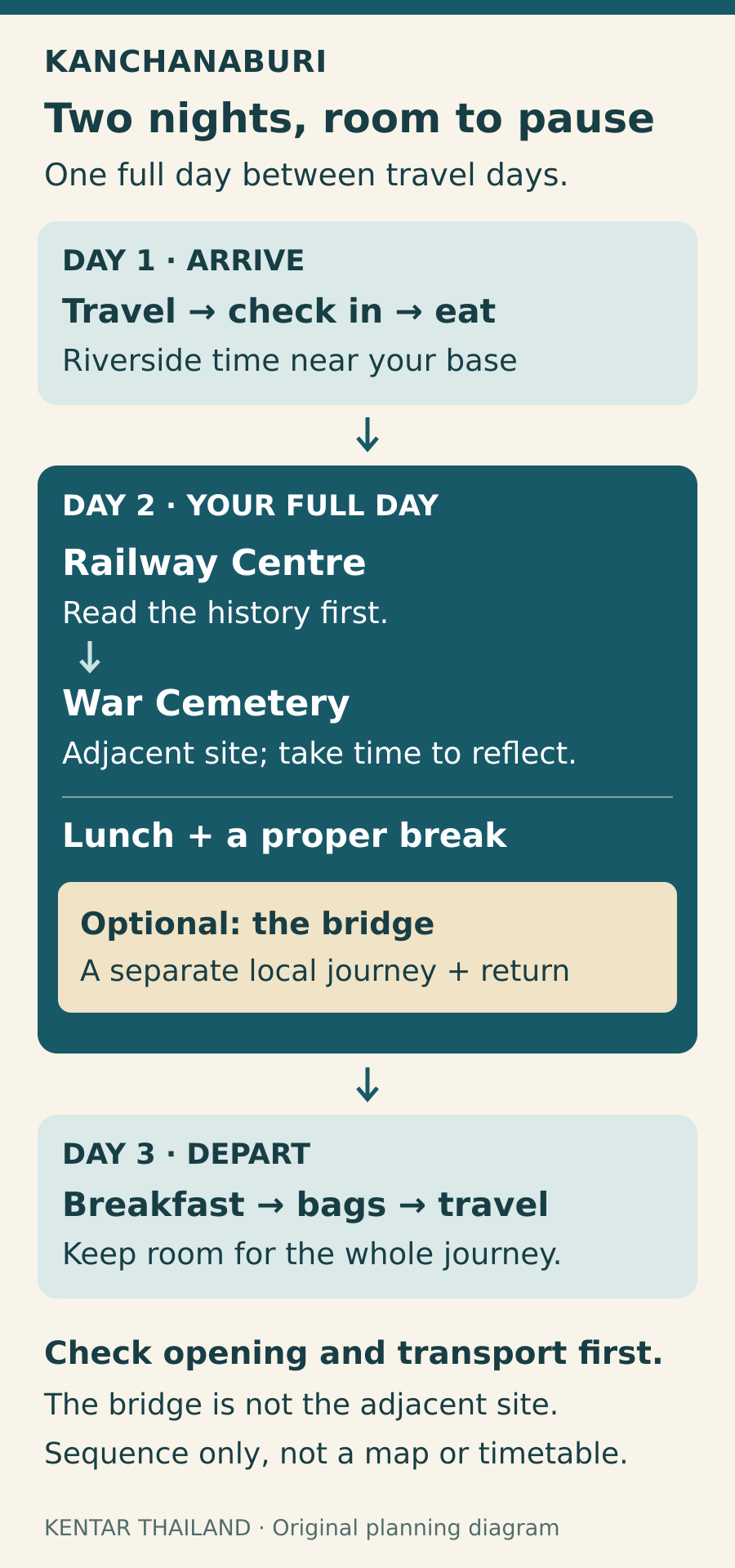
This is a town-centred plan. Its main sequence is the Thailand–Burma Railway Centre followed by Kanchanaburi War Cemetery, with the bridge as a separate, optional visit. Staying twice in the same room gives you a day without luggage, checkout or a Bangkok departure hanging over the museum visit.
What two nights actually give you
Arriving on Monday and leaving on Wednesday means two nights and one complete intervening day: Tuesday. Monday and Wednesday may contain usable hours, but those depend on your actual transport and accommodation arrangements. Build the trip around Tuesday first, rather than counting three sightseeing days.
- Arrival day: travel, reach your accommodation, eat and settle in. Keep the evening near your base.
- Full day: museum, cemetery, lunch and a proper break. Add the bridge only if there is time and energy.
- Departure day: breakfast, packing and the return journey. A short nearby stop is a bonus, not something the plan needs to succeed.
That may look modest beside a tour listing with six stops. The extra night buys room to read, pause and change pace. If a long railway ride or an outlying nature visit is essential, it needs its own substantial block. Either extend the stay or decide explicitly which part of this town plan it replaces.
Choose your base around the full day
Use the museum and cemetery as your location anchor, then compare that with the precise address of your accommodation. The Railway Centre’s visitor information places it on the western side of Kanchanaburi War Cemetery. That adjacency is the reason to visit them together; it does not make every riverside property equally convenient.
Before booking, check the journey from your arrival point to the room, from the room to the museum, and back from dinner. Ask the property how you would make those trips on your dates and what they would cost. A room with a river view can be appealing, but the view does not tell you whether you can reach dinner comfortably on foot or find a ride back at the time you need.
If you want a riverside evening, make it concrete: somewhere you are entitled to sit, an accessible route from your room and a way back after dark. Do not assume there is a continuous public promenade between separate hotels, restaurants and attractions. For limited mobility, ask about the actual entrances, surfaces, steps and toilets you would use rather than accepting a broad “easy access” description.
Arrival day: keep the journey honest
For the ordinary rail route, State Railway of Thailand’s route guide identifies Thonburi as the Bangkok departure station for services towards Kanchanaburi and Nam Tok. Use that as a starting point for checking your train, not a reason to head to whichever Bangkok terminal is most familiar. Confirm the exact departure station, travel date, stopping station, ticket arrangements and return service directly with SRT.
No train times or fares are reproduced here. In particular, the Railway Centre’s visitor page displays a last-updated date of 31 October 2022, so its old transport instructions should not become your current timetable. The SRT page is also route guidance, not proof of a seat or service on your chosen date.
For a bus, minivan or arranged car, confirm the actual boarding and drop-off locations before comparing prices. Count the whole journey: reaching the departure point, waiting, travelling, collecting luggage and getting to the room. A station-to-station duration cannot answer when you will be ready to visit a museum.
Once you arrive, leave the main history visit for the next day. Have a meal, establish tomorrow’s transport and spend whatever time remains close to your accommodation. If arrival is late, you have lost optional leisure time rather than the centrepiece of the trip.
Full day, first stop: understand the railway
Start with the Thailand–Burma Railway Centre. Its published museum description covers the railway’s construction, geography, living conditions, medical care and aftermath. Read as a sequence, those themes connect the engineering to the people who endured it. The facilities page also carries the 31 October 2022 update date; reconfirm current opening, admission, access and exhibition arrangements before travelling.
Reserve the morning for the museum and cemetery together, without promising a driver that you will emerge from the museum after a rushed photo stop. This is an editorial time allowance, not an official visit duration. Some readers will move quickly; others will want to read carefully or stop when the material becomes difficult.
Three questions can give the visit a purpose:
- How did the railway’s route and construction demands shape the workers’ daily lives?
- Whose experiences are being described, including Asian labourers as well as Allied prisoners of war?
- What happened to people after construction and after the war, beyond the familiar image of a railway bridge?
You do not need to become an expert before stepping outside. The aim is to leave with enough context to see individual lives behind the names at the cemetery. Treat museum evidence, personal testimony and later popular retellings as different kinds of material; a familiar story is a starting question, not a substitute for reading the exhibits.
Then visit the cemetery as a place of remembrance
The Tourism Authority of Thailand’s cemetery description, in Japanese, identifies the site as a resting place for Allied servicemen who died during the railway’s construction. Visit after the museum so the graves are connected to the history you have just considered.
Move quietly, leave room for other visitors and follow the site’s access and photography instructions. Take time with individual names and inscriptions rather than treating rows of graves as a backdrop. Avoid posing on memorial structures or making other people’s private acts of remembrance part of your photographs.
Allow yourself to leave when you need to. There is no useful target for how many graves to pass or photographs to take. Nor should a cemetery visit replace the broader account of Asian labourers in the railway’s history. Keeping that wider perspective is part of visiting thoughtfully.
Lunch, a pause and an optional bridge visit
Put lunch and a rest into the plan before adding another attraction. The morning may ask for sustained attention as well as walking. Returning to your room, sitting somewhere comfortable or taking an unhurried meal can be the most useful next step.
If you still want another visit, make the bridge a separate local journey. TAT’s bridge guide, in Japanese, identifies its connection with the wartime railway and describes access from town. The bridge is not the adjacent neighbour of the museum–cemetery pair, and visiting it is not the same commitment as taking a longer train ride.
Confirm your return transport before setting out. At the bridge, follow current signs and staff instructions around the railway; do not step into restricted track areas for a photograph. You can decide to view the bridge without crossing it. If the weather, access conditions or your energy do not suit, leave it out and keep the second evening by your base.
Departure day and a workable fallback
Work backwards from your confirmed departure: when to reach the boarding point, how to get there, and when you need to collect bags or check out. Ask about luggage storage rather than assuming it is available. Leave a generous margin before any separate onward flight or other fixed commitment.
A later departure can allow a slow breakfast or short outing close to your room. An early departure can simply be a travel morning. Neither changes the value of having protected the previous full day.
Check the museum’s availability before booking non-refundable arrangements. If it will be closed on your full day but open on arrival day, move the museum–cemetery pair only when your arrival leaves enough confirmed opening time. Otherwise change your dates or accept a different trip. Another named museum is not automatically an equivalent replacement.
If rain or a local restriction interrupts the outdoor part, use the break for rest and move the cemetery or bridge to a suitable remaining window, provided access is confirmed. Do not turn a closure into a hurried long-distance excursion. For this stay, success is a well-understood morning of history, time to reflect and a return journey that still works.
Information checked: 11 October 2026. This is an original planning guide, not a first-hand trip report. The suggested sequence and time allocation are editorial recommendations. Linked official descriptions support the locations and historical context; they do not guarantee current opening, accessibility, transport availability or conditions on your travel date.