A scuba taster lets you try the experience under professional supervision. An entry-level certification course asks for a larger learning commitment and assesses whether you meet its requirements. Choose the outcome first, then compare the actual programme, timetable and written terms.
This guide uses PADI Discover Scuba Diving and PADI Open Water Diver as named examples. It is a booking comparison, not underwater instruction or a personal assessment of fitness to dive. Other agencies and programmes have their own requirements.
Information checked on 8 October 2026, Bangkok time.
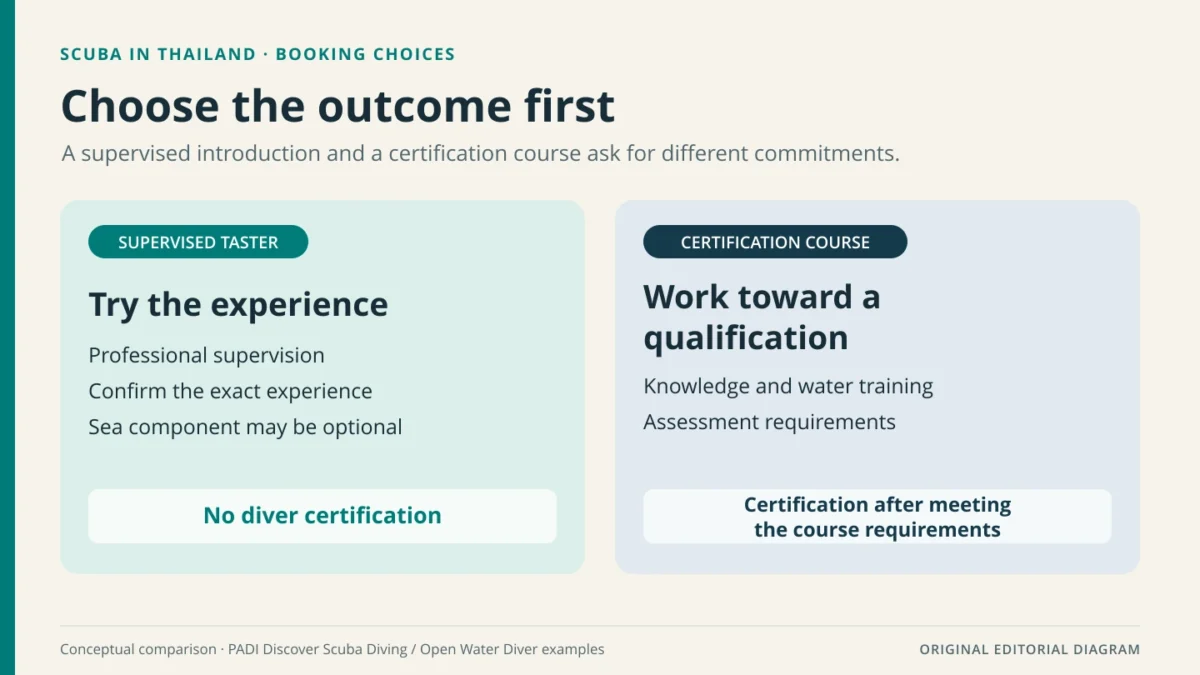
Start with the outcome you want
PADI describes Discover Scuba Diving as a first experience in a pool or calm-water setting with a PADI Professional and provided scuba equipment. Its programme comparison makes the key distinction: this introduction does not certify you as a diver. An open-water dive may be an optional part of the experience, so a sea outing should never be assumed from the word “taster.”
PADI Open Water Diver combines knowledge development, confined-water practice and open-water training. Successful completion leads to a recreational diving qualification. The agency's comparison describes diving with a certified buddy within the certification's limits; it does not mean solo diving, unrestricted access to every site or a professional qualification. Confirm the exact rating and any age-related restrictions with the centre.
| Your question | Supervised taster | Certification course |
|---|---|---|
| What am I buying? | An introductory experience; confirm whether it includes the sea | Training and assessment toward the named qualification |
| What should I expect afterward? | No diver certification from the taster itself | Certification only after meeting the course requirements |
| What must the timetable show? | Briefing, practice, any optional sea session and return time | Learning, water sessions, assessment and room for additional learning |
| What should I compare in the quote? | The exact experience and inclusions | The full training package, not just online learning |
A useful decision question is: “Would I still want this booking if I finish the trip without a certification?” If you mainly want to discover whether scuba appeals to you, investigate a taster. If your goal is a qualification, compare complete courses and reserve enough flexibility to learn without a departure deadline driving the decision.
Compare the learning calendar with your holiday calendar
PADI's current Open Water Diver course page advertises learning in as little as two to four days, while its older comparison describes a typical three to four full days. Neither is a completion promise for your booking. The current page also separates eLearning from the later training steps.
Ask the centre to write out:
- What must be completed before arrival, in which language, and by what date?
- Which days require full attendance, and when must you be at the centre rather than your hotel?
- Where do the confined-water and open-water sessions happen, and how are transfers arranged?
- What happens if you need more learning time or cannot complete an assessment during the reserved dates?
- Can unfinished training be documented for possible continuation elsewhere, and what must another centre agree to accept?
Do not count a travel day twice. A morning ferry, hotel check-in and an advertised afternoon session may look compatible on a booking page, but you still need the centre's actual reporting time and a workable transfer. Put learning time and travel time in separate rows of your calendar.
You can investigate a full course without first buying a taster. PADI's programme comparison says Discover Scuba Diving is not a prerequisite for Open Water Diver. That does not remove the course's eligibility, screening or performance requirements.
Check the centre and the exact programme
The PADI Thailand dive-shop directory is a starting point for finding listed centres. A directory result alone does not verify the instructor assigned to your dates, the language of instruction, a specific package or its availability.
Match the centre's name and location to the booking confirmation. If an agent sells the activity, ask which organisation actually provides the training and who handles changes or complaints. Keep the agency and full programme name alongside the operator name; “beginner diving,” “scuba course” and “PADI experience” are not enough detail for comparing outcomes.
Ask who teaches the programme, how you can verify their current professional status with the training agency, the maximum group size, and whether the advertised language applies to instruction and assessments as well as the sales conversation. Ask about the centre's emergency arrangements and who explains them before participation. A clear answer helps you compare providers; it is not a guarantee of safety.
For prerequisites, request the agency's current age, swimming and other participation requirements for your exact programme. Do not substitute an online description of a different course, a friend's experience or a salesperson's general reassurance.
Deal with medical screening before the non-refundable stage
DAN's guidance on health status and medical evaluation says to answer the diver medical questionnaire honestly and consult a physician when indicated. It also explains that DAN can help with specialist advice or referral when a physician needs diving-medicine expertise.
Request the centre's current screening documents early. Follow their instructions and seek qualified medical evaluation where required or if you have concerns. An instructor manages programme participation; an article or booking agent cannot provide personal medical clearance. A short taster is not a reason to skip screening.
For planning, record only whether the screening process is complete and whether a professional appointment is still needed. Keep health details in the appropriate confidential medical process rather than a shared holiday worksheet. Ask what happens to your deposit if clearance is not obtained in time, and get the answer before paying.
Compare the total package, not the headline figure
There is no single verified Thailand-wide price in this guide. Obtain dated written quotes in the same currency and compare like with like. An online-learning purchase is not evidence that the centre's water training, transfers or other charges have been paid.
Use two columns and ask each centre to identify whether these items are included, optional or charged separately:
- Learning materials, instructor-led training, assessments and certification processing
- Equipment hire and any required personal items
- Pool or confined-water access, sea sessions and boat charges
- Transport from your accommodation, meals and any site or park fees
- Any stated insurance, what it covers and which exclusions need checking
- Extra sessions, repeat assessments, changes of date and optional photographs
Write the total payable, deposit, balance deadline and payment method at the bottom. For an optional item you do not want, ask for a quote without it. For an unexplained charge, leave the comparison unresolved rather than treating it as zero.
Insurance should be checked against the actual activity with the insurer. Do not infer that a provider's insurance or a standard travel policy covers your participation, medical treatment, evacuation or cancellation.
Make the weather and incomplete-course plan explicit
Before committing, ask what happens if the provider cancels a sea session, changes the site or replaces an advertised activity. Who makes the operational decision? When will you be told? Is the remedy a new date, a credit, a refund or something else, and which charges are excluded?
Also ask separately about your decision to stop, late arrival, illness, screening delays and needing more practice. Those are different circumstances and may have different terms. Do not assume a weather cancellation automatically refunds learning materials, accommodation, transfers or an independent flight booking.
Leave the go/no-go decision for conditions and the activity to the responsible professionals. A paid booking, a sunny beach or a tight departure date does not establish suitable diving conditions. If the plan changes, ask for a revised written schedule and total before accepting it.
Plan onward flying before choosing your last session
Tell the centre your onward flight plans before agreeing to the diving calendar. Ask how the proposed last session and any rescheduled sessions affect the time available before travel.
DAN's flying-after-diving guidance gives recommendations with specific scope: air dives, specified aircraft cabin altitudes, and divers without symptoms of decompression sickness. It explicitly says the recommendations reduce risk rather than guarantee avoidance of decompression sickness. This guide does not turn those recommendations into a personal clearance time. Discuss your actual itinerary and diving with qualified professionals; seek medical advice and do not fly if symptoms suggest decompression sickness, as DAN advises.
A useful booking answer is a schedule the provider can explain, with room to change plans. “You will be fine” without discussing your itinerary is not enough information to make a decision.
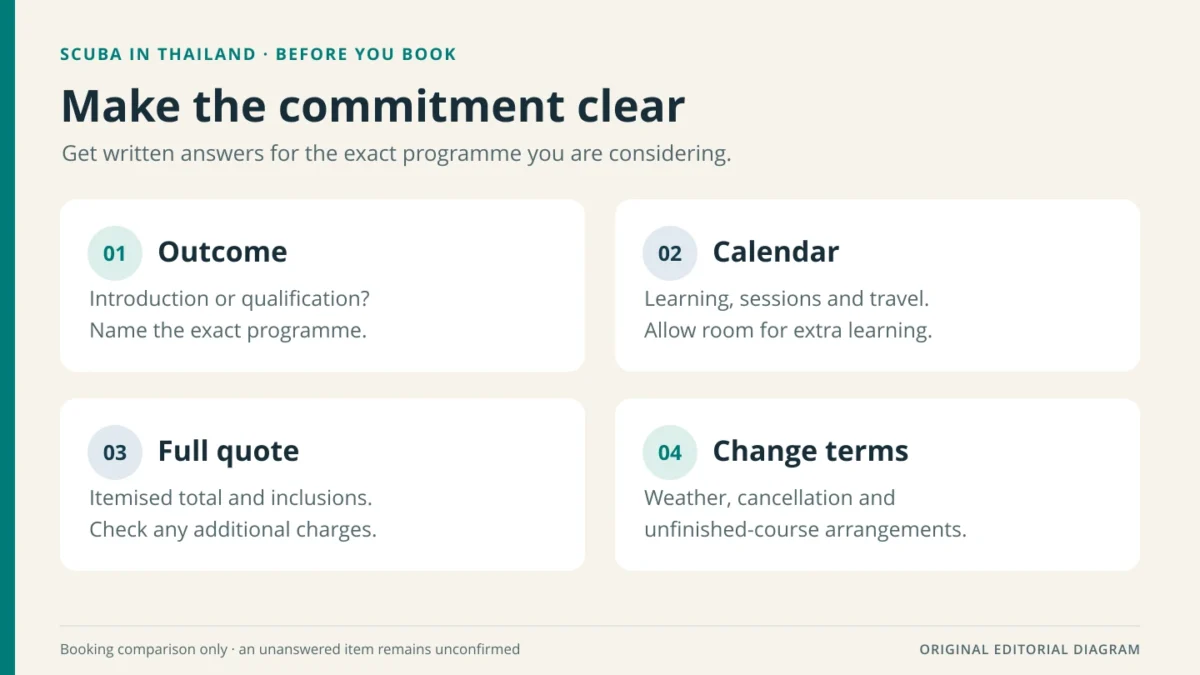
Your two-option comparison worksheet
Copy this list twice, once for each option. Keep written replies with the quote date. Blank answers mean “not yet confirmed,” not “included.”
- Centre, location, training agency and exact programme:
- My intended outcome: supervised introduction or qualification:
- Instructor verification route, teaching language and maximum group size:
- Prerequisites checked; screening process complete or appointment pending:
- Learning before arrival, attendance dates, session locations and transfers:
- Sea component included, optional or absent:
- Requirements for completion and additional-learning arrangements:
- Itemised total, currency, inclusions, exclusions and balance deadline:
- Weather cancellation, personal cancellation and incomplete-course terms:
- Onward flight plan discussed; revised schedule required if sessions move:
- Unanswered question that must be resolved before payment:
Choose the option whose outcome and obligations you can explain in your own words. If the qualification, total cost, screening process or fallback terms are still unclear, ask again before committing. There is no need to turn a first experience into a rushed certification deadline.