Choose the fruit and the form you want, then confirm the selling unit. A price for a kilogram of whole fruit tells you something different from a price for a prepared pack. Agree on the unit price and requested amount before weighing. Then check the measured weight and final total before buying or asking for preparation.
This guide covers mango, mangosteen, rambutan and pomelo. Use the illustrated examples to ask about produce at a fruit stall; confirm the name with the seller. The descriptions come from Thailand’s Department of Agricultural Extension (DOAE), rather than a tasting visit. They are not a guide to identifying wild plants for eating.
Information checked on 8 October 2026.
Match the outside to the inside
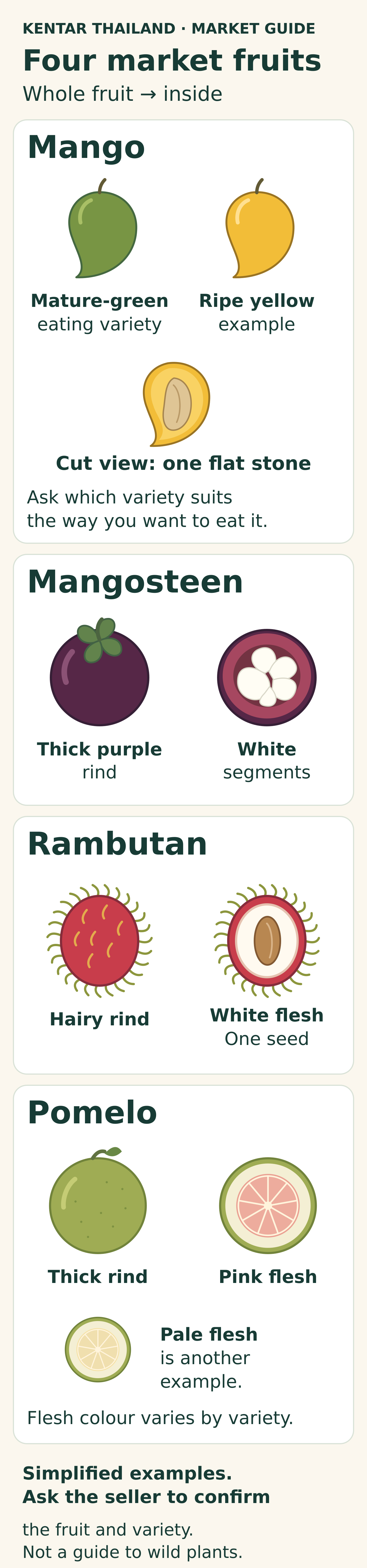
Mango: ask which kind of eating experience you want
DOAE distinguishes varieties eaten at the mature-green stage from yellow-fruited examples. It describes Khiao Sawoei as crisp, sweet and slightly sour at the mature-green stage, while its Nam Dokmai description has golden skin, deep-yellow flesh and a sweet, fragrant taste. Green skin alone is therefore a poor reason to reject a mango or assume how it will taste. DOAE’s mango variety guide.
Ask, “Which one is for eating crisp? Which is soft and ready to eat?” Then confirm the variety and the actual fruit the seller proposes. These are preferences to discuss, not a colour test for every mango. The illustration shows a large central stone so you can distinguish the flesh from the part you leave.
For a small purchase, ask whether one fruit or a prepared portion is available. If the seller offers to prepare it, confirm whether that changes the price.
Mangosteen: look for the thick rind and white segments
The DOAE description pairs a rounded fruit and thick, dark-purple skin with white flesh. Its preparation guide shows the fruit opened to reveal segments inside. Match those features together rather than relying on a purple shape alone. DOAE’s mangosteen guide.
Ask the seller to confirm the name and select fruit for eating now. If you are unfamiliar with opening it, ask for a demonstration or a prepared portion. The diagram separates the rind from the white segments. Confirm which parts to leave, including any seeds, before eating.
If the fruit is sold by weight, check whether the quote is for whole fruit with its rind. Do not treat that weight as the amount of flesh you will eat.
Rambutan: a hairy rind around white flesh
Rambutan has hair-like projections on its skin. DOAE’s examples show that skin and hair colours vary by variety. Inside is white flesh around a seed, which its eating instructions say to remove. DOAE’s rambutan guide.
Point to the fruit and ask its name, then ask what small quantity the seller can supply. If you buy it whole, ask how to separate the flesh and seed; leave the rind and seed.
Pomelo: a thick peel around citrus segments
Pomelo is also written “pummelo.” DOAE lists rounded and pear-shaped varieties, with different flesh colours, including white and pink. A green exterior does not tell you which variety or flesh colour you are buying. Its preparation description separates the outer peel, the thick pale layer and the membrane around the segments. DOAE’s pomelo guide.
If a whole fruit is more than you want to handle, ask whether peeled segments are available. Confirm what a pack contains and whether its price is fixed or weight-based. You can ask for the membranes and any seeds to be removed. No cutting equipment or opening technique is needed for this buying plan.
Set the amount before agreeing to the sale
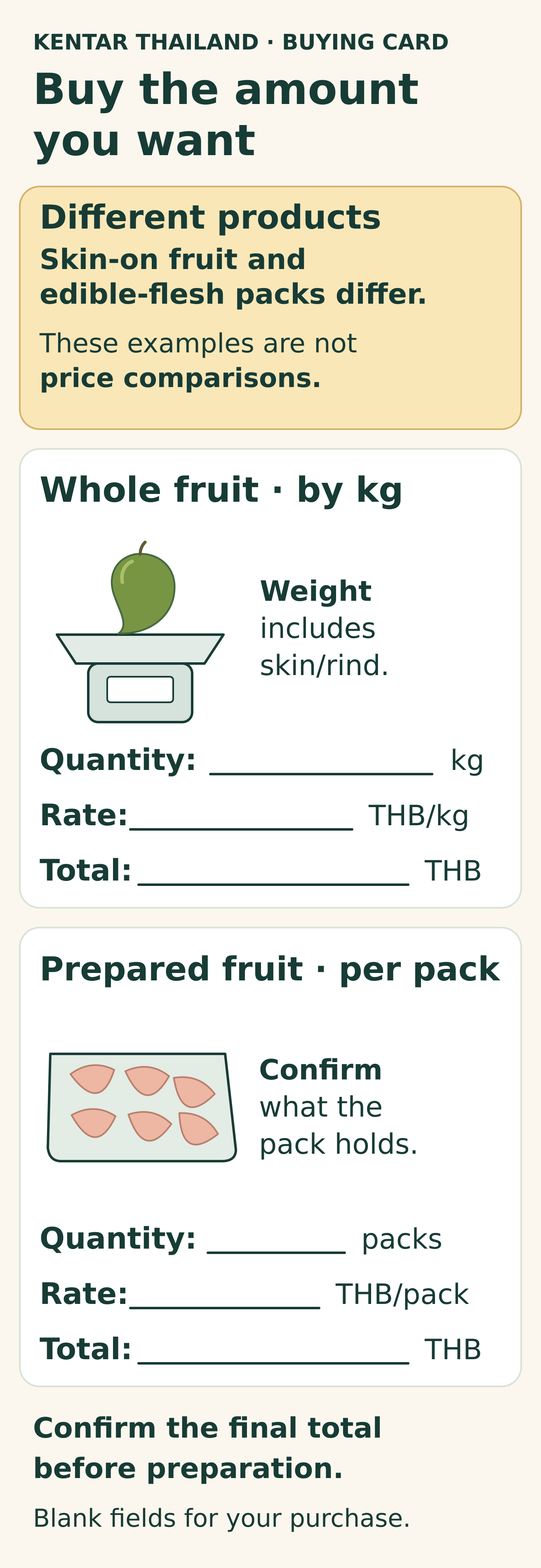
Use this order at the counter:
- Identify the exact fruit and form: whole, opened or prepared flesh.
- Ask what the displayed number covers: a kilogram, one fruit, one pack or something else.
- Ask for your preferred amount. For example, “Can I buy half a kilogram?” or “Can I buy this one pack?” The seller may have a different minimum or fixed pack size.
- Confirm the total, including any preparation charge, before agreeing.
For weight-based sales, read the weight and total together. Half a kilogram is 500 grams. If the final weight differs from what you requested, check the recalculated total rather than expecting the original estimate to stay the same.
Two invented examples show the arithmetic. These are not market prices and do not compare value:
- Whole fruit at an imaginary 80 THB per kilogram: 0.5 kg costs 40 THB, assuming no additional charge.
- Prepared fruit at an imaginary 35 THB per pack: two packs cost 70 THB, assuming no additional charge.
You cannot decide which is cheaper per edible portion from those figures. The first includes the fruit’s rind, stones or seeds where present; the second gives no pack weight. Even with a weight on each label, compare the same fruit, preparation and stated contents before making a like-for-like price comparison. This guide assumes no standard edible yield.
Save a buying note
Copy these fields into a phone note, or use them as a short checklist while pointing to the product:
- Fruit and variety: ______
- Whole fruit or prepared flesh: ______
- Selling unit and price: ______
- Quantity I want: ______
- Final measured weight or number of packs: ______
- Preparation charge, if any: ______
- Total in THB: ______
Useful questions are “What is this called?”, “Is that price per kilogram or per pack?” and “How much for this amount, including preparation?” Confirm the answer against the product, numbers and scale or label. An English question alone does not establish that you and the seller mean the same thing.
Let the available fruit guide the choice
Seasonal summaries are not a promise about an individual stall. TAT’s 2026 southern-fruit guidance says availability varies by fruit and location, and advises checking locally because harvest periods depend on growing conditions. That is a useful reason to ask what is available where you are instead of following one nationwide “best fruit month.” TAT’s regional fruit guidance.
Choose an amount you want to eat during this visit. If only a larger quantity is offered, ask for another option rather than buying extra to complete a checklist. Save the fruit’s name and whether you chose it whole or prepared; that will make your next purchase easier.
For a different kind of tasting, use the Thai dessert guide. It covers prepared sweets, including fruit-shaped ones, rather than these fresh fruits.