For a two-day trip built around the ruins, start by looking for accommodation in Old Sukhothai, also called Mueang Kao. Check the actual location before booking: a hotel described simply as being in “Sukhothai” may put you in the modern city instead. A nearby room can make a midday rest and a second morning much easier to arrange.
The useful version of two days is not a race through every monument. Give the central area your first substantial visit, then choose one outlying area for the next morning. Leave room for lunch, transfers and collecting your bags. The plan below is a suggested allocation, not an operator timetable or a report of a personally tested route.
Information checked: 11 October 2026. Confirm opening, tickets, transport and accommodation arrangements for your travel dates.
Old Sukhothai and New Sukhothai are different bases
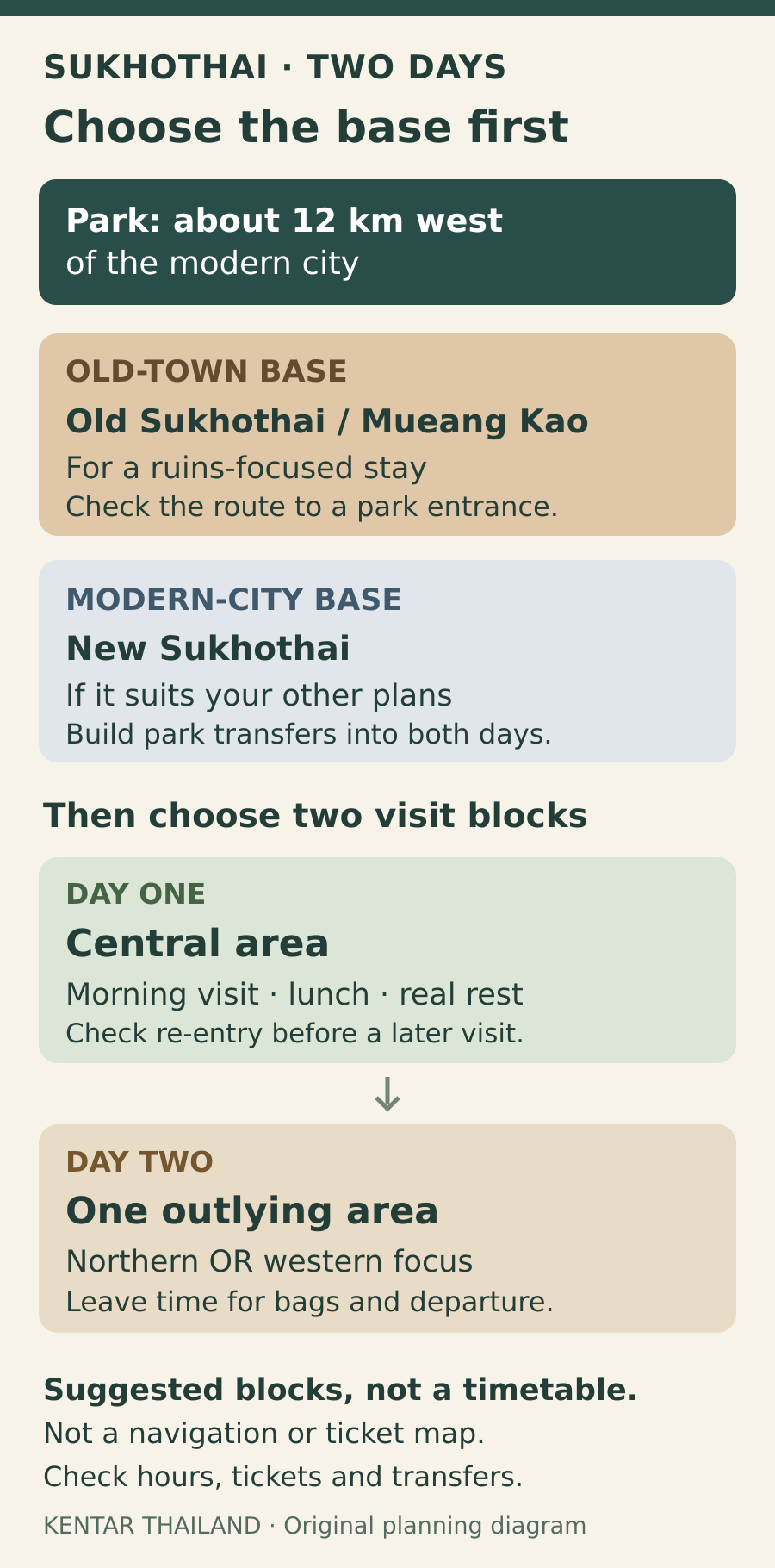
The Fine Arts Department places Sukhothai Historical Park in Mueang Kao, approximately 12 km west of the modern provincial city. That distinction matters more to this trip than a hotel’s “central Sukhothai” description. Use the department’s park location information to orient yourself, then compare the property’s exact map pin with the entrance you intend to use.
Choose the old-town area for repeated park visits
Our default for a ruins-focused visit is the old-town area. This is an editorial recommendation based on proximity: it can reduce the backtracking involved in two separate mornings and a break between outings. It is especially useful if you want your room to be part of the plan rather than a place you reach only after sightseeing.
However, “Old Sukhothai” is an area label, not a guarantee of a short or comfortable walk. Check the actual route from the property to a usable entrance, including road crossings. Decide whether you are comfortable making that journey after dinner or would need an arranged ride. A short straight-line distance on a booking map is not enough.
Choose the modern city when your other plans favour it
New Sukhothai can still make sense if a particular property, your confirmed arrival arrangements or activities in the modern city suit you better. The trade-off is that the park becomes an excursion from your base. Budget for the outward and return transfers on each visiting day, rather than assuming you can casually return to the room between monuments.
Compare the whole plan, not only the room price. Ask what an early departure, a midday return and an evening pickup would involve. We have not verified a transport headway, last departure or ride price for this guide; confirm those details with the actual provider before relying on them.
Check these details before committing to a room
No individual hotel is recommended here. Use this checklist with any property you are considering, and get answers that relate to your dates rather than relying on general listing descriptions.
- Location: is the property in Mueang Kao or the modern city, and which park entrance is practical from its actual pin?
- Arrival: where will your booked bus or transfer drop you? Save that location separately from the hotel and arrange the final journey if needed.
- Room access: will check-in, check-out and any agreed luggage storage fit your rest and sightseeing blocks? Leaving bags does not mean you can keep using the room.
- Daily logistics: confirm breakfast timing, an early pickup if needed, and where you can get dinner without an unplanned extra journey.
- Getting around: if the property advertises bicycles or transfers, check availability, charges, return deadlines and what happens if plans change.
Save the property name and address in Thai as well as its map pin. Also keep your onward departure point: the word “Sukhothai” on two bookings does not prove they use the same stop. For a short stay, we would usually keep one base rather than spend the middle of the trip changing rooms.
Understand the park areas before making the itinerary
For this plan, think in two layers: monuments within the old walls first, then a selected group outside them. The Fine Arts Department’s archaeological inventory has central, north, south, east and west groupings. Those geographical labels do not establish which current ticket covers a particular visit.
The department lists Wat Mahathat, Wat Si Sawai and Wat Sa Si among the monuments inside the walls. Its outside-the-walls guide places Wat Si Chum by the northwestern corner and Wat Phra Phai Luang near the northern gate. These make a useful northern focus for a second outing.
Do not confuse the park’s areas with the separate historic towns in the UNESCO listing. Sukhothai, Si Satchanalai and Kamphaeng Phet form one World Heritage property but are managed as three historical parks, as UNESCO explains. This two-day plan stays with Sukhothai; adding another park deserves its own travel allocation.
Day one: central monuments, then a genuine break
Give the first morning one clear focus
If you can arrive the previous evening, use that time to settle in, confirm your morning arrangements and check the next day’s opening. Otherwise, start the sightseeing plan after arrival and bag arrangements, rather than treating a bus arrival time as a park-entry time.
As a planning allowance, set aside roughly two to three hours for a selective central-area visit, with more time if you like reading interpretation or taking photographs. Start with Wat Mahathat, then choose Wat Si Sawai or Wat Sa Si rather than making all three compulsory. The allowance includes pauses; it is not a promise that every visitor can cover the same ground in that time.
Decide how you will move before entering. For any bicycle rental, check the fit, brakes, return terms and the park’s current admission rules for bicycles. If cycling does not suit you, reduce the walking circuit or ask about the vehicle options actually operating that day. Do not build the itinerary around an unconfirmed tram departure.
Protect the middle of the day
Plan lunch and a substantial rest before deciding whether to continue. With a conveniently located room, that may mean returning to your accommodation. From a modern-city base, consider whether you really want two extra transfers or would rather finish the park visit and return once.
A later central-area visit is optional, not something the morning ticket automatically permits. Check re-entry conditions and the relevant closing time first. If you arrived late, move the main central visit to tomorrow morning and drop the outlying extension. Two days give you flexibility; they do not require two full days outdoors.
Day two: one outlying area, with a departure buffer
For a first visit, our suggested second morning is Wat Si Chum and, if time and energy allow, Wat Phra Phai Luang. Allow roughly two to three hours for the outing as an initial planning block, then adjust it after confirming your transport and chosen stops. Transfers from your accommodation and back to collect bags need their own allowance.
If the western monuments interest you more, choose them instead of automatically adding them to the northern outing. Wat Saphan Hin requires particular thought: the Fine Arts Department describes a stone-paved path ascending the hill. Arriving nearby by bicycle or vehicle does not remove that uphill section. Ask about present conditions and skip it if the climb is unsuitable for you.
Work backwards from your booked onward journey. Include time to return rented equipment, collect luggage, eat, reach the correct departure point and meet the operator’s check-in requirement. Set a sightseeing finish time before leaving the hotel. If a transfer cannot be confirmed, shorten the outing rather than hoping a ride will appear at the last minute.
If you are staying another night, keep the afternoon open. Revisit a favourite place only if ticket terms allow, or simply finish sightseeing. An extra night is most useful when it takes pressure off the visit, rather than creating another list of monuments to complete.
Hours and tickets: check each part of your actual plan
The Tourism Authority of Thailand’s Japan-office listing gives daily hours of 06:30–19:30 and Saturday lighting until 21:00, with an August 2026 note. Treat this as published guidance to reconfirm, not proof that every outlying entrance stays open that late. Confirm each area’s opening and last admission, and any event-related changes.
We have not reproduced a price table: the official tourism listing and older fee guidance differ, and the current ticket conditions for a two-day visit need checking locally. Before paying, ask which selected areas are included, whether a combination ticket is offered, whether it covers both dates, whether re-entry is permitted and whether a bicycle charge is separate. Do not assume that “all areas” means “two days”.
Choose an early visiting block if the confirmed opening and your transport allow, and leave room to change the plan for heat or rain. Shade, shelter and seating are not guaranteed throughout your route. Follow barriers and site instructions, avoid climbing on ruins, and keep time to rest without having to earn it by finishing every stop.
The simplest booking order
- Choose your two main visit blocks: central area, then one outlying area.
- Compare actual accommodation pins and the transfers those blocks require.
- Confirm arrival, room access, luggage arrangements and onward departure.
- Check current area hours and ticket validity before setting the final schedule.
The best base is the one that makes your actual two days easy to use. For a park-focused trip, start your search in Mueang Kao. Choose the modern city deliberately when it suits the rest of your journey, and build the park transfers into the decision from the beginning.
This guide combines official location and monument information with our own suggested planning allowances. It does not represent a hotel inspection, a transport-service audit or a surveyed accessible route.