For a first visit to Si Thep, make the ancient town your main stop. Add Khao Klang Nok if you have a confirmed transfer and enough outdoor time left. Treat Khao Thamorrat as a separately arranged excursion. You can understand the landscape without trying to reach every component in one day.
Si Thep is in Phetchabun province. Fine Arts Department’s site overview.
This guide helps you choose what to see, recognise specific features and protect time for the journey home. The suggested durations are our planning allowances, not official tour times or a tested walking route.
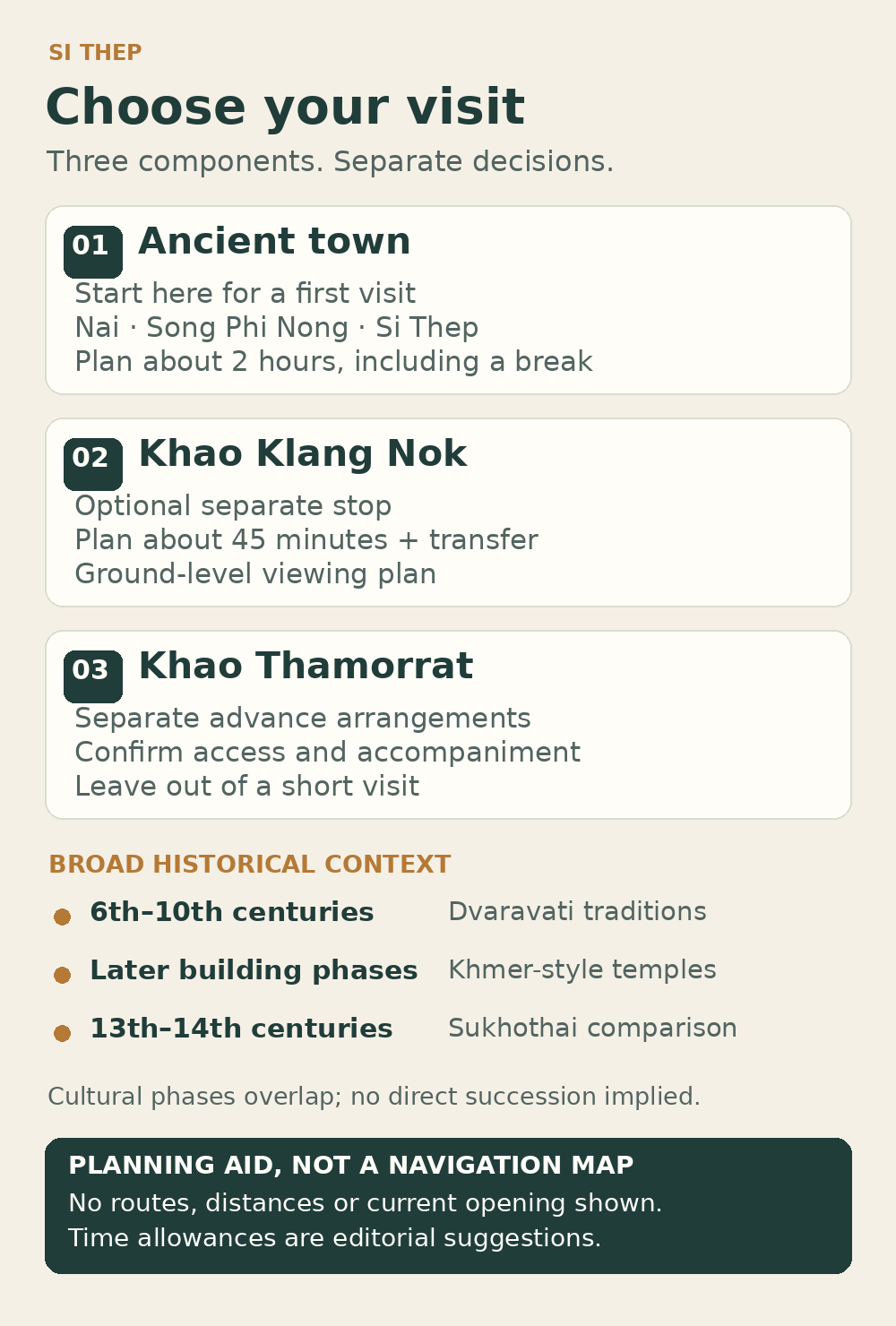
One World Heritage property, three different visits
UNESCO inscribed Si Thep in 2023 as a serial property: the ancient town, Khao Klang Nok and Khao Thamorrat Cave. Its significance includes Dvaravati religious and artistic traditions of the sixth to tenth centuries, with Hindu and Buddhist influences adapted locally. UNESCO’s account.
The title “before Sukhothai” gives a broad historical comparison. UNESCO places Sukhothai’s role as a capital in the thirteenth and fourteenth centuries. It does not establish a simple transfer of power from one town to the other. Sukhothai’s historical context.
The town itself includes an approximately round Inner Town and an adjoining Outer Town to the east. Its best-known monuments represent different building phases. Use the surviving layout to look for change over time rather than treating everything visible as one construction campaign. Fine Arts Department’s site overview.
Choose your component
- Ancient town: choose it first for variety. Focus on Khao Klang Nai, Prang Song Phi Nong and Prang Si Thep. Allow roughly two hours, including orientation and a break. If you have less time, keep the first two and leave the wider town for another visit.
- Khao Klang Nok: add it for scale. Make this a separate stop with its own pickup. Allow roughly 45 minutes at the monument, plus the transfer. Shorten the town visit only if this structure is your main interest.
- Khao Thamorrat: choose it for a dedicated cave visit. Leave it out of the short plan below. Confirm permission, who will accompany you, the route’s condition and the full return arrangement before committing. No current guided visit or walk-in access has been verified for this guide.
What to look for in the ancient town
Khao Klang Nai: look low before looking up
This Buddhist monument has a substantial rectangular laterite base. The Fine Arts Department identifies surviving stucco supporting figures and scrolling decoration on the lower south and west sides. Those small details give a different reading from the overall mass. Official monument description.
From the permitted viewing area, find one figure, trace the repeated pattern beside it and then step back to see how the decoration relates to the base. Use your camera’s zoom if useful. Do not reach through a barrier to photograph, touch or brush the stucco. If a side is screened for conservation, leave that part of the exercise unfinished.
Prang Song Phi Nong: compare the two towers
The name identifies a pair of unequal towers on a shared base. The principal temple’s entrance faces west; its other sides have false doorways. Fine Arts interprets the complex as a Hindu sanctuary later adapted for Mahayana Buddhist use. Official monument description.
Begin with the two silhouettes and their shared platform. Then compare the entrance with a visible false doorway from the visitor path. This gives you a concrete feature to recognise without needing to identify every deity or architectural term. Follow the permitted circulation; a doorway’s appearance is not an invitation to enter.
Prang Si Thep: read an unfinished change
This brick sanctuary stands on a laterite base, aligned with Prang Song Phi Nong. Fine Arts links unfinished architectural pieces to a later alteration that was never completed. Its account therefore offers a useful distinction between the surviving building and the work people intended to carry out. Official monument description.
Look first at the change of material between base and tower. Use the interpretation panel to identify the evidence for alteration; do not label every broken stone as unfinished work. If time or energy is running short, this is the stop to omit from the two-monument version.
Khao Klang Nok: make the extra stop count
Khao Klang Nok stands outside the ancient town to the north. Fine Arts describes a square laterite base, miniature buildings around it, stairways on four sides and the remains of a brick stupa above. Official monument description.
Start from a permitted ground-level position far enough back to read the whole structure. Move closer along the visitor route to compare one miniature building with the much larger base it decorates. The scale change is the reason to add this stop after the smaller details at Khao Klang Nai.
Plan a ground-level visit. Use only areas that the signs and staff allow. Do not make reaching the top essential to your visit, and do not follow another visitor over a barrier. A staircase visible in a monument description does not establish current permission to climb it.
Khao Thamorrat: understand its role without assuming entry
The cave contains Buddhist reliefs carved into natural limestone, including standing Buddhas and bodhisattvas, with additional imagery on the inner walls. Fine Arts connects these works with Mahayana worship. The setting makes the rock itself part of the religious monument. Official cave description.
Its World Heritage status does not confirm visitor opening, a permitted trail, guide availability or weather suitability. We could not establish the current permission and guide arrangements from the official information checked. Do not set out for the cave on the strength of this article.
For a future cave visit, obtain a dated answer from the park naming the responsible local contact, permitted access point, accompanying guide or staff requirement, physical demands, turnaround time and cancellation conditions. Until those arrangements are settled, keep your visit to the confirmed town and monument areas. You can still include the cave in your understanding of the heritage landscape through the official description.
A limited-time plan with an easy stopping point
Use this as an order of priorities, not turn-by-turn directions. On arrival, ask staff to mark the available route, identify any temporarily restricted areas and explain transport within the park.
- First 15 minutes: orient yourself. Locate today’s entrance, ticket point, toilets, return pickup and permitted monument route. Set a firm time to leave.
- Next 60–75 minutes: two close-looking exercises. Prioritise Khao Klang Nai’s base decoration and the paired towers at Prang Song Phi Nong. Keep the pace comfortable rather than chasing a minute-by-minute schedule.
- Next 15–30 minutes: optional third monument. Add Prang Si Thep if you still want another architectural comparison. Otherwise return for your break and pickup.
- Then decide on the separate stop. Add Khao Klang Nok only if its access, transfer and return ride are settled. Allow its viewing time separately; transport time is additional. Otherwise finish with the town.
With only an hour available, choose one monument and its interpretation rather than squeezing in both components. With a full day, lengthen observation and breaks before adding more destinations. The cave remains a separate arrangement even when your schedule has spare hours.
Getting there and getting back
Fine Arts’ published directions use Highway 21, then Highway 2211 toward the park. Its public-transport description separates a bus arrival at Si Thep’s Ban Klang market from a hired onward ride. That distinction matters: a ticket to the district is not a transfer to a monument entrance. Official directions.
No current bus timetable, fare, park shuttle schedule or on-demand return service has been verified here. If using public transport, confirm the exact stop and the final ride before buying the intercity ticket. An old description of buses running through the day is not enough for a dated journey.
For a car-and-driver visit, give the driver the ancient town and the optional separate monument as distinct stops. Agree waiting time, the total price, the final collection point and what happens if you finish early. Do not assume a town shuttle serves the whole World Heritage property. Keep the driver’s contact and your return destination available offline.
Hours, heat and the checks that change the plan
Research checked 10 October 2026 (UTC). Fine Arts’ published park-service page lists daily hours of 08:30–16:30. Use this listing to plan a daytime visit to the town and an optional ground-level stop at Khao Klang Nok. Check for new restrictions before departure and confirm last admission, ticket coverage and charges with the park. Published visitor services.
The Fine Arts Department’s contact page lists +66 56 921 322. Name the exact components you want when asking about entry, transport and interpretation. Park contact page.
Check the Thai Meteorological Department forecast before travelling. Put outdoor viewing earlier in the day when it suits the confirmed opening arrangements. Bring water and sun protection, take breaks, and cut the optional stop if heat or rain makes the outing uncomfortable. No shaded circuit, step-free route or operating shuttle is promised by this guide.
Stay on designated visitor paths and keep away from fragile surfaces. Leave loose fragments where they lie. If you need step-free access, describe your requirements to the park for each stop; a flat-looking photograph cannot establish the condition of the entrance, path or toilet.
Save this short visitor card
- Main choice: Ancient town; optional separate monument only after checking the return ride.
- Look closely: Khao Klang Nai: supporting figures and pattern. Prang Song Phi Nong: paired towers and doorway contrast. Prang Si Thep: material change and the explanation of alteration.
- At the extra stop: Khao Klang Nok: whole mass first, miniature architecture second; keep to permitted viewing areas.
- Cave decision: Khao Thamorrat stays off the short itinerary until access and accompaniment are confirmed.
- Before leaving the first stop: Check your remaining energy, the weather and the agreed final pickup time.
For another way to look at Thailand’s past, our Ban Chiang pottery and burial guide focuses on archaeological objects and their recorded contexts. Si Thep’s visitor exercise is about comparing buildings and landscape components.