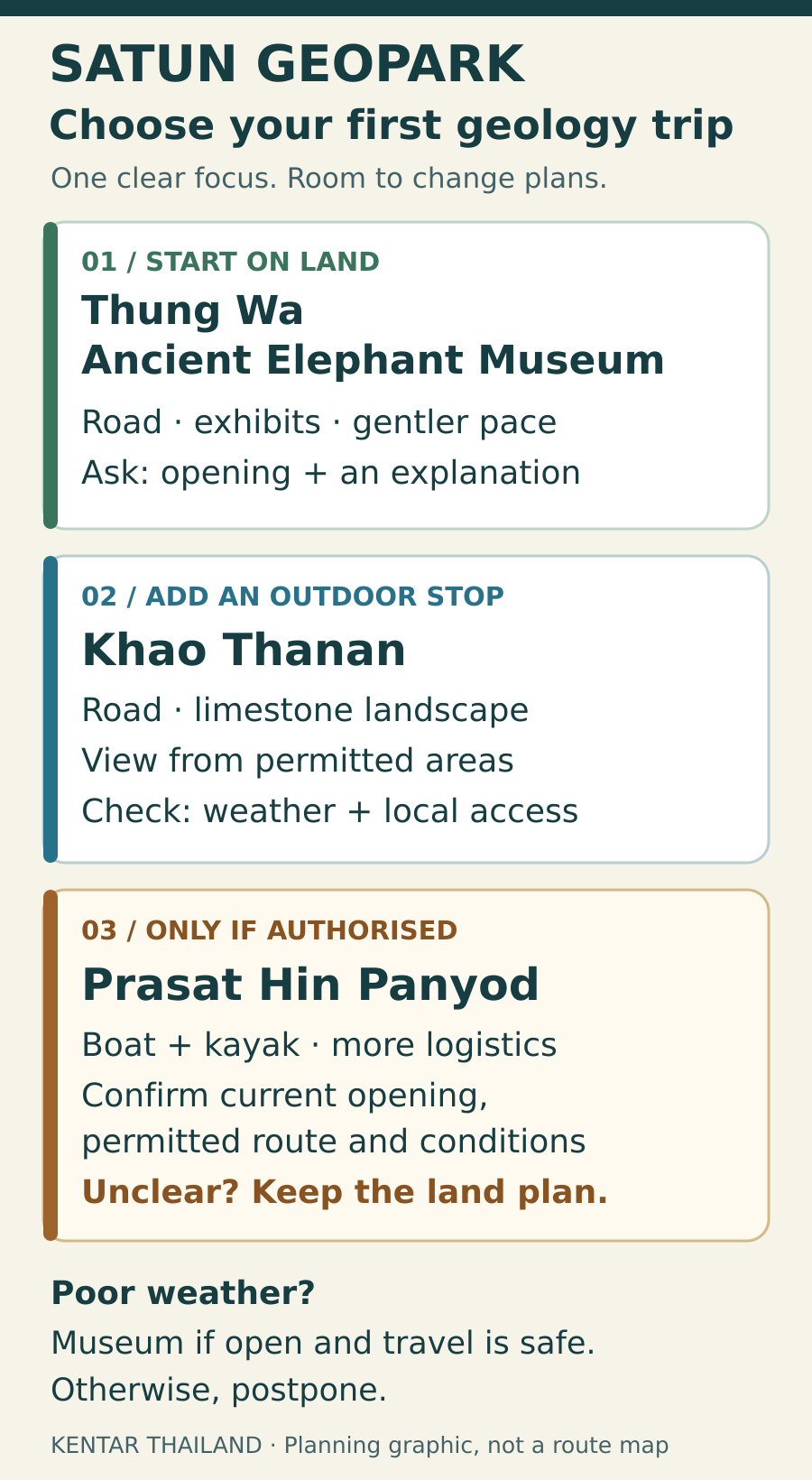
For a first geology day in Satun, start on land: visit the Thung Wa Ancient Elephant Museum, then add Khao Thanan if the weather and local access allow. The museum gives you something to recognise; the limestone hill gives that story a landscape. Keep a sea excursion to Prasat Hin Panyod as a separate, conditional choice that needs current permission and safety checks.
You do not need geological training to enjoy this trip. Arrive with two questions: “What lived here?” and “How did this landscape take shape?” Choose a stop that helps you answer one of them, rather than trying to collect every cave and island on a map.
First, understand the scale of the geopark
Satun UNESCO Global Geopark is a broad area of southern Thailand, covering 2,597 square kilometres, including land and coastal islands. The Global Geoparks Network places it across Thung Wa, La-ngu, Manang and part of Mueang Satun districts. Your transport plan therefore needs named stops, rather than a request to be dropped at “the geopark”. Global Geoparks Network profile.
UNESCO lists Satun's designation year as 2018 and highlights its sequence of ancient marine sedimentary rocks, spanning the Cambrian to Permian periods. Fossils in those rocks include trilobites and other marine organisms. That regional record is one reason the landscape matters; it does not mean every fossil or cave you see is the same age. UNESCO's Satun profile.
A useful distinction is between the rock, the fossil and the landform. A fossil is evidence of past life. A limestone hill, cave or pinnacle shows how rock has been shaped. In limestone, mildly acidic water can dissolve rock along cracks and help create cavities: a basic process explained by the US National Park Service. The age of the limestone and the age of a cave within it are different questions.
Choose your first stop
- For explanations and a gentler pace: choose the Thung Wa Ancient Elephant Museum. Travel by road and concentrate on the exhibits. Confirm opening and any language or access needs.
- For an outdoor landscape without a boat: choose Khao Thanan. Make this an external viewing stop, with a locally confirmed walking area. Heat, rain and the chosen route affect the effort involved.
- For limestone scenery from the water: investigate Prasat Hin Panyod only after the manager confirms current opening, the authorised route and conditions. Boat and kayak transfers add demands that a museum visit does not have.
1. Thung Wa Ancient Elephant Museum: start with the evidence
The Thung Wa Ancient Elephant Museum, also translated as the Museum of Prehistoric Elephants, is under the Thung Wa Subdistrict Administrative Organization in Thung Wa district. The Thai government's description identifies fossils from Stegodon Cave among its exhibits, with a Stegodon molar and ancient rhinoceros teeth as highlights. Government museum description.
This is a useful first stop because a labelled tooth gives you a specific object to investigate. Look for the animal's name, where the specimen was found and what the label says about its age. If a model or reconstruction accompanies it, ask which parts are based on recovered fossils. You can learn about the cave discovery without booking a cave trip.
Allow roughly 45–60 minutes as a relaxed planning allowance, not an official tour duration. Ask whether a staff explanation can be arranged in English or whether you should bring an interpreter. If you need step-free entry, seating or an accessible toilet, confirm those details directly; a general facilities icon is not enough to establish a workable visit.
DASTA's community-tourism listing places the museum in the Thung Wa administrative area and describes its ancient-elephant fossils and cultural displays. Use the full museum name when arranging your stop, and ask your host to confirm the exact building. Do not assume a booking for a “geopark museum” includes this exhibition. DASTA museum listing, in Thai.
2. Khao Thanan: read an old coast in a limestone hill
Khao Thanan is in Thung Bu Lang subdistrict, Thung Wa district. Thung Bu Lang Subdistrict Administrative Organization advertised a visitor event there for 10–16 February 2026 and subsequently published an event photo report. Those dated records establish recent tourism activity; the flower displays and event opening times should not be treated as year-round arrangements. Local authority announcement and February 2026 event report.
The geological reason to come is the hill itself. The Department of Mineral Resources describes limestone containing marine fossils, together with old coastal notches and sea-cave features. Its booklet interprets Khao Thanan as a former near-coastal islet, with the sea later retreating from it. DMR's Satun Geopark booklet, printed page 36.
Start by looking at the whole hill from an authorised open viewing area. Then, if you have arranged a local guide, ask where the geological features can be observed from a permitted path. A notch is an indentation in the rock face; the useful question is how it relates to an earlier shoreline. Marine fossils add a different clue about the environment in which the rock formed.
Keep this a landscape-viewing stop. Do not turn it into an improvised climb, cave exploration or fossil hunt. Stay clear of cliff bases and overhangs, follow local barriers and leave rocks and fossils in place. A guide may help you recognise a feature that would otherwise look like an ordinary patch of stone; there is no promise of an easily visible fossil at every point.
Allow around 30–45 minutes for a simple external stop, plus whatever transfer your driver confirms. This is an editorial estimate. Ask ahead about the current viewing area, ground conditions, shade and any guide arrangements. In heavy rain or thunderstorms, drop the outdoor stop rather than looking for shelter beneath the limestone.
3. Prasat Hin Panyod: a conditional sea option
Prasat Hin Panyod, also written Prasat Hin Pan Yot, is the dramatic coastal choice: limestone pinnacles, sea caves and a lagoon described in UNESCO's geopark profile. TAT's Japanese office lists it in Pak Nam, La-ngu district, and describes boat access with kayaking. TAT's Prasat Hin Panyod listing.
There is an important reason to look beyond promotional photographs. A 2023 study by DMR researchers examined rockfall and rockslide hazards at the site, including a collapse on 20 February 2021. It found the previous entrance unsuitable and discussed an alternative route and protective measures. Those research recommendations are not a current visitor permit. Primary rock-failure study.
Current opening and the permitted route were not independently confirmed for this guide. Include this excursion only when the responsible site or park manager, through your operator if necessary, confirms that your proposed visit and route are authorised. Ask about restrictions, sea and tide conditions, safety equipment and who makes the cancellation decision. If the answer is unclear, keep the land-based plan.
Also establish the practical effort: who paddles, how you transfer between boats, how long you remain seated, and whether the trip suits everyone in your party. Request an explanation of the geology, in a language you understand, rather than assuming every boat package includes one. There is no fixed departure time, fee or guaranteed lagoon entry in this guide.
Build a day around the visit you have confirmed
For the land-based first visit, arrange the museum and return transport first. Put lunch or a break between the museum and Khao Thanan, and make the outdoor stop optional. Both places are in Thung Wa district, but ask for the actual pickup location, route and travel time; sharing a district does not establish a short walk between them.
For a sea-focused trip, leave the day flexible around the authorised departure and return. Avoid attaching a tight onward ferry or flight connection to it. Ask for the full price in writing, including transfers, admission where applicable, guiding, equipment and any minimum group charge. Check the cancellation or refund arrangements before paying.
For poor weather, consider a museum-only visit if staff confirm it is open and the journey is safe. Otherwise postpone. A water-filled cave is not an automatic alternative to a cancelled sea trip. Check the Thai Meteorological Department's current warnings and local instructions before travelling; a season label or a calm-looking photograph cannot establish the day's conditions.
Your best first geology trip is the one with enough time to understand one fossil or landform. The museum and a carefully chosen land stop can do that well. Add the sea only when the current arrangements support it.
Information checked on 11 October 2026. Sources establish geological context and documented attractions; they do not confirm a booking, current price, daily opening or individual accessibility. Suggested time allowances and the order of visits are editorial planning advice.