Choose one festival date, one confirmed viewing place, a meal and a workable way back. That makes a better first visit than trying to follow a procession across town or fit several shrines into one day. The Phuket Vegetarian Festival runs from 10 to 18 October 2026 and is already under way at this guide’s 11 October check. All times below are local Thailand time, ICT (UTC+7).
The practical sequence is simple: check the day’s shrine programme, ask where visitors may stand, decide what you want to eat, and confirm your collection point before travelling. Leave room to shorten or postpone the outing. The official TAT Phuket festival pages are the starting point for the programme.
Weather and access check: 11 October 2026
The Thai Meteorological Department’s 11 October, 11:00 bulletin, covering 12:00 on 11 October to 12:00 on 12 October, lists Phuket among provinces expecting heavy rain in some areas. Its general warning includes flash flooding, runoff and waterlogging from accumulated rain. Read the dated TMD forecast and check the latest TMD updates before leaving.
This forecast cannot establish whether a particular street, crossing or shrine entrance is usable. Current street and shrine access has not been confirmed for this guide. Ask the shrine or local event staff about your intended approach and follow barriers and official directions. If water, weather or access restrictions interrupt the plan, postpone rather than improvise a route through them. Recheck the weather on your actual visit date; this bulletin is not a forecast for the whole festival.
Understand the occasion before choosing a stop
Known locally as Jia Chai, the festival belongs to Phuket’s Thai-Chinese Hokkien religious and community life. TAT describes street processions carrying the Nine Emperor Gods through the city, where residents prepare altars to receive blessings. Those meanings are religious beliefs and traditions. They help explain why visitors should allow the worshippers’ needs to set the pace. TAT’s 6 October festival introduction
For a first visit, decide what interests you most: observing a procession from a permitted place, visiting a shrine when visitors are welcomed, or eating festival vegetarian food. You can make a meaningful visit with just one of these. Ask locally which option is possible that day; a shorter visit is a good choice if the crowd, noise or weather does not suit your group.
Pick a date and read the right schedule column
TAT Phuket’s programme lists 39 shrines, with separate columns for different rituals. A fire-walking or bridge-crossing time is not a street-procession time. Start with the street-procession column and select one shrine. These are three forthcoming options at the 11 October check:
- Tuesday 13 October: Lim Hu Tai Su Shrine (Sam Kong), 07:45. Choose this date only after checking the shrine’s latest programme and where spectators may wait.
- Thursday 15 October: Bang Liao Shrine, 06:00. Work out your journey before choosing such an early start; do not assume transport will be waiting outside your accommodation.
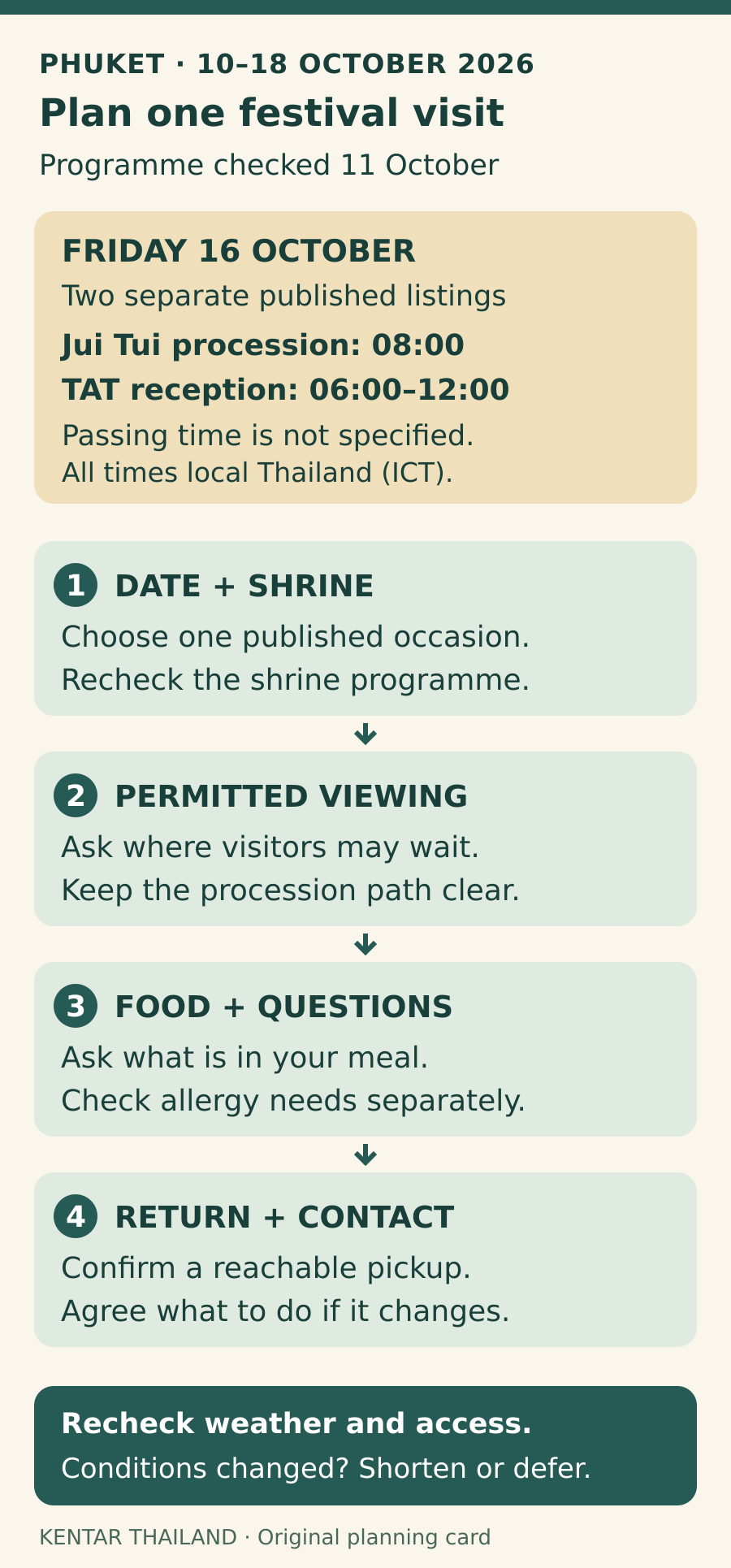
- Friday 16 October: Jui Tui Shrine, 08:00. This has a separately announced reception point at the TAT Phuket Office, explained below.
These are published procession times, subject to change. They do not predict when the procession will reach an individual street corner. Use the full official ritual schedule to check your date again, then ask the shrine or event staff about viewing arrangements. Save the exact shrine name with the date; “the festival procession” is too vague for a driver or a travel companion.
Friday 16 October: keep the two times separate
For a concrete planning example, TAT’s announcement lists a ceremonial reception table outside the TAT Phuket Office from 06:00 to 12:00 on Friday 16 October, welcoming the Jui Tui procession. Separately, the shrine schedule lists Jui Tui’s street procession at 08:00. The office’s published address is 191 Thalang Road. TAT reception announcement, TAT Phuket office details
Do not read 06:00 as the Jui Tui departure or 08:00 as an arrival at the office. The reception window does not establish an exact passing time. Before choosing this option, ask TAT or the shrine whether the announced arrangement still applies and where visitors can stand without obstructing the table, entrances or procession.
Plan around one viewing location rather than trying to see the shrine departure and then race ahead to the office. Agree on a point at which your group will reassess: if waiting becomes uncomfortable, access changes or rain worsens, finish the visit. Confirm access separately, even when an event appears in the published programme.
Watch respectfully and keep the way clear
TAT’s shrine guidance asks visitors to speak quietly, obtain permission before photographing deities or rituals, give way to processions and follow shrine staff. Never cut across a procession. Observant participants wear white and follow vegetarian and other religious precepts; ask the shrine about visitor dress and entry instructions rather than assuming clothing gives permission to join a ritual. Official shrine etiquette
Leave space around household altars and people making offerings. A doorway or table that looks useful for a photograph may be part of someone’s observance. Keep your bag close, avoid blocking entrances and put the camera away whenever staff ask. Ask individuals before taking close portraits, and respect a refusal without negotiating.
Some ceremonies involve fire, piercing or other practices that may be distressing to watch. Choose your viewing accordingly and do not imitate or attempt hazardous rituals. This guide does not treat them as visitor activities. You can focus on the community’s preparations, food and permitted shrine visit instead; there is no need to seek a more intense experience to make the day worthwhile.
Make one thoughtful food stop
TAT describes strict observance as avoiding meat and animal-derived products, alongside other religious commitments. When choosing a meal, ask whether it is prepared for the festival’s vegetarian observance. Do not assume an ordinary restaurant dish has changed its ingredients simply because the festival is taking place.
Start with a few practical questions: what is available now, what is in it, and what does the displayed price cover? Decide whether you want a seated meal or a small takeaway portion before joining a queue. For a group, choosing one place where everyone can make a clear order is often easier than splitting up among unfamiliar stalls.
A vegetarian label does not answer an allergy question. If an ingredient or cross-contact matters to you, ask specifically about both ingredients and preparation. If the seller cannot give a clear answer, choose another option rather than interpreting the label as an assurance. Allow time for that conversation rather than ordering in a rush.
Keep food purchases separate from offerings. Ask before taking anything from a ceremonial table, and follow the hosts’ instructions if food is being shared. Finish eating in a suitable place and dispose of packaging without using an altar or shrine entrance as a resting surface.
Arrange the return before the outward journey
Tell your driver the date, shrine and intended viewing area. Ask for an agreed drop-off and a collection point outside the affected procession route that the driver confirms is reachable under that day’s arrangements. Agree how you will contact each other if the point changes. A saved map pin helps identify a place; it does not prove that vehicles can reach it.
The official festival pages provide procession-route material, but a route illustration is not a police closure order, a pedestrian crossing plan or a statement that adjoining roads remain open. Do not build the visit around crossing the route at a particular time. If your food stop or collection point would require an uncertain crossing, choose a simpler plan with local guidance.
Leave flexibility before a flight, boat departure or another fixed appointment. No reliable festival-day journey time or guaranteed vehicle availability has been established here. If you need step-free access, seating or a particular toilet arrangement, confirm those details with the places you intend to use before committing; the viewing areas have not been accessibility-audited for this guide.
Save these four answers before you leave
- My date and shrine: the current programme and the correct procession time.
- My viewing place: where staff permit visitors to wait and how to leave if conditions change.
- My meal: a manageable food stop, with ingredients checked for my needs.
- My return: a specific collection point, a contact method and an agreed alternative if access changes.
If one answer is missing, simplify the visit before setting out. One respectfully observed occasion, a meal and a clear return plan are enough.
Information checked: 11 October 2026, Asia/Bangkok. This is a dated planning guide based on published official material, not a field inspection or direct confirmation of access, transport or stall operation. Review the programme and weather daily during the event. After 18 October 2026, treat these dates as an archive, not the next festival’s schedule.