Choose Phuket or Koh Samui by comparing the journey to your actual accommodation, then counting the days left for the trip you want. A well-timed flight into either island can make a short stay work. A mainland flight followed by a road transfer and ferry needs a different time budget, even when the ticket is advertised as travel to Samui.
For three nights, favour the itinerary that protects your two full days. For a longer holiday, the accommodation and activities you most want may justify a more involved arrival. Neither island is automatically the cheaper, quieter or easier choice.
Start with three arrival plans
Compare these complete chains before comparing room photographs. They describe the transport stages, not a promise about journey time or availability on your dates.
Phuket: flight, airport exit, road transfer
Flying into Phuket puts you on the island. Airports of Thailand lists shuttle buses, an AOT limousine service, taxis and car rental among the airport transport options. For accommodation on Phuket itself, the onward plan can be a road journey without a ferry. Establish the pickup arrangement and destination rather than assigning one transfer time to the whole island. Phuket Airport transport information
The useful comparison starts before landing: can you get a suitable flight from your previous stop, and does the return flight fit the next one? A convenient airport-to-hotel journey does not compensate for an awkward flight connection elsewhere in the itinerary.
Samui: flight to the island, airport exit, road transfer
Koh Samui has its own airport. Its arrival guidance describes baggage collection and a meeting area for pickups. Anantara Bophut’s access page also distinguishes a road transfer from Samui Airport from a mainland-airport-and-ferry arrival. Flying to Samui therefore does not require a ferry to reach accommodation on the island. Samui Airport arrival guidance · Anantara Bophut access information
Here, “flying to Samui” means the final flight lands at Samui Airport. It does not mean your starting city has a nonstop service. Check the actual airport names, connection airports and dates on the itinerary. Compare the full journey with your Phuket option.
Samui via the mainland: flight, road, ferry, island transfer
Arriving at Surat Thani Airport is a different journey. Anantara describes a mainland road transfer followed by a ferry. Raja Ferry lists both Donsak–Samui and Surat Thani Airport–Samui products, identifying its Samui arrival as Lipa Noi. Its website presents an island pickup or drop-off option separately. Confirm exactly where your ticket ends. Mainland arrival overview · Raja Ferry route and booking information
For this option, write down the airport meeting point, mainland pier, sailing, island pier and final accommodation transfer. Ask who handles a missed connection and what happens if the flight is late. A combined transport product needs its own terms checked; do not infer that a separately purchased flight is protected by it.
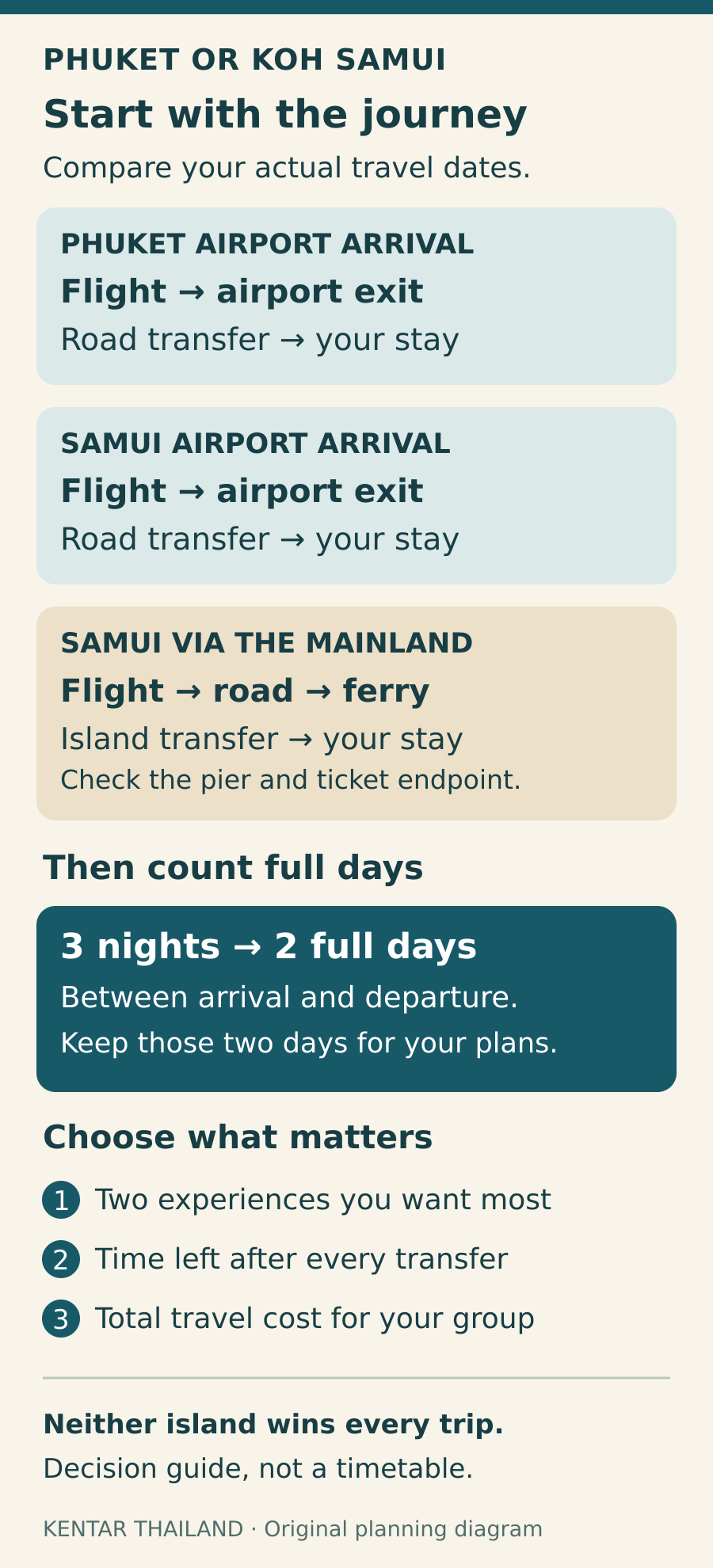
Count usable time, not just booked nights
Three nights normally give you two full calendar days between arrival and departure. What happens on the outer days depends on the real transport plan. Compare expected hotel arrival with the time you must leave the hotel, including the return transfer and your airline’s requirements.
Consider this deliberately hypothetical three-night comparison. These are invented hotel-door times for arithmetic, not flight schedules or transfer estimates for either island:
- Option A: reach the hotel on Monday at 14:00 and leave on Thursday at 11:00. The window between arrival and departure is 69 hours.
- Option B: reach the hotel on Monday at 20:00 and leave on Thursday at 08:00. The equivalent window is 60 hours.
Both have three booked nights and two full intervening days. Option A leaves nine additional hours at the destination, including more of the first afternoon and final morning. That is elapsed time, not nine guaranteed hours of sightseeing; sleep, meals, room access and your energy still matter. Either Phuket or Samui could be Option A on your real dates.
Now repeat the exercise with two bookable itineraries. Use the transport provider’s guidance for connections and pickup timing, and the accommodation’s check-in or bag-storage arrangements. Do not treat landing time as the start of beach time. If the arrival estimate is uncertain, keep the first evening simple rather than reserving an outing you may struggle to reach.
Choose a stay length around what survives the travel days
These are suggested planning patterns, not official minimum stays. Use the same test for both islands.
- Three nights: choose one accommodation base and two main day plans. For example, one relaxed local day and one outing. Keep arrival and departure days free of essential activities.
- Four or five nights: you have three or four full days between the travel days. This gives room for an outing, time near your accommodation and an uncommitted day if you want one.
- Six or seven nights: you have five or six full days before allowing for any hotel moves. Add activities only if you want them; a longer stay can simply mean less pressure to go out every morning.
If your preferred Samui arrival involves the mainland and a ferry, check whether the complete outbound and return chains still leave enough time for those plans. With a well-timed flight to Samui Airport, the same three-night outline may be perfectly workable. Apply that scrutiny to Phuket too: its road-based airport arrival does not fix an inconvenient departure time.
Set the pace through your plans
“Phuket is busy” and “Samui is relaxed” are poor substitutes for deciding how you will spend the days. Write down the two experiences you would most regret missing, then count how many journeys each would require from your proposed base.
For a rest-first holiday, compare the accommodation you would actually book and whether you would be happy spending most of the stay nearby. For an outing-led holiday, check the operator’s pickup location, time commitment and cancellation conditions for the specific activity. A relaxing room can still produce a tiring holiday if every day begins with another long transfer.
Give a full-day outing a full day in your plan. Leave another day relatively open if doing so matters to your enjoyment. This is how you create a slower pace on either island, rather than expecting the island’s name to create it for you.
Once Phuket is your choice, our Phuket beach-area guide helps with the next, more local decision. For travel months, use when to visit Thailand by region to compare the Phuket and Samui climate data. Keep current conditions and any weather-dependent activity separate from the historical comparison.
Compare the whole transport price
Price the same dates, party and luggage allowance for both island options. Include the flights, required baggage charges, airport transfers in both directions and every road or ferry segment. Identify whether each figure is per person or per vehicle, and whether the final island transfer is included.
If the mainland route appears less expensive, subtract all the extra transport costs before calling the difference a saving. Then ask whether that saving is worth the change in usable time and the extra connections for your group. Conversely, do not assume that flying to Samui Airport is always more expensive: only the actual quotes can settle your comparison.
Read the change and cancellation conditions alongside the price. A low fare and a flexible fare are different products. If an overnight stop is necessary to make your chosen connections comfortable, include that room and its transfers in the route’s cost. This guide deliberately gives no universal airfare, ferry fare or cheapest-island verdict.
Should you split the holiday between both?
First assign the move its own travel block: packing, checkout, reaching the departure point, the booked journey, onward transfer and check-in. Do not count a short flight’s duration as the entire relocation. Confirm the available route for your date before deciding how much of the day remains.
For a six-night holiday, compare two actual outlines: six nights in one base, or three nights on each island with a move between them. The split gives two full days in each base if the move takes place between the stays. The single base gives five full days between initial arrival and final departure. That extra uninterrupted day may matter more than adding another island.
Choose the split when each island offers something specific you want enough to justify the move. If the reason is only uncertainty about which one to choose, settling on the better-fitting itinerary is usually a more restful solution.
Make the final choice
Keep Phuket on top when your actual flights, road transfers and preferred stay fit together better. Keep Samui on top when its accommodation or activity plan matters more to you and the complete journey still leaves the time you want. For a close result, favour fewer awkward connections and more usable time rather than an unsupported island-wide ranking.
Before paying, save the exact airport and pier names, hotel arrival and departure estimates, transport inclusions, cancellation terms and a contact for each connection. Recheck the services for your dates. The best choice is the island that supports the holiday you can actually take.
Information checked: 11 October 2026, Thailand time. Access stages are based on airport and operator information. Stay lengths, planning examples and the decision diagram are original editorial guidance. No flight, ferry, transfer, hotel stay or all-in fare was independently tested; published routes do not establish availability for a particular date.