Make Khum Chao Luang and Khum Wong Buri the anchors of a short architecture walk in Phrae. At each, slow down enough to study a roof edge, a window surround and one repeated timber pattern. You will get more from two buildings with a clear question than from a long checklist of house names.
If you want to enter both museums, plan for Monday to Saturday. Wong Buri’s own website currently lists a Sunday closure. Its museum uses the English name Vongburi House Museum, useful when checking visitor information or showing the address to a driver. Vongburi’s official contact page.
A simple plan for the walk
- Start: Khum Chao Luang, on Khum Doem Road in Nai Wiang, central Phrae.
- Second stop: Vongburi House Museum, 50 Kham Lue Road, also in Nai Wiang.
- Time to set aside: roughly 1½–2½ hours for two unhurried visits, the connection and a break. This is an editorial allowance, not a museum tour duration or a measured walking time.
- Before leaving: confirm that both interiors are open, save their full names and addresses, and ask for the current public-street route between the entrances.
Phrae’s historic centre is a setting for exploring on foot in TAT’s destination guide. The two-stop sequence here is our own suggestion; it is not an official marked trail. Use a current map and local advice for navigation. TAT’s Phrae destination guide.
First, distinguish the two buildings
Khum Chao Luang, the former ruler’s residence, dates to 1892 in the Phrae Provincial Administrative Organization’s account and now houses a museum. Phrae PAO’s museum history, in Thai. Its conservation record describes brick-and-plaster walls, wooden floors and pierced timber decoration. The woodwork is an important part of a mixed-material building. ONEP’s Khum Chao Luang record, in Thai.
Khum Wong Buri is the pale-pink, two-storey teak house. Thailand’s Office of Natural Resources and Environmental Policy and Planning (ONEP) records gingerbread decoration around its roof, ventilation openings, doors, windows and verandas. ONEP’s Khum Wong Buri record, in Thai. The museum’s own history connects the house with Mae Chao Bua Tha and a wedding home for Chao Sunanta, and describes the natural plant forms in its decorative woodwork. The museum’s own history, in Thai.
These are related places to study timber craftsmanship, with different building materials and histories. Keep that distinction in mind when you write captions: “wooden decoration” is more accurate than calling every surface in both houses teak.
Three ways to read the woodwork
You do not need a specialist vocabulary. Start with these three observations, looking only from areas open to visitors.
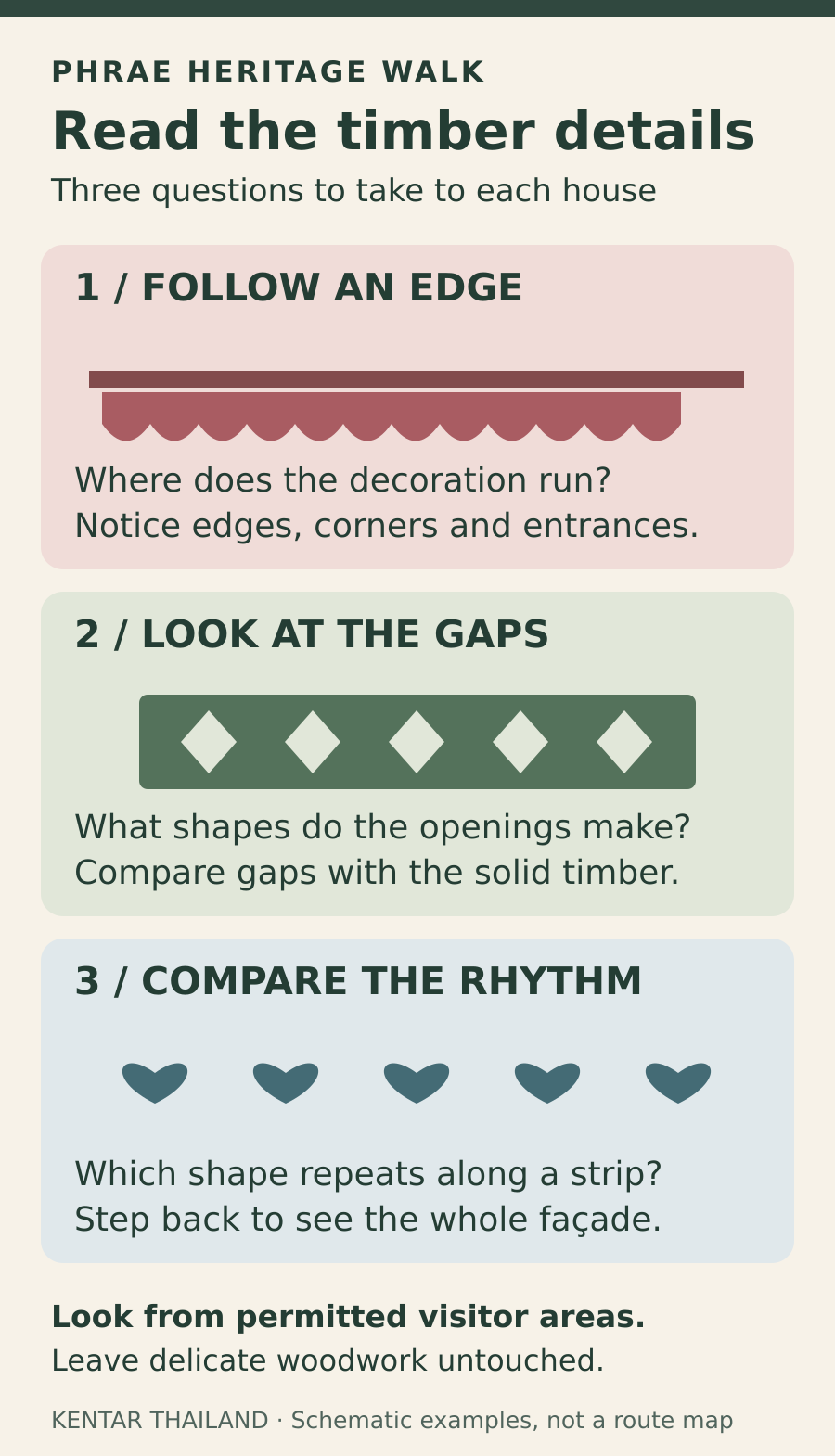
1. Follow an edge. Find a decorated board beneath or beside a roof edge. Trace its outline with your eyes. Does it form a continuous strip, change at a corner or draw attention to the entrance? An eave is the part of a roof that projects beyond the wall.
2. Look at the openings. In pierced work, the cut-out spaces help make the pattern. Look at both the timber that remains and the gaps between it. Compare a ventilation panel with a window surround. Can you see a leaf-like curve, a geometric shape or a repeated unit? Record what is visible rather than assigning a symbolic meaning without an explanation from the museum.
3. Compare the rhythm. Choose a short section and notice how a motif repeats. Then step back, where there is room, and see how it fits the whole façade. A close photograph can capture the workmanship; a wider view shows its position on the building. Do not touch, lean on or reach through the woodwork.
Stop 1: Khum Chao Luang
Begin with a full view of the building from a permitted visitor area. Notice the relationship between the solid walls and the lighter-looking timber ornament. Then concentrate on one roof edge and one opening rather than trying to catalogue the entire exterior.
If the museum is admitting visitors, use the interior displays to add context to what you have seen outside. Read the labels and ask which elements are original and which have been repaired. A fresh-looking painted surface alone cannot tell you the age of the timber underneath.
The operator’s museum page lists daily opening from 08:30 to 16:30, with free admission, and gives 054 524 158 for enquiries. These are published visitor arrangements checked for this guide; confirm any temporary closure or room restriction before your visit. Ask at reception about photography and video, since this guide has not established a current published camera policy for this museum. Operator’s opening information and contact, in Thai.
The connection to Wong Buri
Set your next destination to Vongburi House Museum, 50 Kham Lue Road. The museums are in the same central neighbourhood, but a map pin does not establish an open entrance, a continuous pavement or a safe crossing. Before departing, ask staff which public streets and entrance they recommend that day.
Keep your attention on traffic while moving, and stop in a suitable place before looking up at buildings or taking photographs. Do not use private gardens or temple compounds as shortcuts. If heat, rain, roadworks or mobility needs make the walk unsuitable, arrange a vehicle transfer with your accommodation and agree the pickup and fare first.
This guide does not specify turn-by-turn directions, a walking distance or a guaranteed step-free route. The purpose of the connection is to compare two houses at a comfortable pace.
Stop 2: Khum Wong Buri / Vongburi House Museum
At Wong Buri, use the same three prompts again: edge, opening, rhythm. Comparing the same kinds of detail makes the differences easier to notice. Look first at the overall arrangement of the pink house, then at a small area of decoration above an opening or along a roof edge.
If you enter, give the domestic rooms and objects some attention too. ONEP describes a private museum displaying the house’s history through belongings passed down in the family. The decoration then becomes part of a lived-in house’s story, rather than simply a background for a photograph. ONEP’s collection description, in Thai.
Published visitor arrangements
The museum’s own contact page lists Monday–Saturday, 09:00–16:00, and Sunday closed. For enquiries it gives 062 860 5554 and 088 216 6541. Recheck before travelling, particularly if you are making a special journey or need particular rooms to be accessible. Official opening hours and contact details.
Its admission page lists the following rates, effective from 1 January 2025:
- Adults: 60 baht
- Visitors aged 10–20: 30 baht, with ID or passport required
- Children aged 0–9: free; the page also lists other eligible free-entry categories
The same page says visitors must remove shoes, that the interior visit involves stairs, and that outside food and drinks are not allowed. Still photographs inside are welcome, but flash and video recording are prohibited. Follow any additional instructions at the entrance. Official admission fees and museum rules.
Use these operator-published details when planning, rather than older directory listings with different hours or prices. Payment methods, temporary closures and individual access needs should still be confirmed directly.
Keep the visit comfortable and respectful
Wear shoes that are comfortable for walking and easy to remove where required. Bring water for the street section, then follow staff instructions on where to leave it before entering areas where outside food and drinks are prohibited. Make time for a shaded break rather than treating the opening hours as a reason to rush.
If stairs are a concern, ask both museums about the exact areas you can reach and whether there is a ground-level alternative. A short urban walk and a historic-house interior can present very different access requirements. Do not assume that a museum listing means step-free entry, an accessible toilet or seating throughout.
Exterior viewing and museum admission are separate choices. A closed museum does not give permission to enter its grounds, and an exterior-only visit depends on what is visible from lawful public space or another area explicitly open to visitors. On a Sunday, plan around Wong Buri’s published closure; do not assume its garden or interior will be available.
For a useful final comparison, write one sentence about each building: what material you noticed, where the woodwork was placed and which repeated shape caught your eye. That is enough to turn a pleasant walk into a closer reading of Phrae’s architecture.
Information checked on 11 October 2026. Opening times, prices and visitor rules above are published information from the museum operators, not a same-day confirmation. The walking sequence, time allowance and observation exercises are editorial suggestions. No firsthand inspection of the route or guarantee of access is implied.