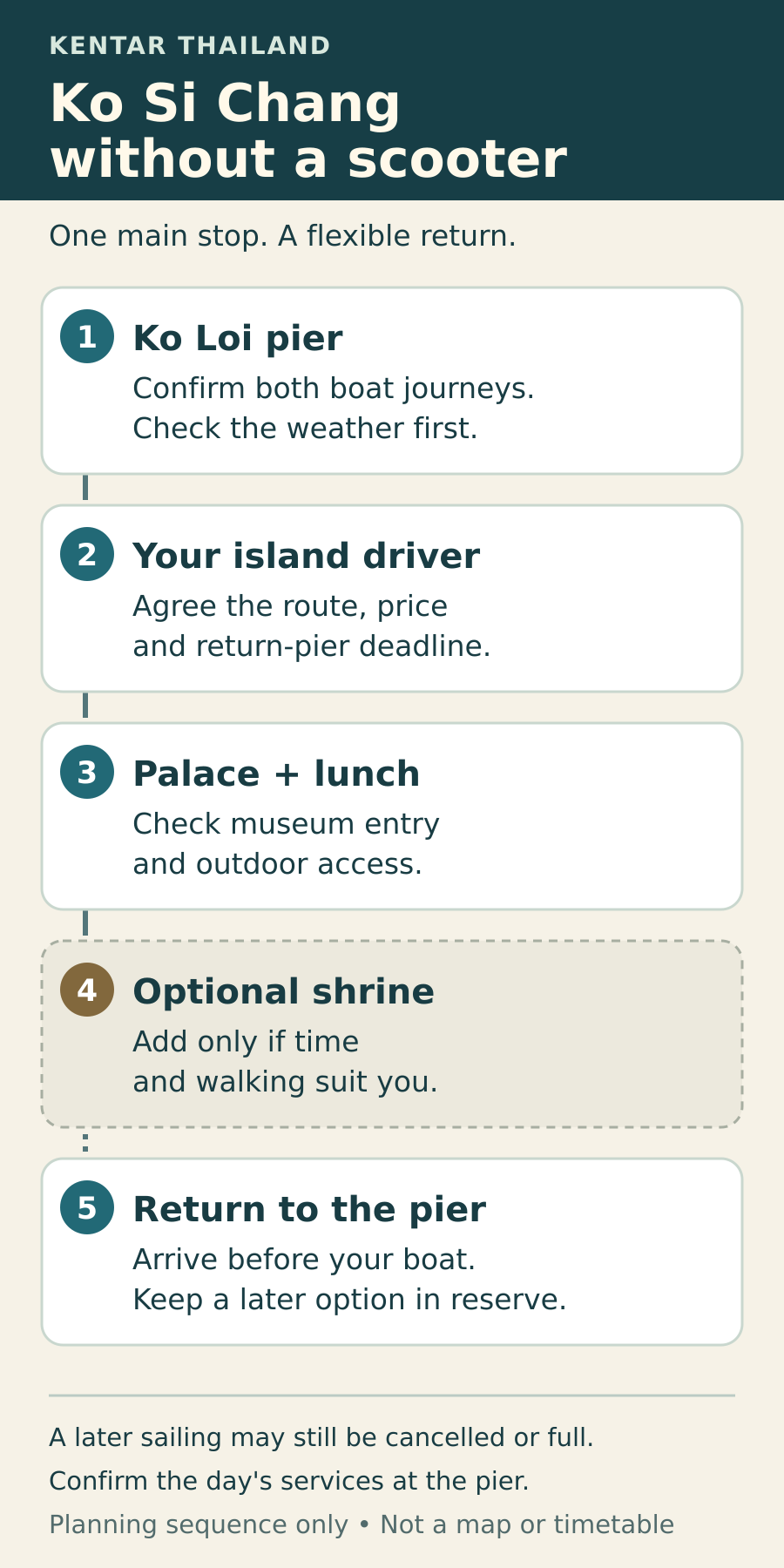
A scooter-free day on Ko Si Chang works best with a small plan: take the passenger boat from Ko Loi pier in Si Racha, hire an island driver, make the former royal residence your main stop, and return to the pier with time to spare. Keep one extra sight optional. The important booking is your ride back to the boat.
Ko Si Chang, also written Koh Sichang, is in Chonburi province. This guide starts at the mainland pier and builds an island visit around the Phra Chutathut Royal Residence Museum. It suits travellers who want local history and a sea crossing without riding a rented motorbike. Expect some walking and transfers between vehicles and boats; confirm individual access needs before committing to the trip.
Decide whether this is the right day trip
Choose this route if you are comfortable paying for hired island transport and leaving time unused when necessary. The palace visit can be the whole sightseeing programme. Lunch and a relaxed return still make a worthwhile day.
Keep a mainland alternative if the crossing is uncertain, the museum is closed, or you cannot arrange a suitable vehicle. A tightly timed flight or another non-refundable connection that evening is a reason to choose a different day. Staying on the island can remove the pressure to sightsee and return immediately, but check accommodation and onward boats before deciding to stay.
For a museum-centred visit, plan around Wednesday to Sunday. Chulalongkorn University's visitor page currently lists 09:00–17:00, closure on Mondays and Tuesdays, and free admission with no advance reservation required. Other official pages retain different closure information, so reconfirm directly before travelling, especially around holidays. Chulalongkorn University's museum visitor page.
1. At Ko Loi, confirm the return before crossing
Ask your mainland driver for Ko Loi pier, Si Racha, for the passenger boat to Ko Si Chang. Ko Loi is the departure point identified in the Tourism Authority of Thailand's island guide. If arriving by intercity bus, establish the bus drop-off and the separate transfer to the pier before buying the ticket. TAT's Ko Si Chang guide, in Japanese.
TAT gives roughly 40–50 minutes on the water as a general indication. Confirm the expected crossing time locally and add waiting, boarding and onward transfers. The linked guide also contains fare and timetable information that should not be treated as a current operator notice. This article therefore gives no fixed fare or departure timetable; ask the pier staff for today's arrangements.
Before buying or boarding, ask the ticket staff:
- Which boat is going to Ko Si Chang, and where will it land?
- What are today's fare and payment arrangements?
- Which boats are expected to return to Ko Loi, and which is the final service?
- Where exactly do I board on the island, and how early should I be there?
- Are weather, sea conditions or other disruptions affecting either direction?
Photograph the current information board if permitted. Choose an intended return earlier than the final service, with at least one later scheduled sailing as a possible backup. A listed backup can still be cancelled or full; it is breathing room, not a guarantee.
Check the dated Thai Meteorological Department shipping forecast, then follow the operator's and port staff's instructions. An old forecast or a calm-looking harbour does not establish conditions for the whole crossing. If the boat is suspended or staff advise against travel, postpone the island plan. Ask about a suitable life jacket and boarding assistance before getting on; wear the life jacket as instructed by the crew.
2. Arrange your island driver before setting off
The island's hired three-wheelers are often called skylabs. DASTA's community-tourism profile identifies them as a way to tour Ko Si Chang, and TAT recommends arranging a tuk-tuk at the arrival pier and telling the driver your return-boat time. DASTA's Ko Si Chang community profile, in Thai.
For this route, ask for the palace, a lunch stop and a return to the correct passenger pier. Discuss the shrine only after those essentials are agreed. You can ask your accommodation or a local host to help arrange a driver beforehand if choosing a vehicle on arrival would be difficult.
Agree these details before riding:
- The total charge, whether it is per vehicle or per passenger, and when to pay
- Whether the driver waits at the palace or returns at an agreed time
- The precise pickup point and how to contact each other
- Any extra charge for waiting, a changed route or an additional stop
- The time you must be back at the passenger pier, allowing for boarding
Take a photograph of the vehicle or its identifying details with the driver's agreement. Keep the agreed route and price in a message or note. For a group, check passenger capacity, seating, luggage space and whether everyone can get in and out comfortably. A hired ride reduces the distance you have to walk, but it does not establish step-free access at the places you visit.
3. Give the royal residence most of your sightseeing time
The Phra Chutathut Royal Residence Museum occupies part of a former royal residence associated with King Rama V. The site offers a way to connect the island's setting with its royal history, rather than treating the visit as a quick photograph and departure. Chulalongkorn University describes exhibitions about the palace, island history and historic buildings on its visitor page.
The university's cultural office identifies displays in the Vadhana, Phongsri and Abhirom buildings, covering events, important people and architecture associated with the site. It also describes a wider landscape of paths, gardens and stairs. Ask which buildings and outdoor sections are available that day, then choose a manageable loop. Chula's cultural-office description, in Thai.
Set aside around 60–90 minutes as an editorial planning allowance, adjusting it to your interest and the parts open. Spend some time with the exhibits before walking outside. Look for how an individual building was used, and how its history relates to the royal family's time on the island.
DASTA also highlights the white wooden Asdang Bridge, a familiar island landmark. If staff confirm access and conditions are suitable, include the waterfront in your palace visit. Follow any barriers or temporary restrictions; the presence of a landmark on a tourism website does not mean every part is accessible on your date.
Museum opening and garden access are separate checks
Use the museum's published days to plan entry to the exhibitions. Do not assume that the gardens, waterfront or bridge are open on a museum closure day. Equally, a closed exhibition building does not by itself tell you the status of every outdoor area. Ask the museum about the exact part you want to visit. The central university page lists +66 38 216 412 and +66 38 216 416 for enquiries.
If walking is a concern, ask about the drop-off point, remaining distance, gradients, steps, seating and toilets. Wear footwear with grip and carry water and sun protection. Keep enough energy for boarding the return boat. No step count, continuous pavement or fully accessible route is assumed here.
4. Have lunch, then decide on one extra stop
Arrange lunch where it fits the driver's route and your return deadline. Confirm the menu price and preparation time before ordering if the schedule has tightened. This is also a useful point to check for any changed boat information and decide whether to end the sightseeing.
For an optional cultural stop, consider Chao Pho Khao Yai Shrine. TAT describes this Chinese-style shrine in a hill cave, with views from the hill. It is a place of worship, so follow the local dress and photography guidance and give worshippers space. TAT's Chao Pho Khao Yai Shrine guide.
Ask your driver about the current entrance and the walking needed from the drop-off. Do not assume the vehicle reaches every part you want to see or that any assisted access is operating. Add the stop only if the climb or other walking suits your party and the driver can still meet your pier deadline. The palace and lunch are a complete version of this route if you prefer to leave it there.
5. Build the return backwards from your chosen boat
For planning, aim to be at the island's departure pier about 30 minutes before your chosen sailing, or earlier if the operator requires it. This is our suggested buffer, not an official check-in rule. Increase it for busy periods, luggage or assistance needs.
Work backwards: pier arrival time, the driver's estimate for the final transfer, then the time you must finish lunch or sightseeing. Show the driver the pier arrival time, not just the boat's departure time. If a stop runs late, drop the optional visit rather than using up the buffer.
Before leaving your last stop, confirm that the intended service is still operating. At the pier, check the boat and destination again. If services change, follow staff advice; do not rely on finding an unplanned speedboat as an automatic fallback. Contact your mainland transport provider if an onward pickup needs adjusting.
Your scooter-free day, in five decisions
- Can you cross and return today? Check boats and weather at Ko Loi.
- Who brings you back? Agree the island vehicle, price, pickup and pier deadline.
- What is actually open? Confirm museum entry and outdoor access separately.
- Is another stop worth the effort? Keep the shrine optional.
- When do you stop sightseeing? Leave in time for your chosen boat, with a later service only as a possible backup.
Ko Si Chang rewards a modest itinerary. Give the former royal residence time, let a local driver handle the road transfers, and make the return journey part of the plan from the start.
Information checked on 11 October 2026. Museum hours are the university visitor page's published information, subject to reconfirmation. Ferry duration is a general tourism-board planning reference; current fares, sailing times, vehicle availability and individual accessibility were not independently confirmed. Suggested visit lengths, route order and return buffers are editorial advice.