For a first Khao Yai forest walk, start with Trail 1 if you want a small commitment, or consider Trail 4 if you want a guided outing without giving the whole day to one hike. Keep Trail 6 for a day organised around walking. The useful choice is the one that fits your group, the ranger’s advice and the ride waiting at the other end.
This guide compares the park’s seven published nature trails. It focuses on the walking day: choosing a route, arranging the right guide and connecting its start and finish.
Confirm the day’s route before travelling
Details checked 10 October 2026. This guide compares the park’s published routes. We have not independently confirmed which numbered trails are walkable today or whether a guide is available for your visit. Ask the Visitor Center about your intended route, weather restrictions and guide arrangements before travelling; reconfirm permission at the park before you start.
The routes below are officially listed choices, subject to permission and conditions on your visiting day. A website’s seasonal “open” label cannot settle a washed-out crossing, a wildlife restriction or whether a guide is free that morning. Do not assume that an advertised seasonal closure end date confirms reopening.
Compare the seven trails
Distances and walking times below are the park’s published estimates. Effort labels and fallback choices are our planning judgments, not official difficulty grades. “Optional” means the trail listing does not mandate a guide; the park’s separate walking code advises against trekking alone.
Seven trail choices. A and B refer to the fallbacks below. Walking commitment labels are editorial judgments.
- 1 · Visitor Center bridge → Kong Kaew → same bridge: 1.2 km; 45–60 min; Light. Guide: Optional; fallback A.
- 2 · Pha Kluai Mai campground → Haew Suwat: 3 km; 2 hours; Moderate. Guide: Optional; fallback A.
- 3 · Km 33 → Nong Phak Chi → Km 35: 4.2 km; 2.5–3 hours; Moderate. Guide: Required; fallback B.
- 4 · Dong Tiw → Sai Sorn Reservoir: 2.7 km; 1.5–2 hours; Moderate. Guide: Required; fallback B.
- 5 · Dong Tiw → Nong Phak Chi → Km 35: 5.5 km; 3 hours; Longer. Guide: Required; fallback B.
- 6 · Visitor Center bridge → Haew Suwat: 8 km; 6 hours; Full-day. Guide: Required; fallback B.
- 7 · Thai-American Friendship: Sai Sorn reservoir circuit: 2 km; 1.5 hours; Short. Guide: Optional; fallback A.
Register and request permission at the Visitor Center. Starts: Trails 1–5/7, 08:00–14:00; Trail 6, before 10:00. Trail 6’s listed annual closure: 1 July–31 August. Trail 5: rainy-season stream crossing may be impassable. Official trail details and start points.
Leave extra time for registration, transfers, breaks and slower members of your group. “Light” describes a smaller commitment relative to the other routes; it does not certify step-free access, dry surfaces or suitability for every visitor.
A: a short visit without a forest hike
Keep the Visitor Center as your first stop, then ask whether a brief visit to Sai Sorn Reservoir is appropriate that day. If access or weather is poor, leave the outdoor stop out. This is an alternative outing, not an instruction to walk around a closure. The park’s itinerary suggestions include the visitor-service area and reservoir.
B: step down the commitment
If a guided route cannot go ahead, consider Trail 1 only after staff approve it and you have suitable company. Otherwise use fallback A. Do not substitute another deep-forest route because its line on a map appears shorter.
Choose for the experience you actually want
For a first taste of forest: make the short walk the main event rather than the first item in a crowded schedule. Stop to listen, look for changes in vegetation and let the slowest walker set the pace. An enjoyable small outing gives you better information about your group than an ambitious plan made at a desk.
For a guided half-day: compare the routes ending at the reservoir and Nong Phak Chi with the guide. Ask what is interesting on that specific day, how much uneven ground is involved and where the driver should wait. Choose the outing you want even if no large animal appears. Forest sounds, tracks and plant life are worthwhile reasons to walk.
For the long Visitor Center–Haew Suwat route: protect the whole day from other commitments. The park’s trail handbook describes forest, fern-rich wetland and bamboo sections, with some steep approaches to streams. It also advises arranging a vehicle at the waterfall car park before 17:00. Pack lunch and agree on the pickup before setting off. Official trail handbook, PDF.
If reaching the waterfall is your main aim, explain that to the ranger. There is little value in committing to a long forest walk simply because the same waterfall name appears at its finish.
Arrange the guide and the ride separately
A person driving you into the park is not automatically the trail guide required for your route. Before paying for an outing, have the provider or Visitor Center identify who will lead the walk and who will handle the vehicle. A private tour should name its actual trail or explain how staff will choose one, rather than promise only “jungle trekking”.
For a guide arranged through the park, start with the Visitor Center. We did not find a current fixed hiking-guide tariff or live availability calendar in the official pages checked. Obtain the total for your route and group, the language available and what happens if staff change the route. Do not build a non-refundable connection around finding a guide immediately on arrival.
Use this short booking note:
- Date, number of walkers, preferred trail and shorter alternative
- Guide name or meeting arrangement, language and group size
- Meeting time and exact starting point
- Finish, pickup point and latest agreed return time
- Total price and whether guide, vehicle, park admission, food and equipment are included
- What happens to the booking if the park closes the route
The park lists visitor information hours as 08:30–16:30. Its Visitor Center number is +66 86 092 6529. Arrange an early hike in advance rather than assuming guide service begins when the entrance gate opens. Official contact details.
Getting to a trailhead is part of the hike
The park’s transport page separates the Pak Chong entrance from the headquarters area, a further approximately 15 km inside. Its public-transport directions reach the entrance and then depend on onward travel. Treat your journey as three bookings or agreements: accommodation to park, park to trailhead, and trail finish back to accommodation. Do not rely on an unconfirmed lift to finish the day. Official access information.
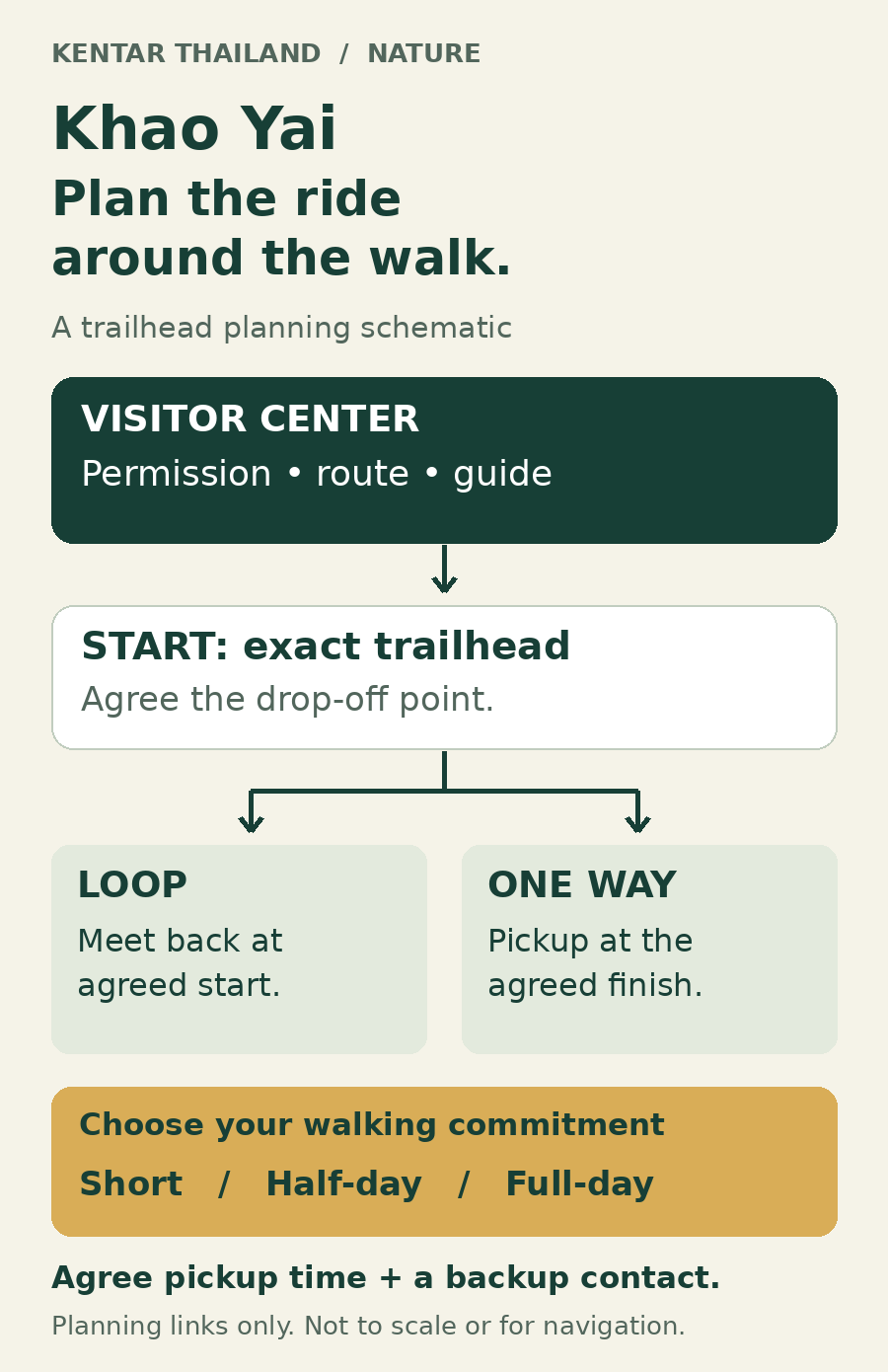
For a one-way walk, give the driver both endpoints. A driver waiting where you started is a different arrangement from one collecting you where you finish. Agree on a visible meeting place and a contingency if you are delayed; do not make finding a mobile signal your only plan.
On the reservoir circuit, confirm the exact return meeting point rather than assuming every reference to “Sai Sorn” means the same place. For Dong Tiw, ask staff to mark the trailhead. For Nong Phak Chi routes, make the road pickup clear instead of telling the driver only the observation tower’s name.
Budget: admission, vehicle and guide
The dedicated official entry-fee page lists the following for the Pak Chong and Noen Hom entrances:
- Foreign visitors: THB 400 per adult; THB 200 per child under 14
- Thai visitors: THB 40 per adult; THB 20 per child
Vehicle admission is extra. The park’s tariff page and a camping section of its FAQ give different vehicle prices. Ask the gate for the current charge before paying. The dedicated tariff’s later foreign-entry rate is used above; its older THB 200 adult figure is not the rate listed for these two entrances.
Keep guide and transport costs as separate lines until you have a quote. A package described as a “park tour” may need clarification about admission, lunch and end-of-trail pickup. Ask for an inclusive total for your actual group.
Pack for walking, and leave wildlife room
Bring drinking water, food appropriate to the outing, any regular medication, a charged phone, a light, a litter bag and suitable rain protection. Wear well-fitting walking shoes and comfortable clothes covering arms and legs; consider leech socks for wet conditions. The park’s walking code also calls for staying on the trail, keeping the group together, avoiding solo treks and observing animals from a distance. Official preparation and walking code.
If your guide stops or changes direction because of wildlife, follow the instruction without trying to get closer first. Do not leave the path for a photograph or treat an animal’s apparent calm as permission to approach.
For the drive, the park’s elephant guidance says to stop at least 30 metres away, leave the engine running and reverse carefully if an elephant approaches. Wait for it to leave the road; do not sound the horn, use flash or get out for a photograph. Follow officers’ directions. These are road-encounter instructions, not a safe-distance formula for approaching elephants on foot. Feeding or touching wild animals is prohibited. Read the park’s full safety guidance.
Save the park’s emergency contacts before leaving: Visitor Center +66 86 092 6529 and headquarters +66 86 092 6527. For an incident, give your trail number, last identifiable marker and what happened. Official contacts.
The final decision at the Visitor Center
Leave with one approved route, one shorter alternative and a confirmed way back. If any of those is missing, spend the visit on a smaller outing. The goal is a good forest day with enough time to look around and get home comfortably.
For the broader overnight decision, see our Japanese guide to a day trip or overnight at Khao Yai. This English trail guide adds route-by-route walking and pickup choices.
Information checked 10 October 2026. Trail permissions, weather restrictions, guide availability and charges can change. Confirm the day’s route at the park before walking.