A community-led visit starts with a clear invitation: which hosts will receive you, what they want to share and how the visit will work. Before choosing a cooking session, village walk or craft activity in Thailand, send one useful enquiry. Ask who makes the decisions, who receives payment and what your group needs to agree before arriving.
This guide uses two published examples to show what you can learn from a listing and what still needs a reply. The aim is a visit that fits both you and the hosts, with enough preparation to avoid putting either side on the spot.
Find out who is receiving your booking
Look for a named community group, a person responsible for bookings and a contact route published by the group or an official tourism source. A village name in a tour title does not tell you who sells the experience or decides its rules.
Ask: “Are we booking with the community group directly, or through an operator? Who confirms that the hosts can receive us?” If an operator handles arrangements, ask which local group leads the visit and who can change the programme. Interpretation and transport can be useful services; understand what the intermediary provides and what remains the hosts’ decision.
For this guide, community leadership means looking for practical evidence that hosts have a say in the activities, timing, group size and boundaries. It is a question to investigate, rather than a certification awarded by this article. Ask whether the hosts can decline a date or an activity, including something featured in promotional photographs.
Award logos and words such as “authentic” or “sustainable” leave important questions unanswered. Ask about the specific experience you intend to book. A straightforward explanation of who hosts, who is paid and what is permitted is more useful than a broad promise of positive impact.
Two listings, two different enquiry routes
Ban Rai Kong Khing: start with the listed community contacts
DASTA’s Ban Rai Kong Khing profile, in Thai, lists community contacts in Chiang Mai, cooking and craft activities, Central Thai and Lanna as storytelling languages, and cash payment. It also describes the possibility of arranging community pickup.
Use the profile’s contact section as your starting point. Ask which activity the group would welcome on your date, whether interpretation can be arranged and what any pickup covers. The published language information gives you a concrete reason to check communication before travelling. It does not establish English instruction, an available session or the payment arrangements for your particular visit.
Ban Talae Nok: understand the operator’s role
Andaman Discoveries’ Ban Talae Nok day-tour page describes a village walk, a women’s soap-cooperative activity, lunch and dessert making in Ranong. Its itinerary separates meeting a translator from meeting the local guide; the inclusion list names an English-speaking guide and transfers to and from Kuraburi.
Here, your enquiry goes to Andaman Discoveries, the operator/intermediary. Ask which community hosts will take part, who confirms their availability and how they are paid. The published transfer inclusion belongs to this advertised package; request your exact meeting point and return destination. Neither the page nor its enquiry form establishes availability for your date or proves how the full price is distributed.
Put six practical questions in the same enquiry
Once you know the booking route, give the recipient your proposed date, party size, preferred activity and language. Be specific enough for the host to assess the request, while leaving room for a different time or activity that works better locally.
- Language: who will explain the activity and help with questions? Ask whether interpretation is available, whether it stays with your group throughout and whether it costs extra. An English webpage alone does not settle this.
- Group size: what minimum and maximum apply to this session? Ask whether you will join others, whether your party can be accommodated together and whether a smaller group changes the total price. Avoid adding extra guests after confirmation without asking.
- Transport: where exactly do you meet, and who arranges the return? Request a map pin or clear address, pickup time, finishing time and any waiting charge. Clarify whether “transfer included” starts at an operator’s office, a local meeting point or your accommodation.
- Payment: what is the total for your group, in which currency, and what does it include? Confirm the deposit, balance, payment method and cancellation terms. Ask what happens if weather or the hosts’ circumstances require a change before you pay.
- Participation: what will you do, observe or make, and may you sit out part of it? Ask about walking surfaces, steps, seating and toilets if these affect your choice. For a meal, explain necessary food exclusions and ask whether they can be accommodated.
- Photographs: where is photography welcome, and whose permission is needed? Ask separately about taking pictures, recording video and posting publicly. A booking gives you no reason to assume permission to photograph everyone you meet.
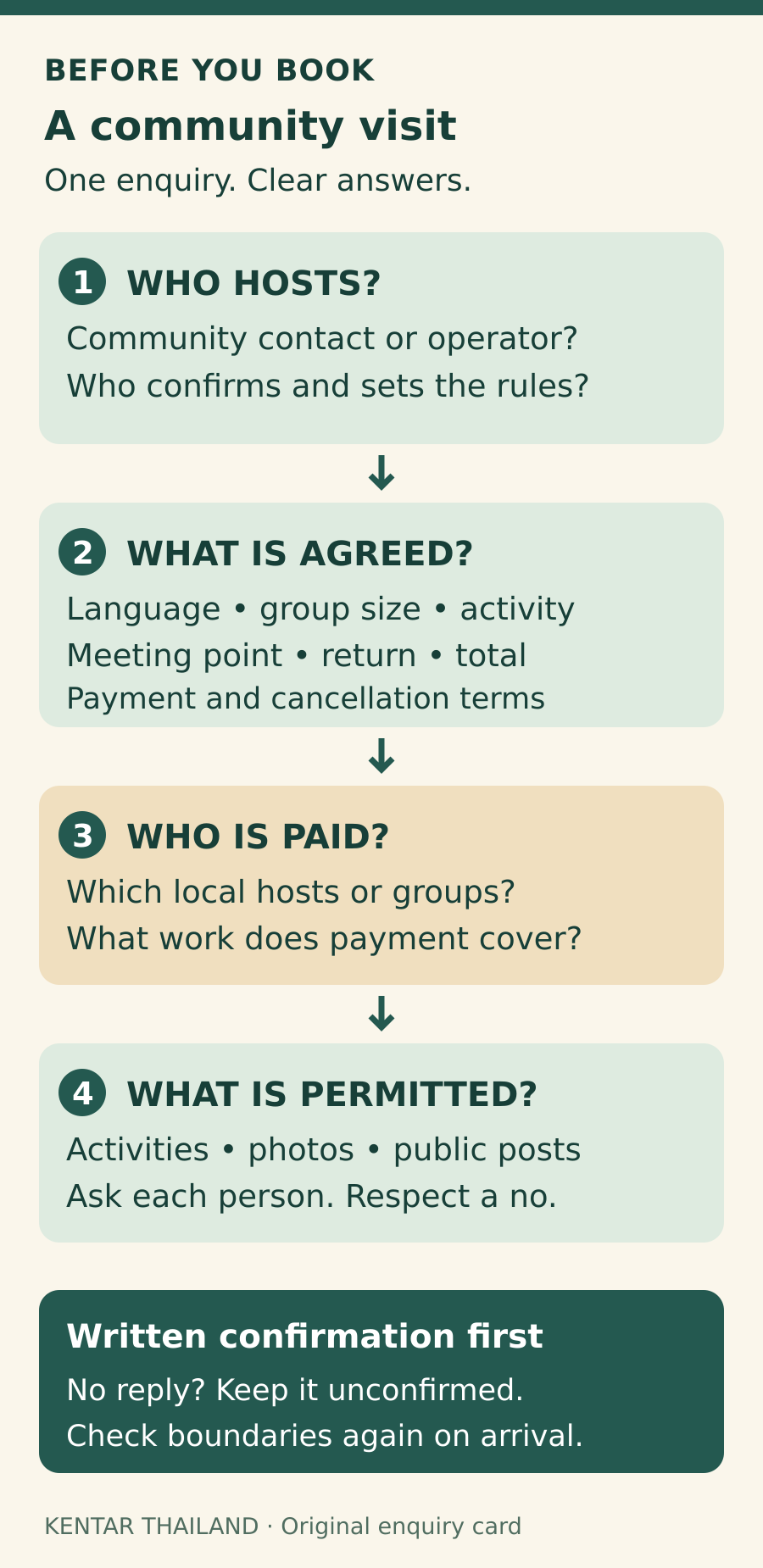
Ask how the visit supports the hosts
Keep the question concrete: “Which local people or groups are paid for this visit, and for which work?” You might ask about the guide, cooking hosts, craft makers and transport separately, where relevant. If a community contribution is advertised, ask whether it is included in the quoted price, who manages it and where its purpose is explained.
You do not need to demand private household accounts to make an informed choice. Look for an explanation you can understand, and distinguish confirmed inclusions from optional purchases or donations. Avoid repeating a percentage of “money staying local” unless the provider supplies a clear basis for that exact claim.
Ask whether hosts have guidance on tips, purchases or contributions. Buy something because you want it and understand its price. An extra gift should never become a condition for a photograph, access to a home or someone’s participation. Respect a host’s choice to keep work, family time or particular spaces outside the visit.
A message you can adapt before sending
Replace the opening details with your own date, number of travellers and activity. These are original English prompts for a reader to adapt; a host may need a shorter message or a translation. Send only the questions relevant to the visit.
Hello, we would like to ask about a visit on our proposed date, for our group of travellers. We are interested in the activity described on your page. Would the community be happy to receive us then, or is there a better date or activity?
- Are you the community booking contact or an operator arranging the visit? Which local group will host us, and who confirms the programme?
- Can the visit be explained in our preferred language? Who provides interpretation, and is it included?
- What group limits apply, will other visitors join us, and what will we do or observe? Can someone sit out an activity?
- Where and when do we meet and finish? Is transport included, from which exact starting point, and how is the return arranged?
- What is the total price, including any required extras? How do we pay, when is payment due, and what are the cancellation or change terms?
- Which local hosts or groups are paid through this booking? Is any community contribution included or optional?
- What should we know about clothing, walking, seating, toilets and meals? Please tell us which practical needs you can accommodate.
- What are the rules for taking photographs or video and sharing them publicly? We will also ask each person before photographing them.
Thank you. Please let us know what you need from us and what counts as a confirmed booking before we arrange the journey.
Read the reply before committing
Check that the answer identifies the host or operator, date, activity, language arrangement, group size, meeting and return points, full price and payment terms. Keep the reply where you can find it offline. If a key answer is missing, send a short follow-up containing only the unresolved questions.
If you receive a generic brochure, ask which parts apply to your actual group. If no one has confirmed the visit, keep it unconfirmed in your plans. Do not arrive at a home or workshop expecting a session because an old photograph or listing made it look possible.
On arrival, check the day’s boundaries again. Andaman Discoveries’ in-village guidelines explicitly ask visitors to seek permission before taking photographs and describe accommodation facilities that vary between homes. Use that as a reminder to ask your own hosts about their setting, without applying one operator’s guidance to every Thai community.
Put the camera away if someone declines or seems unsure. Ask before sharing an identifiable image publicly, even if taking it was welcomed. Let the hosts set the pace and accept a changed or omitted activity. A worthwhile visit can be small: time with willing hosts, an agreed exchange and a clear understanding of what everyone has said yes to.
Information checked: 11 October 2026, Thailand time. This is a source-based planning guide; no firsthand visit or contact with the hosts is claimed. The linked pages establish published enquiry routes and advertised details, not live availability, response times, current capacity or independently verified benefit distribution. The questions and enquiry card are Kentar Thailand editorial guidance. Confirm arrangements with the relevant host or operator before booking.