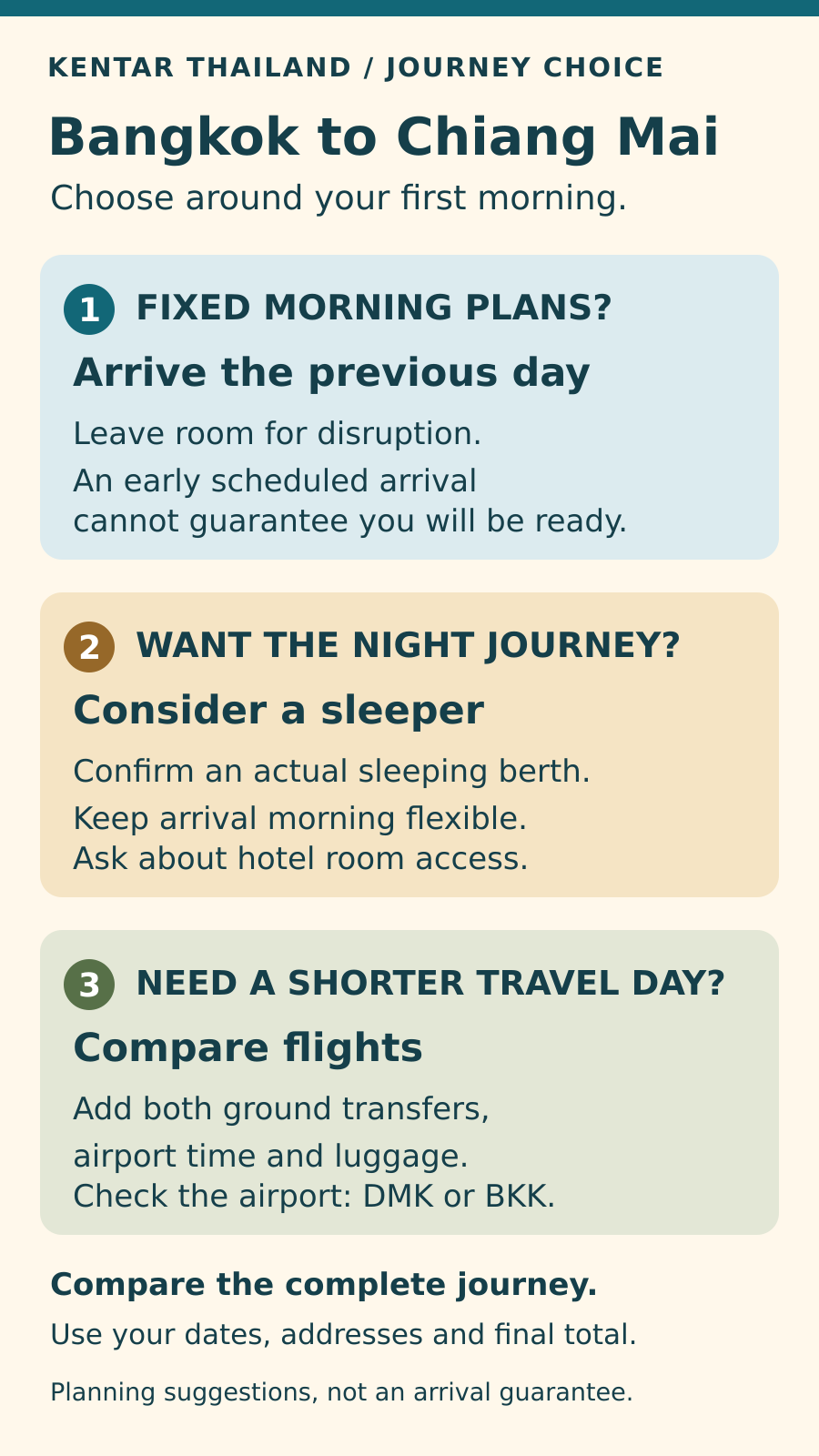
Choose a flight from Bangkok to Chiang Mai when a shorter travel day matters most. Choose a sleeper train when the overnight journey is part of the trip and you can keep the following morning flexible. The deciding question is often what you need to do after arrival, rather than which ticket looks cheapest.
This guide compares the journey from your Bangkok accommodation to your Chiang Mai accommodation. It focuses on time, sleep and the first day in Chiang Mai, using official service information checked on 11 October 2026. It is a choice guide, rather than a step-by-step booking tutorial.
The quick decision
- A short break with limited daytime: start by comparing flights, including the time needed at the airport and both transfers.
- An overnight rail journey you genuinely want: consider a sleeper, provided a suitable berth is available and the arrival morning can stay light.
- A fixed morning meeting, tour pickup or other costly commitment: plan to arrive the previous day and leave disruption room. Neither an early scheduled train arrival nor a morning flight guarantees that you will be ready on time.
- A light sleeper or someone who needs a proper room before functioning: favour a flight followed by a hotel night, or budget for a confirmed room arrangement after the train.
What the scheduled journeys actually look like
Sleeper train: evening departure, next-day arrival
The SRT official timetable, checked on 11 October 2026, showed these northbound examples from Bangkok’s Krung Thep Aphiwat station to Chiang Mai station:
- Train 9: 18:40 departure and 07:15 arrival the next day, a scheduled 12 hours 35 minutes.
- Train 13: 20:05 departure and 08:45 arrival the next day, a scheduled 12 hours 40 minutes.
These are general timetable examples, not a promise of seats, operation on your chosen date or punctual arrival. Check your exact date and service again before committing. The train journey also needs time on each side: reaching the departure station, finding the boarding area, leaving Chiang Mai station and getting to your accommodation.
Flight: a shorter scheduled leg, arriving the same day
As a dated example, AirAsia MOVE’s route offers displayed a Thai AirAsia flight for 31 October 2026, departing Suvarnabhumi (BKK) at 18:50 and arriving at Chiang Mai (CNX) at 20:10 the same day. That is a scheduled 1 hour 20 minutes. It is one observed offer, not a daily timetable or a held seat; recheck the flight details for your date.
Read the airport code on the selected flight. Bangkok searches and route pages can show more than one airport. Thai AirAsia’s 1 October 2026 announcement confirmed the resumption of its Suvarnabhumi (BKK) services, including Chiang Mai, alongside its Don Mueang operations. Do not choose a transfer based on the airline name alone.
All times above are local Thailand times. The flight and rail examples establish the difference between a same-day flight and an overnight journey; they are not a like-for-like fare comparison.
Compare door-to-door time, with your own allowances
Work backwards from the accommodation where you want to finish. A flight’s scheduled duration excludes getting to the airport, check-in and security, baggage collection and the final transfer. A train’s advertised duration similarly excludes the journeys to and from the stations.
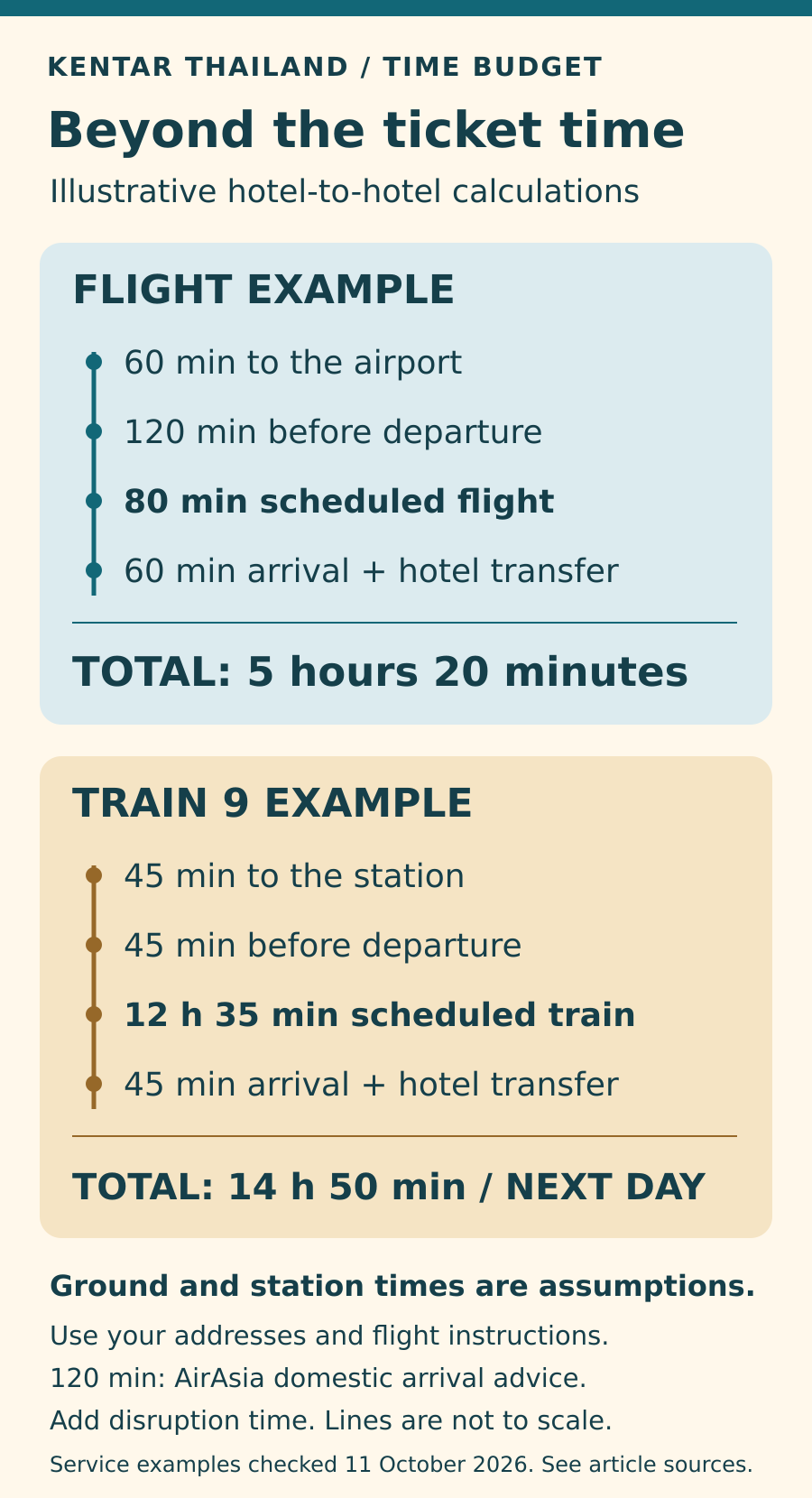
Here are two illustrative calculations. The ground-transfer and station allowances are assumptions for showing the method, not measured local journey times or recommended minimums.
- Flight example: 60 minutes to the Bangkok airport + 120 minutes before departure + the sampled 80-minute flight + 60 minutes for arrival procedures and the Chiang Mai hotel transfer = 5 hours 20 minutes.
- Train 9 example: 45 minutes to Krung Thep Aphiwat + 45 minutes before departure + the scheduled 12 hours 35 minutes on the train + 45 minutes to leave Chiang Mai station and reach the hotel = 14 hours 50 minutes, crossing into the next day.
The 120-minute airport allowance reflects AirAsia’s advice to reach the airport at least two hours before a domestic departure. That is an arrival recommendation, not the check-in or boarding deadline. Follow the instructions for your selected airline and flight, and allow more time when your circumstances require it.
Replace every other allowance with a realistic plan for your addresses, transport, luggage and mobility needs. Add disruption time separately. These examples are not connection advice for someone arriving on an international flight; that situation also depends on immigration, bags, terminals and whether the onward journey is protected.
When the sleeper earns its place in the itinerary
The sleeper makes sense when you want time aboard, would enjoy an evening departure and do not need to turn the scheduled arrival into an immediate sightseeing deadline. You can spend much of the preceding day in Bangkok, then use the night for the journey.
SRT’s Train 9/10 service guide shows air-conditioned first- and second-class sleepers. Its first-class diagram shows two berths per compartment; using a compartment alone requires a separate arrangement and additional payment. The second-class diagram shows upper and lower berths arranged along a shared aisle. Check what is available on the specific service before deciding that one option meets your privacy needs.
Choose the actual accommodation on the train with care. A reclining seat and a sleeping berth are different products. Before paying, confirm the class, berth position and the sleeping arrangement for every traveller; do not treat the word “overnight” as proof that a bed is included.
If an upper berth would be awkward to climb into, make a suitable lower berth or other confirmed arrangement a condition of choosing the train. If you need privacy, check exactly what your ticket buys and whether it covers the whole compartment. Ask SRT about assistance or equipment you depend on rather than inferring it from photographs of another service.
Be honest about sleep. A berth gives you somewhere to lie down, but movement, sound and an unfamiliar environment may affect your night. Plan a modest first morning: breakfast, a luggage arrangement and an easy activity that can move later if necessary.
When flying is the more useful choice
A flight is usually the more useful starting point for a tightly planned short trip because the scheduled intercity leg is much shorter. The benefit is strongest when the departure time fits your day and the airport transfer is straightforward from your actual starting point.
If your priority is being rested for something important the next morning, consider flying the day before and sleeping in Chiang Mai. An evening flight can be a reasonable alternative to a night on the train, but check hotel reception and transport arrangements for the scheduled arrival, then leave room for delays.
A low headline fare is less useful if it requires a difficult airport transfer or a baggage add-on you have not counted. Compare the complete journey that you would actually take.
Compare the final cost, including luggage and the night
There is no verified price winner in this guide. Compare live, one-way totals for the same travel date and the same travellers, then check what each total includes. An airline promotion and a different-date sleeper quote do not establish which option is cheaper for your trip.
- For the flight: include taxes and compulsory fees, the luggage you need, any seat option you actually want, airport transfers and the relevant change or cancellation conditions.
- For the train: price the selected class and berth, both station transfers, food or other extras you intend to buy, and the conditions attached to that ticket.
- For both: compare the nights of accommodation you will really pay for, including any confirmed early-arrival room arrangement.
For one concrete luggage example, AirAsia’s standard cabin policy allows two pieces with a combined weight of up to 7 kg. The larger cabin bag must fit within 56 × 36 × 23 cm, including handles, wheels and pockets; the smaller item within 40 × 30 × 10 cm. Check any checked-baggage allowance or purchased extra separately. These are AirAsia conditions, not rules for every airline.
Do not automatically count the sleeper as a full hotel-night saving. It only removes that expense if you truly would otherwise pay for a room. An early train arrival also does not establish early hotel check-in. Ask the property what it can confirm for room access and luggage storage, and include any charge before comparing totals.
A final check before choosing
- Name tomorrow’s first fixed commitment. If missing it would be costly, move the arrival earlier in the itinerary.
- Confirm the actual journey. Record the date, next-day arrival where applicable, train or flight, and exact station or airport.
- Choose for your sleep and luggage. Verify the berth or fare product that fits your needs, rather than pricing a product you would not use.
- Compare complete totals. Include transfers and accommodation arrangements, then keep some time uncommitted after arrival.
For a time-limited Chiang Mai visit, start with flights. For a journey you want to experience overnight, choose a suitable sleeper and give yourself an easy arrival morning. Let the first day in Chiang Mai decide which trade-off is worthwhile.
Information checked: 11 October 2026. Timetables, flight offers, baggage policies and operating arrangements can change. The service examples are scheduled information; the door-to-door totals and decision guide are editorial planning illustrations.