Choose between Ao Nang and Railay by tracing the journey all the way to your hotel reception. A boat ticket to “Railay” is not the same thing as a transfer to your room, and a beachfront photograph may show the opposite side of the property from its lobby.
For an arrival with little flexibility, start by comparing road-accessible Ao Nang hotels. Choose Railay when staying there is part of the point of the trip and you can confirm the boat, landing place and final luggage movement. This is an arrival-planning recommendation, not a claim that one base is better for everyone.
Start with the last part of the journey
Work backwards from reception rather than forwards from the airport. Ask the accommodation to identify its check-in entrance, the arrival landing it recommends and how you get between the two with your actual bags. Then choose the mainland meeting point and transport that connect to that landing.
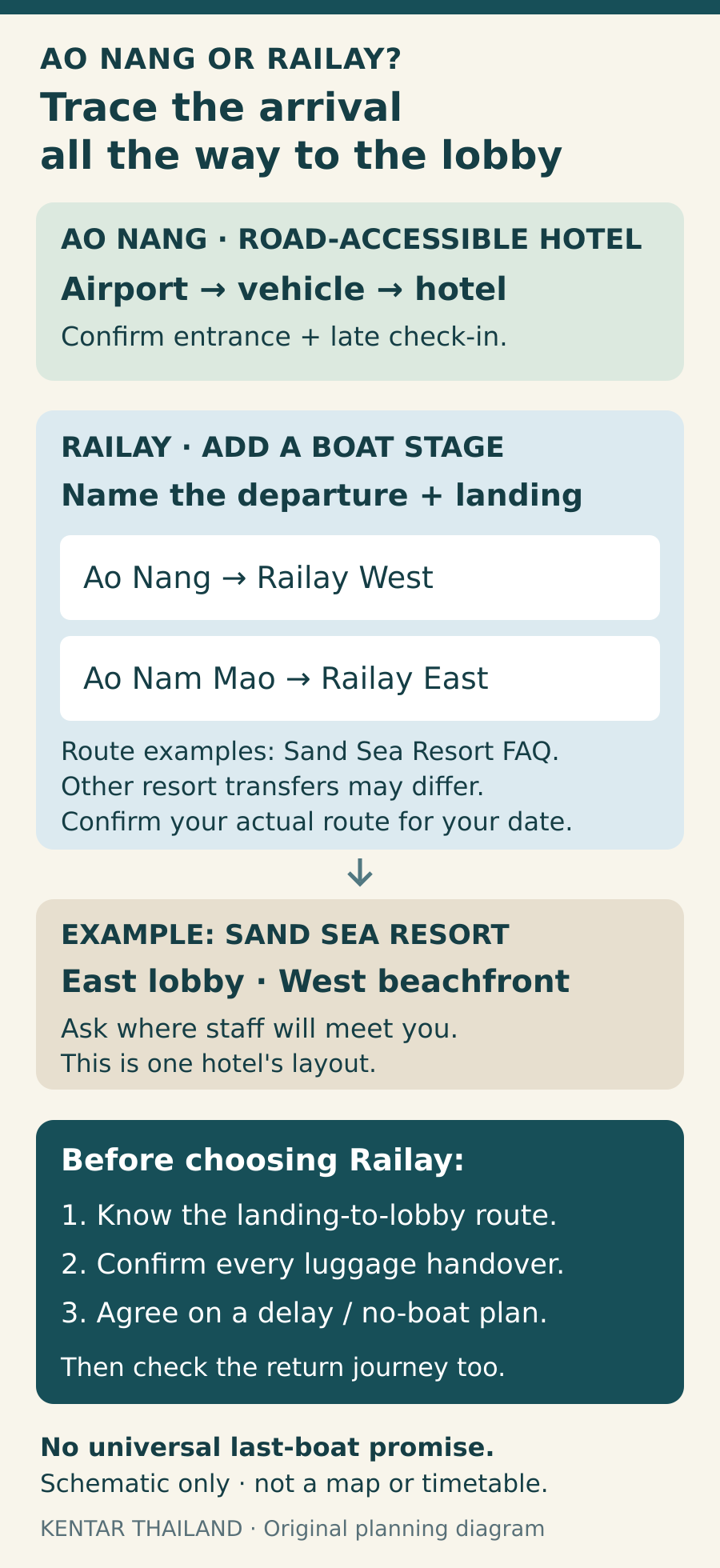
A road-accessible Ao Nang stay can keep this chain relatively simple: airport pickup, vehicle journey and hotel drop-off. As a concrete example, Centara Ao Nang Beach Resort’s operator fact page describes access from Krabi airport by road. That does not establish the entrance, walking route or transfer service for another hotel bearing an Ao Nang address.
Railay adds a boat stage. Do not compare only the driving time and the crossing time. Your real arrival includes collecting bags, finding the driver, reaching the correct departure point, any waiting, boarding, landing and reaching reception. A short crossing can still be one part of a tiring journey.
“Railay” is not a precise drop-off point
Sand Sea Resort’s FAQ describes boats from Ao Nang arriving at Railay West, while those from Ao Nam Mao arrive at Railay East. Treat those as different endpoints when discussing a transfer. Do not tell the driver only the hotel name and assume the boat connection will sort itself out.
Get both place names in the same written confirmation: the mainland departure point and the Railay landing. If someone proposes changing the departure point, ask whether the landing and hotel meeting arrangements change too. A replacement boat route is useful only when you also know how its final stage works.
The beachfront and the lobby can be on different sides
Sand Sea illustrates why this matters. Its FAQ places the beachfront facilities on Railay West but the lobby on the East side near the floating pier, with guest access through its grounds. It also describes luggage assistance at its mainland parking office when coordinating a private boat transfer. Those are that hotel’s arrangements, not services guaranteed to all Railay visitors.
The useful question is therefore not simply “Is this a West-side hotel?” Ask: “Which arrival point should I use for check-in, where will someone meet me, and how will my bags reach reception?” If your chosen room is in a different wing, ask about that last movement as well.
A resort transfer may use a different chain
Do not copy another property’s instructions. Rayavadee’s arrival guidance describes a car or van to its private Nong Nuch pier, followed by a resort boat. It requests advance arrival details, including at least 48 hours’ notice for guests booking through online travel agents, and explains that shared transfers can involve waiting. That is a specific resort procedure, not a general Railay departure point.
Railay Princess’s transfer page offers an airport van plus shared longtail arrangement via Ao Nam Mao and asks for booking at least a day ahead. It distinguishes limited shared departures from privately arranged boats. Confirm what it can provide for your date and flight; wording offering a private service does not establish an unconditional late-night arrival guarantee.
These examples show why the room booking and the arrival booking should be treated as two separate confirmations. A reservation number does not tell you that a driver is waiting, that the boat has been arranged or that your delay contact has your phone number.
Read a transfer quote from door to door
Before accepting a quote, turn it into a short sequence you can follow while tired. Keep the reply offline with your booking details.
- Pickup: the meeting point after baggage collection, the driver’s identification and the contact to use if you cannot find them.
- Mainland handover: the named pier, beach or hotel office; who takes you from the vehicle to the boat; and whether there is a wait.
- Boat and landing: whether the service is shared or private, its confirmed departure arrangement, and the expected East, West or resort-specific arrival point.
- Landing to lobby: where hotel staff meet you, which entrance you use and whether the route includes sand, steps, slopes or a further vehicle movement.
- Bags and price: which stages include assistance, how many bags are covered, any charges outside the quote and what happens if the agreed arrival plan changes.
If the reply stops at “drop-off at Railay,” the final stage is still unresolved. Ask for the actual meeting landmark and route to reception rather than estimating it from a booking-site distance.
A suitcase is a handling question, not an automatic veto
Large luggage does not by itself decide the base. The important issue is whether you can manage each handover, or have confirmed help for it. A bag that rolls easily through an airport may be awkward if the confirmed route includes sand or boarding steps.
Tell the accommodation the number and approximate size of your bags. Ask how you and the bags board and disembark at the expected tide, whether the landing is at a pier or beach, and what changes if conditions alter the usual route. Keep essentials and electronics in a small protected bag you can carry yourself.
For a wheelchair, limited mobility or an inability to lift luggage, ask for a description or recent photos of every transfer stage. “Near the pier” and “staff can help” do not establish a step-free route or suitable boarding. Make the booking decision from the specific response, including any room-access obstacles.
Late arrival: agree on the fallback before flying
A flight’s scheduled landing time is not your boat-ready time. Build the discussion around being ready after airport formalities and baggage collection, then the road transfer and handover. Give the accommodation your flight details and ask which arrival plan it can actually accept.
Do not rely on an unsourced last-boat time. Shared departures, hotel boats and private arrangements are different products, and a published schedule is not a promise for a delayed arrival. This guide deliberately gives no universal boat cut-off or after-dark guarantee.
Agree on three things: whom to contact when delayed, the latest point at which the plan must be changed, and what happens if the boat cannot operate. Ask whether the response is another confirmed transfer arrangement or an overnight stay on the mainland. Also establish how transfer charges and the first hotel night are handled; do not assume either will be refunded.
If nobody can confirm a workable late-arrival chain, a road-accessible Ao Nang first night is a practical option to compare. It removes the boat stage from that evening, but still requires a confirmed vehicle, suitable drop-off and late check-in. Do not travel to a pier merely hoping someone will be there.
Make the return plan before choosing your last night
Reverse the same chain for departure: room, luggage collection, hotel meeting point, boat, mainland vehicle and airport. Confirm the departure landing and vehicle meeting point separately; do not assume they duplicate your arrival.
For an early flight, ask the hotel to assess the connection against the airline’s required airport arrival time. Leave room for each handover, not just the crossing. If the connection depends on an unconfirmed boat, compare moving to a road-accessible hotel the previous day. That adds a hotel change, so weigh it against the consequence of missing the flight.
The booking decision in six checks
- Choose a road-accessible Ao Nang hotel when reducing arrival stages matters most, once the vehicle drop-off and check-in are confirmed.
- Choose Railay when you want to stay there and can name the departure point, landing, lobby route and people handling the transfer.
- Resolve the bags by checking each handover, including the final walk and the route to your room.
- Resolve a delay with a working contact, a decision point and an agreed mainland fallback if needed.
- Check the total for both directions, including private arrangements or assistance you have requested.
- Check departure separately before committing to a boat-dependent final night ahead of a flight.
Once those answers fit your trip, the base choice becomes clearer. You are choosing an arrival and departure you can manage, as well as the place where you want to wake up.
Information checked: 11 October 2026. Hotel examples explain published arrival arrangements and are not inspected-property recommendations. Routes, services and operating conditions can change. Confirm your exact transfer, luggage requirements and hotel access directly before travel.