A Chiang Rai day trip from Chiang Mai can work if you want a focused visit, have both journeys arranged and are comfortable with a long travel day. Choose an overnight stay if you want an evening in Chiang Rai, several unhurried visits or more breathing room when transport runs late.
The useful question is how much time remains after arrival. A bus ticket gets you between terminals; your sightseeing day also needs local transport, food, waiting and a return margin. This guide helps you make that calculation before committing to either plan.
How long does the Chiang Mai–Chiang Rai bus take?
Use the duration shown for your selected service. An official FairFair search checked on 11 October 2026 for Sunday, 18 October 2026 displayed these examples:
- Chiang Mai to Chiang Rai: 07:00–10:45, scheduled for 3 hours 45 minutes; 07:30–10:50, scheduled for 3 hours 20 minutes.
- Chiang Rai to Chiang Mai: 16:00–19:45 and 18:00–21:45, each scheduled for 3 hours 45 minutes; 18:30–21:50, scheduled for 3 hours 20 minutes.
The searches showed Chiang Mai Bus Terminal 3 (Arcade) and Chiang Rai Bus Terminal 1 in the respective directions. These are dated timetable examples, not a complete list, reserved seats or a promise of actual arrival times. Search both directions for your own date.
Greenbus’s route guidance, dated 9 October 2026, also identifies Terminal 3 (Arcade) and Terminal 1 as the endpoints of its linked search. Confirm the exact boarding and arrival points on your chosen service and ticket. Do not route yourself simply to “the bus station.”
For a return day trip, add the duration of each selected bus, then add the time from your Chiang Mai accommodation to the terminal and back. The Chiang Rai leg needs its own local transfers. A departure time is the time the bus leaves, so hotel pickup or leaving your room must come earlier.
Count the time you can actually use in Chiang Rai
Start with the interval between your scheduled arrival in Chiang Rai and your return bus’s departure. Then subtract everything that is necessary but is not a visit:
- Travel from the arrival terminal to your first stop, between stops and back to the correct departure terminal
- A proper meal and any rest you need
- The operator’s boarding requirements, plus time to find your platform
- A contingency for a delayed inbound bus or slower local travel
The remainder is a planning allowance for visits. Check that each venue is open during the part of the day you intend to use. An hour after a museum closes cannot replace an hour inside it.
A worked example, not a timetable
Imagine that your selected bus is scheduled to arrive at 10:30 and your return departs at 18:00. That leaves 7 hours 30 minutes between buses. Reserve 60 minutes for local travel, 45 minutes for lunch, 30 minutes for boarding and 45 minutes for delay contingency. Those allowances total 3 hours, leaving 4 hours 30 minutes for visits.
All six figures are illustrative inputs. The 30-minute boarding allowance is an editorial example, not a Greenbus rule; follow your ticket’s instructions and allow more when necessary. Local travel can require much more than 60 minutes if your stops are spread out. Replace the inputs with your actual services, transport plan and pace before deciding.
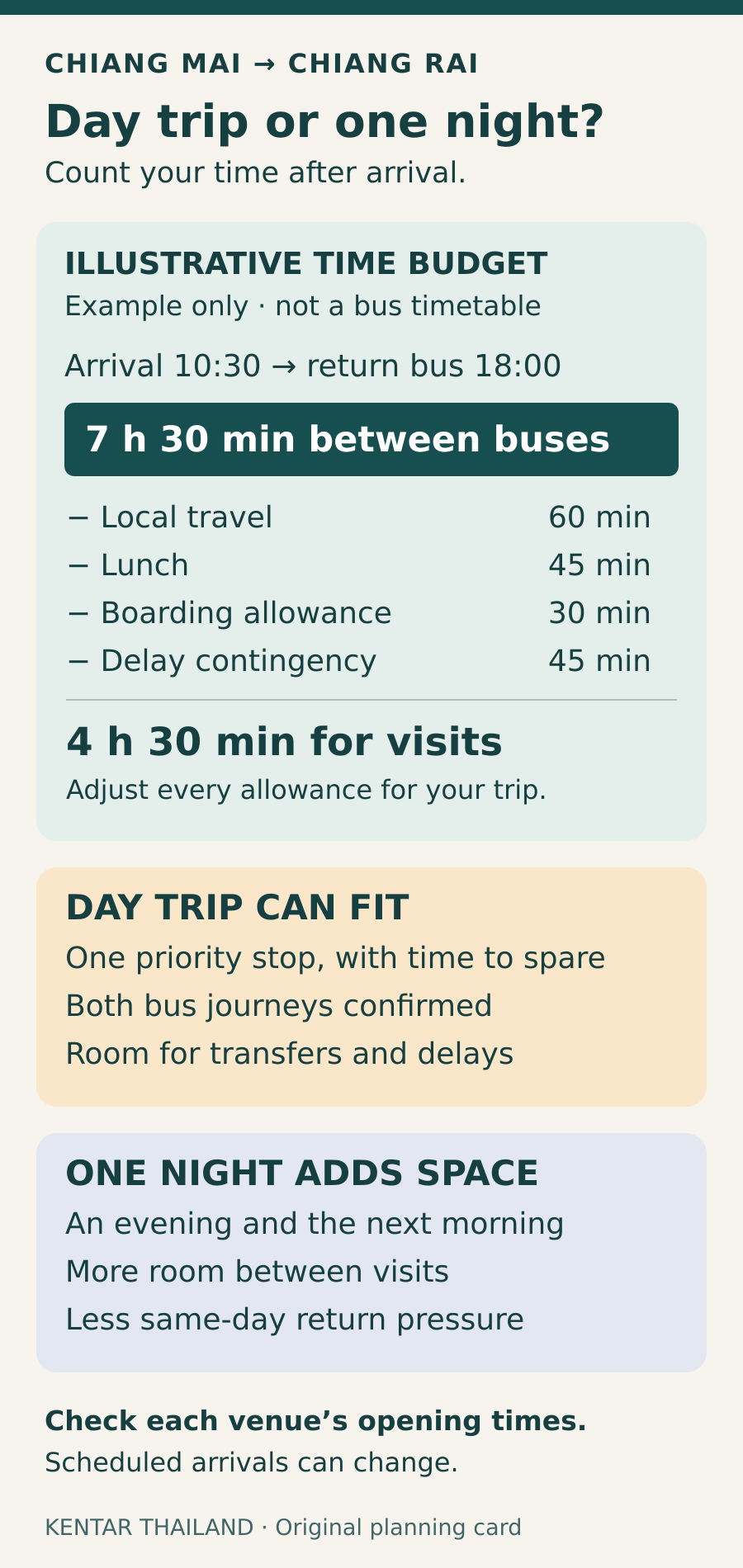
Try one stress test: what happens if your arrival is an hour later? In this example, the 45-minute contingency absorbs part of that delay; preserving the other allowances leaves 4 hours 15 minutes for visits. If the reduced plan no longer fits, remove a stop or stay overnight. Do not recover the time by spending your return-boarding margin.
When a day trip is a reasonable choice
A same-day visit suits a short, deliberate plan. Choose one essential experience, arrange how you will reach it, and treat anything else as optional. The plan is stronger when all of the following are true:
- You have checked and secured a suitable outward and return service, rather than assuming a later bus will have a seat.
- Your first choice fits comfortably inside the usable window, including its opening and last-entry times.
- You know how you will get back to the departure terminal from the final stop.
- You can accept an early start or late return without placing a tight flight connection or another fixed commitment afterward.
If keeping the same Chiang Mai hotel is your priority, compare an organised day trip or a private car on a door-to-door basis. Ask for the pickup area, expected return window, driving and break time, included stops and how long you get at each. A longer list of attractions only helps if you actually want that pace. Do not apply the scheduled-bus examples above to a tour or car journey.
What one night changes
Staying overnight separates the two intercity journeys. You can use the arrival day for a modest plan, have dinner without a same-evening bus deadline, and put your most important visit in the following morning. Your return service still sets a limit on day two.
One night is especially useful if you want to linger over meals, prefer a later start from Chiang Mai, need frequent breaks or have several places that matter equally. It also makes the plan less dependent on the inbound bus reaching Chiang Rai at precisely its scheduled time.
There is a trade-off: changing accommodation takes time. Before booking, check whether the hotel can store luggage before check-in or after checkout, where it is relative to your chosen terminal, and how you will reach the first stop. Do not count a full day of sightseeing on both sides of a one-night stay; calculate the arrival afternoon and departure morning separately.
A practical decision for a short northern Thailand stay
- Write down the one thing you most want from Chiang Rai. If you cannot name a priority, consider keeping the day in Chiang Mai rather than spending it on a rushed transfer.
- Search the two directions for your real dates. Record departure, scheduled arrival and exact terminal names. Calculate your full day away from the hotel, not just time on the bus.
- Build the usable window. Deduct local travel, meals and realistic margins. Check venue hours against the remaining time.
- Choose the arrangement that still works after a delay. A day trip with one satisfying visit can be better than an overloaded overnight stop; a night with a relaxed morning can be better than watching the clock all afternoon.
If you are continuing elsewhere after Chiang Rai, compare that onward route before committing to a return to Chiang Mai. An overnight stop may fit the wider trip better, but onward transport and baggage arrangements need their own confirmation.
Before booking
FairFair’s Chiang Mai–Chiang Rai guide publishes different departures by direction and day of the week. It says advance sales can open up to 30 days ahead, depending on the services released. Use the live date search to see what is actually offered; the general timetable is not a seat reservation.
Check the date after opening a booking link. Greenbus warns that a link without a travel date can default to today. Review the selected stops, service details, ticket conditions and final total before paying. Price displays and optional extras need checking for your own booking, so this article does not quote a fixed fare.
Quick answers
Can I do Chiang Rai as a day trip by public bus?
Potentially, if the services on your date leave a useful window after all transfers and margins. Confirm both directions first and keep the visit focused. The timetable alone cannot guarantee that a particular sightseeing plan will fit.
Is one night enough?
It can be enough for a focused arrival-day visit and a second plan the next morning. The value depends on when you arrive and leave. Arriving late and taking an early return bus provides much less usable time.
Should I book the hotel or the bus first?
Check that the transport and accommodation can work together before committing to either. Pay particular attention to hotel check-in arrangements if arriving late, and compare cancellation terms if you have not yet secured both parts.
Information checked: 11 October 2026. Timetable examples are scheduled services observed on that date, not actual arrival records. Recheck your travel date, ticket details and venue access before travelling.