Doi Tung is in Chiang Rai province. For a first visit, combine a public visitor site and a coffee stop. If learning about coffee production is your priority, arrange that experience separately before travelling. A café order, a garden ticket and permission to enter a production area are different things.
This guide helps you choose the right kind of visit and ask better questions about the people behind the products. It is based on published sources checked on 10 October 2026, rather than a firsthand tour.
Choose the experience before the itinerary
Public visitor sites: an introduction to the project
DoiTung’s official tourism page lists the Royal Villa, Mae Fah Luang Garden, Hall of Inspiration and Mae Fah Luang Arboretum at Doi Chang Moob. The Hall introduces the Mahidol family’s development work; the Villa was the Princess Mother’s residence. The garden and arboretum offer different plant settings.
For this article’s people-and-production theme, choose the Villa as your starting point, then carry one question from the visit to your coffee stop. Before adding the Hall of Inspiration, confirm current visitor access: a foundation notice effective 21 February 2023 reported a renovation closure, and no reopening notice was verified for this article.
These are editorial suggestions, not a guided route. Buying admission does not establish access to a plantation, processing facility or working craft studio.
Coffee and shopping: taste a product, then investigate it
The brand lists roasted coffee and drip products among its coffee range. Its café introduction identifies Arabica varieties including Catimor, Caturra and Catuai. That is background for reading a packet, not proof of the beans in a particular cup: ask about the item actually available.
A purchased drink can be your own small tasting exercise. If the menu allows, choose a preparation without added flavours, note what you notice, then ask which beans were used. A staffed cupping, comparative tasting or explanation by a producer needs its own confirmation; an ordinary café order does not promise any of those services.
Arranged learning: ask about eligibility and the actual programme
In its 22 September 2026 announcement, the Mae Fah Luang Foundation describes Living University programmes involving field visits, discussions with practitioners and community members, and tailored sustainability learning. The announcement primarily addresses organisations. It does not advertise a daily drop-in coffee-farm tour for individual travellers.
For programme enquiries, it names the Sustainable Living Academy: 053-767-015-7, extension 23700, or klc@doitung.org. Ask whether your group size and interests can be accommodated, what dates are possible and whether English-language interpretation is available. An enquiry is not a reservation.
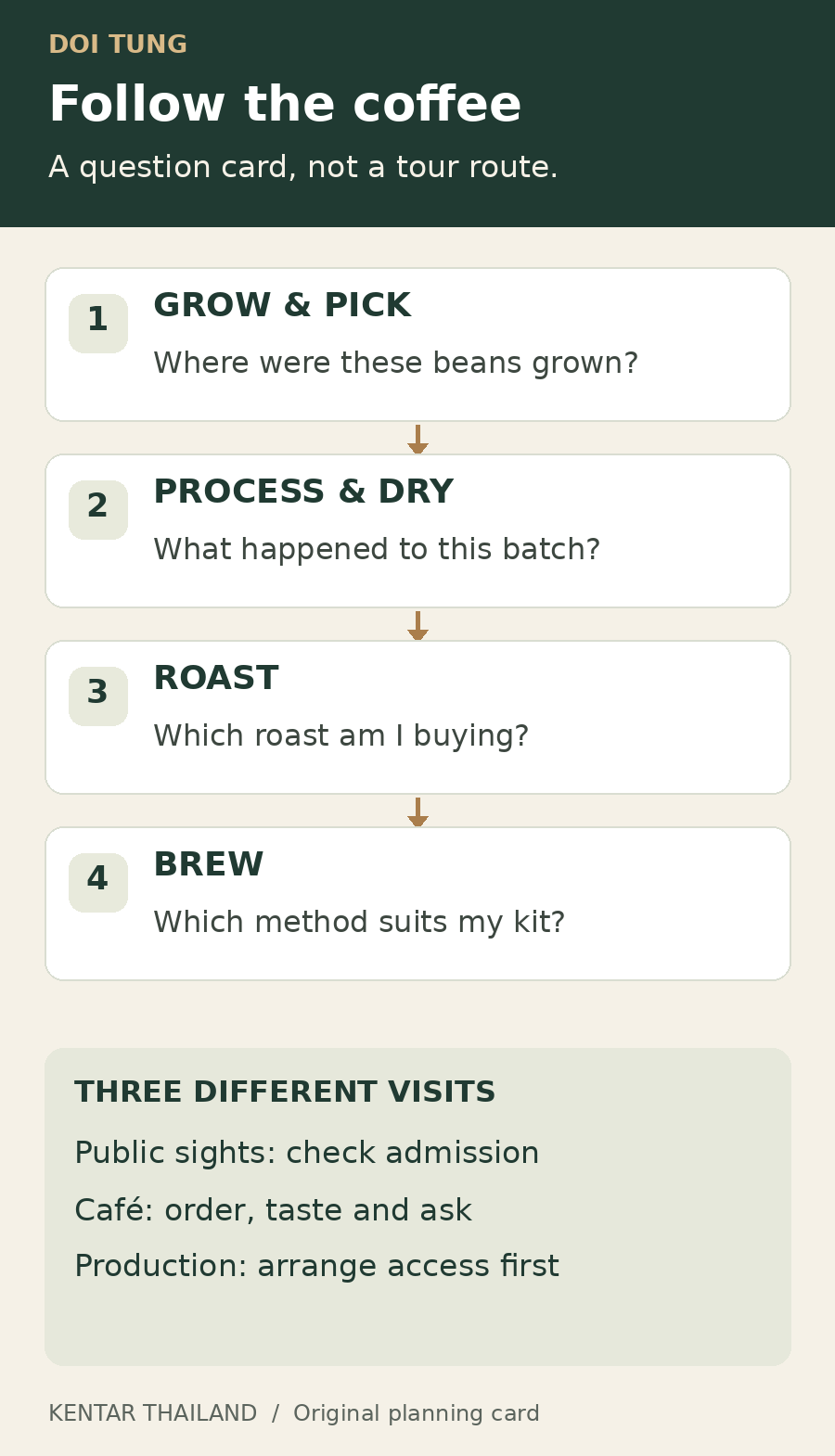
Follow the coffee with four specific questions
You do not need to watch every production stage to learn something useful. Start with the bag or drink in front of you, and distinguish a label, a staff explanation and something you have actually observed.
- Growing and picking: “Where were these beans grown?” Ask for the origin of this product, rather than assuming the café location is its origin. If a farm visit matters to you, ask who hosts it and which growing area is included. Do not choose travel dates around an assumed harvest season.
- Processing and drying: “What process is named for this batch?” If the label gives a processing method, ask what it involved and where it took place. For a proposed visit, establish whether you would see work happening, an explanation with equipment, or a display. Those are different experiences.
- Roasting: “Which roast and batch am I buying?” Compare the product name and date information on the packet with the coffee you tried. If you want to recreate that cup at home, ask whether the retail packet is the same coffee, rather than simply choosing the same brand.
- Brewing: “Which preparation suits what I have at home?” Say whether you need whole beans, ground coffee or individual drip portions. Ask about the grind or brewing instructions for that exact product. A small, usable purchase is more helpful than a large bag you cannot prepare.
Keep your notes modest: product, origin stated, process stated, roast or date information, and one thing you tasted. Leave unknown fields blank. A tasting note is your impression; it does not verify a farm’s employment conditions or environmental performance.
Look beyond the coffee cup
DoiTung’s handicraft description includes handwoven textiles, mulberry paper and ceramics. One useful production detail is its account of using coffee residue, macadamia leaves and yarn scraps as decorative elements in Thai-style mulberry paper. Ask whether an item you are considering uses those materials; the description does not apply automatically to every product.
For a craft you genuinely like, ask who makes it, which stages are carried out locally and how it should be cared for. If you want to meet a maker, ask for an arranged opportunity rather than interrupting work or entering a workshop uninvited. Request permission before photographing people, their workstations or demonstrations.
What the project’s impact claims tell you
Coffee is one part of Doi Tung’s wider development programme. UNODC’s 2023 practical guide discusses Doi Tung as a case combining reforestation, land-use planning and alternative livelihoods, including shade-grown coffee and macadamia farming. Its discussion places production within a wider development approach. It is not a certification of every product, and the accompanying land-use graphic draws on foundation information.
The foundation’s 2025 annual report, page 21, reports more than 1,500 formal jobs annually and income for over 2,500 local households across DoiTung’s activities. These are the organisation’s reported aggregate outcomes. They do not tell you how much of one café bill reaches a grower.
If impact is a major reason for your visit, a useful question is: “Which people and activities does this programme support, and where can I read how that is measured?” Keep the answer attached to the specific programme, date and evidence. Buying something you value and learning how it is made is a reasonable starting point; avoid turning it into an unsupported promise about each purchase.
Use this enquiry card for a production-focused visit
Send the organiser your proposed date, number of visitors, preferred language and main interest. Then ask:
- Access: Which exact sites are included, and who has agreed to host us? Is any plantation or production-area entry included?
- Activity: Will we observe current work, join an activity, taste products or attend a discussion? What is the alternative if production is not running?
- People: Who explains the work? Is interpretation included, and may we ask questions directly?
- Practicalities: What are the meeting point, duration, walking surfaces, steps and shelter? Can the programme accommodate our specific access needs?
- Booking: What are the total price, minimum group size, payment deadline and cancellation terms? Which transport, meals, materials or take-home products are included?
Save a written reply before arranging a day around it. If the answer is only that public attractions are open, keep the plan to those attractions and a coffee stop. Do not treat it as confirmation of a behind-the-scenes visit.
Opening hours and the journey: what to settle before leaving
An official foundation notice changed Doi Tung tourism-site hours to 08:00–17:00 from 1 March 2025. Use that as the published general schedule, not a last-entry time or confirmation that every facility follows identical hours. Check the particular sites, current charges and any closure for your date.
The foundation’s contact page lists the Doi Tung Development Project on 053-767-015-7 within Thailand. For an international call, dial +66 53 767 015, +66 53 767 016 or +66 53 767 017. Use the programme extension above for learning enquiries.
Give your driver the exact confirmed meeting point, not just “Doi Tung”. Agree the return pickup and waiting arrangement before setting off. If a session is booked, plan around its start time; otherwise, keep the day flexible enough to spend longer at one public site or finish after coffee. Ask about the current road approach rather than relying on an old tour’s driving time.
If buying coffee, food or crafts to take abroad, use our souvenir checks before paying. Permission to visit or buy locally does not settle the rules at your destination.
Source check: 10 October 2026. No current public booking inventory, farm-access entitlement, harvest timetable or standard coffee-workshop price was verified. Confirm a specific programme directly; the questions and visit sequence above are editorial planning aids.