Information checked on 10 October 2026. This is an interpretation and observation guide. It does not confirm current trail access, a permitted return route or admission fees.
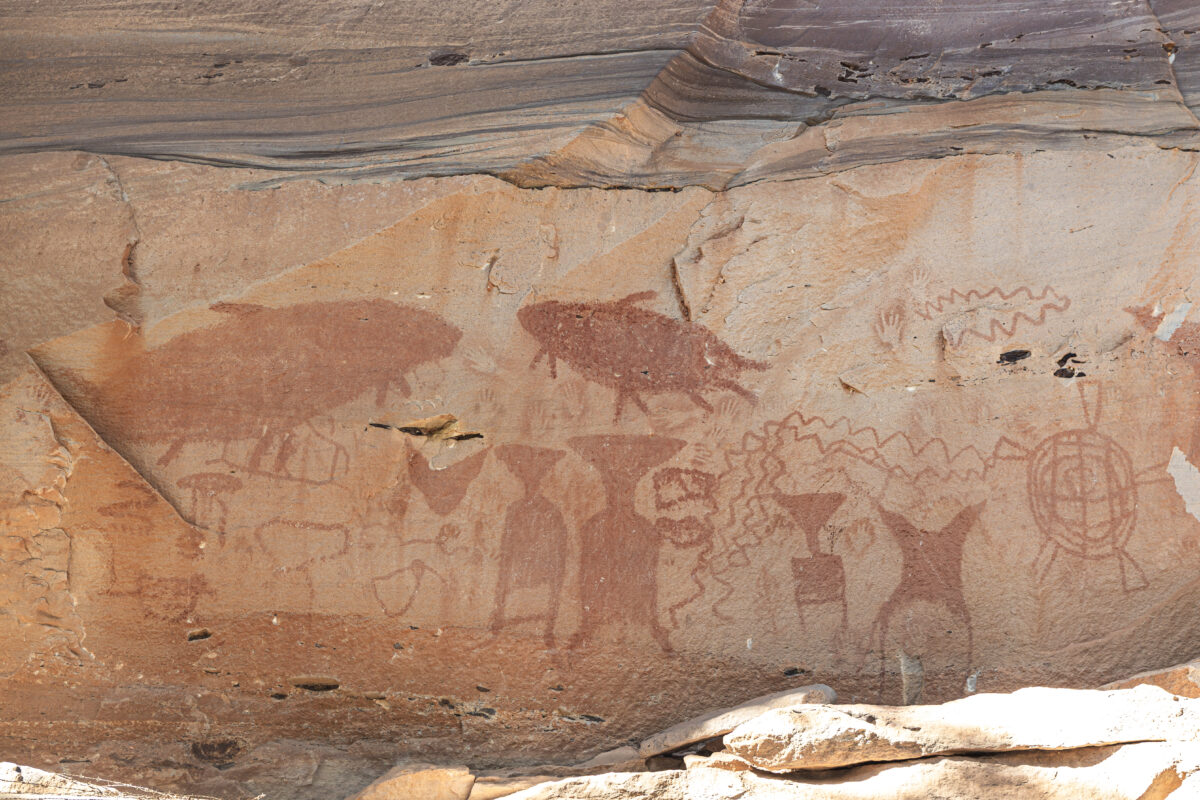

Begin with what you can see
A useful rock-art visit starts with a small question rather than a race to identify every figure. Choose one shape. Describe its outline and position before deciding what it means. Then compare your description with an on-site interpretation panel, if one is available.
The Sirindhorn Anthropology Centre record, created in 2016 and reviewed for this guide on 10 October 2026, distinguishes four named groups: Pha Kham, Pha Taem, Pha Mon Noi and Pha Mon. These are group names, not proof that all four are currently reachable. Its interpretations include possibilities rather than a single certain account of what every image meant.
Use two separate notes: “I can see…” and “The interpretation suggests…”. If a sign identifies an animal but you cannot make out the feature yourself, record both honestly. You do not need to turn an uncertain outline into a confident identification.
Compare the way an image was made
The Anthropology Centre's Thai description of Pha Kham records fish with internal details, described as an X-ray style. “X-ray” describes the visual convention; it does not mean the artists used imaging equipment.
Try this observation sequence:
- Find the outer edge. Can you follow it, or does it disappear?
- Look inside that edge. Is the area filled with colour, left open, or divided by lines?
- Compare a second figure without assuming that both used the same technique.
- Leave unclear marks unidentified. A faint patch is not a puzzle you must solve.
You can use the same sequence with an official photograph viewed beforehand. Keep a note of whether you observed the original, a sign, or an online reproduction; those are different kinds of evidence.
Do not confuse painted marks with worked rock
The Anthropology Centre's Thai record of the Pha Taem group describes colour and grooves worked into stone. Its discussion covers people, animals, objects, symbols and hands, including filled silhouettes, outlines and several ways of making hand marks.
That gives you another question to take to the interpretation panel: does the explanation identify pigment on the surface, a mark worked into the surface, or both? Do not test this by touching, rubbing, wetting or tracing the rock. If you cannot distinguish a technique from the permitted viewing position, write “unclear from here”.
An observation card you can actually use
Select one subject rather than trying to make a complete inventory.
- Group name shown on the sign:
- What I can directly distinguish:
- Outer edge: continuous / broken / unclear
- Interior: solid / lines / open / unclear
- Position relative to a neighbouring mark:
- The sign's interpretation:
- Words of uncertainty used by the sign:
- A question I would like to check later:
Leave blanks when a feature is not visible. A blank is more useful than an invented detail. If photography is permitted at the place you are viewing, record the sign as well as the image so you can keep the explanation attached to its source. Follow local photography restrictions. Before publishing a photograph of an interpretation panel or reusing someone else's image, check the relevant reuse rights.
Keep your own description separate from a story
Compare these two kinds of note:
- Observation: “A line extends from the figure toward another shape.”
- Interpretation: “The panel proposes a hunting scene.”
These are invented examples of note-taking, not descriptions of a verified panel arrangement. The second sentence needs an actual interpretation source. If you write a caption later, do not quietly remove “proposes” or add an identity, date or ritual meaning that your source does not establish.
A good visit does not require a definite answer to every question. Your useful takeaway might be one technique you can recognise, one interpretation you can attribute, and one uncertainty you have kept open.
Check the walk separately
Before making a journey specifically for the paintings, confirm which groups can currently be visited, whether you may retrace the access path, where the return route ends, and any restrictions for your intended date. Do not turn distances between groups in an older description into a complete return-walk distance. If the current route is unclear, keep the observation card for later or use it with the linked official record instead.