Before paying for a flight with a baby, settle three practical questions: how the infant will be booked and seated, which bags and equipment your fare covers, and where the stroller will leave and return to you. Put the answers against each flight, including the return journey. A confirmation for one airline or aircraft may leave the next leg unresolved.
Start with the operating airline shown on the booking, then check the route, travel dates and cabin. If an airline change would undo the seating or equipment arrangements, resolve those arrangements before choosing an inflexible fare. This guide gives you a booking question sheet and an airport handoff plan. It does not advise on whether a baby is medically ready to fly or on feeding, medicines or child-restraint installation.
Information checked on 8 October 2026, Bangkok time. Airline pages can change; the examples below explain what to check rather than certify a particular booking.

Make one record for each flight
Write the operating airline, flight number, airports, date and booked cabin on separate lines. Include any domestic connection and the flight home. If the seller and operating airline differ, ask the seller to record the request and the operator to confirm that it can provide the arrangement.
Use three status labels: “question sent,” “request recorded” and “confirmed for this flight.” A request in a booking note is useful, but it leaves a different planning problem from an allocated seat or accepted equipment item. Save the actual answer privately with the booking, including its date and any conditions.
For an itinerary with two airlines, keep enough flexibility to handle different answers. For example, you might be allowed to take a compact stroller into one aircraft cabin but need to check it on the next leg. Plan how the adults will manage the baby and remaining bags during the stretch without it. Do not make a short connection depend on the stroller being returned at the aircraft door.
Check the age rule before comparing fares
Ask the operating carrier how it defines an infant, its minimum travel age, and how it handles a birthday between the outward and return flights. Confirm whether each infant must be attached to a particular adult and whether your planned adult-to-infant arrangement is accepted. Request the full price, including any infant charge and any separate seat you are considering.
Published airline examples show why copying another family's rule is unreliable:
- Bangkok Airways' infant page describes its infant category as starting at seven days and extending to 24 months. Confirm the exact birthday boundary and ticket arrangement for every travel date.
- THAI's infant page says infants under 14 days cannot travel. It also gives route and size limits for bassinets. Eligibility for carriage and eligibility for a bassinet are separate checks.
These are carrier policy examples, not health recommendations. If a carrier's minimum age is met, that alone does not answer a medical question. Keep any such question with an appropriate healthcare professional rather than relying on a travel checklist.
Separate the ticket, seat, bassinet and restraint decisions
A useful seating request describes what you actually want. “Travelling with a baby” leaves too much unstated. Ask about the following items individually:
| Decision | Question to settle before relying on it |
|---|---|
| Infant ticket | Is the infant correctly included on every flight and linked to the accompanying adult? |
| Separate seat | Can I book the proposed arrangement, at what fare, and in which seats? |
| Child restraint | Will this exact make, model and approval label be accepted on this flight and seat? |
| Bassinet | Is the service offered on this route and aircraft, and how is availability confirmed? |
| Family seating | Which seats are actually assigned, and what should I do if the aircraft changes? |
Ask for the carrier's approved-restraint instructions before buying or bringing equipment specifically for cabin use. Transporting a car seat as baggage does not establish permission to install it on an aircraft seat. Follow the carrier's and manufacturer's instructions; this article does not supply an installation method or a substitute restraint recommendation.
THAI's published bassinet criteria are under six months, under 10 kg and no longer than 67 cm. The page excludes domestic Thailand flights and routes to or from Cambodia, Laos, Myanmar, Vietnam and Malaysia from the service. Check the actual booking even when the listed criteria fit. The same page contains differing statements concerning lap infants in Boeing 787-9 business class, including a note about particular cabin versions. If that is your planned cabin, obtain a flight-specific answer from THAI before paying instead of choosing between the passages yourself.
If an important seating question remains unresolved, compare a different flight or cabin whose arrangement the operator can confirm. A cheaper fare can be poor value when it requires you to abandon the equipment or seat plan you intended to use.
Budget for bags and equipment separately
List each piece you plan to bring: adult cabin bag, everyday baby supplies, stroller, car seat and checked suitcase. Record whether it uses a normal allowance, has a separate equipment exemption or requires payment. Measure the stroller folded in its travel configuration, with any cover you intend to use.
Bangkok Airways' baggage page lists a 10 kg infant checked allowance in Economy and Blue Ribbon classes. Its cabin-baggage table includes an infant occupying a seat and excludes an infant without one. Confirm the aircraft limits and your ticket rather than assuming every baby has an extra cabin bag.
AirAsia's cabin-baggage advisory, dated 8 August 2024, says children below two have no cabin allowance and that a foldable stroller must meet its cabin-baggage policy to be taken into the cabin. This older advisory illustrates what to verify; it does not establish your 2026 booking allowance. Read the current policy for the actual AirAsia operating carrier and your purchased allowance. “Compact” in a product advertisement is not airline approval.
Bangkok Airways' stroller page likewise makes cabin carriage conditional on meeting the permitted size. Ask whether the stroller counts toward your allowed pieces and weight, whether it must be checked if cabin storage is unavailable, and what happens to any accessories. Keep the written answer with the measurements.
This is the point to compare the full cost of two flights. Add required checked baggage, equipment charges and seat costs to the fare before deciding. Leave airport liquid and security-screening checks on a separate packing list so baggage entitlement does not get mistaken for screening approval.
Verify documents for the actual journey
Check the carrier's document page and the official entry or transit requirements for the countries on your itinerary. Ask separately about a domestic Thai flight and an international flight; do not transfer a domestic identification rule to an international journey.
Bangkok Airways' travel-document guidance distinguishes international requirements from domestic rules and separates Thai and foreign passengers. It directs international passengers to check the requirements of departure, transit, transfer and destination countries. Use the rule for the infant's own nationality and journey.
Confirm which originals are required, their validity, and whether permission or relationship documents apply to the adults travelling. A different surname, one accompanying parent or another guardian can raise questions that a generic packing list cannot settle. Ask the relevant border authority or embassy as well as the airline where necessary. Do not treat a birth certificate or a phone photograph as a universal substitute for a travel document.
Keep documents in the responsible adult's accessible bag. This article's worksheet needs only “verified” or “still to check”; it does not ask you to record the baby's name, birth date, passport number or document images.
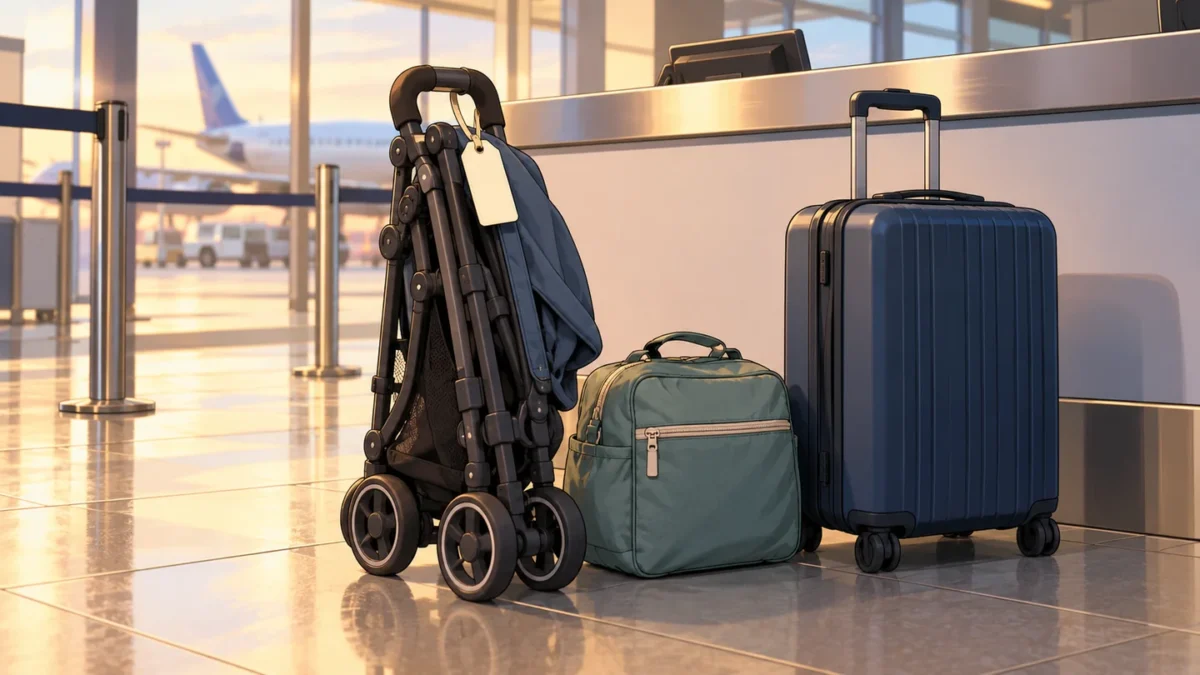
Plan the stroller handoff from departure to arrival
At home, rehearse folding and carrying the stroller while another adult manages the other bags, if two adults are travelling. If travelling alone, reduce the number of separate items you must handle and ask the airline what assistance is available. Avoid relying on an unconfirmed service.
At check-in, ask staff to confirm all of these points:
- Where the stroller must be handed over: check-in, gate or another designated point
- Whether it needs a tag even if you keep using it to the gate
- How it should be folded and packed
- Where it is expected to be returned at the arrival airport
- Whether a connection requires collecting it and checking it again
Before handoff, remove the items you need during the flight and keep the claim tag. An adult's accessible bag should still be manageable when the stroller is gone. Take a private photograph of the equipment's condition if useful for identifying it later, without including the child or travel documents.
At the gate, ask whether the return location has changed. Follow staff instructions for the actual boarding arrangement. A bus gate, stairs or a changed aircraft can make a previous plan less useful, so be ready to carry the folded equipment to the point staff identify.
On arrival, ask staff where to collect the stroller before leaving the relevant area. If it does not appear where advised, show the tag to the airline's baggage team and ask for the next step. If it is missing or damaged, ask how to make a report and retain the reference and instructions. Do not assume that buying a protective bag guarantees compensation.
A worked planning example
Imagine a family booking an international arrival followed by a domestic flight on a different airline. The international airline records a bassinet request. The domestic airline accepts a stroller for transport but has not confirmed cabin carriage or the collection point.
The useful next step is to finish the second airline's equipment check and plan the connection without relying on either a bassinet allocation or aircraft-door stroller return. The family can then decide whether the connection leaves enough time for the required collection, document checks and check-in. No generic number of minutes answers that question for every airport or booking.
If the domestic leg is THAI-operated, the published domestic bassinet exclusion is already relevant. If it is another airline, ask that operator instead. A request copied from the first booking does not resolve the second flight's arrangements.
Copy this question sheet before booking
Use a separate sheet for each flight. Store confirmations privately; leave personal identifiers off a copy carried loose in a bag.
- Operating airline, flight and travel date: ____________________
- Airport pair and booked cabin: ____________________
- Infant age category checked for this travel date: yes / unresolved
- Adult-to-infant arrangement accepted: yes / unresolved
- Infant ticket and any separate seat confirmed: yes / unresolved
- Total fare, infant charge, seat costs and baggage costs: ____________________
- Restraint make/model and airline acceptance status: ____________________
- Bassinet available on route; request versus confirmation: ____________________
- Checked allowance and cabin allowance separately verified: ____________________
- Folded stroller measurements and allowed carriage method: ____________________
- Equipment quantity, fees and packing instructions: ____________________
- Handoff and expected collection point: ____________________
- Connection collection/recheck requirement: ____________________
- Travel-document requirements verified with carrier and relevant authorities: yes / unresolved
- Answer received on; saved confirmation location: ____________________
- Questions still requiring an answer before payment: ____________________
Recheck the arrangements after a flight, aircraft or cabin change and again before departure. The goal is a short, usable record of what your own airline has confirmed for each stage of the journey.
For separate tickets, use the same-airport connection checklist. For departure screening, check the liquids, food and power-bank packing guide.