Sort the awkward items before you reach the airport: bottles and pastes, food purchases, power banks and spare batteries. For each item, check the departure airport’s screening guidance, the operating airline’s carriage rules and, for food, your destination’s import requirements. A shopping receipt or an item’s original packaging cannot answer all three questions.
This guide gives you a packing decision card for an ordinary passenger flight. It does not determine whether a particular medicine, food or specialist device may legally enter another country. Leave time to ask the airline about anything you cannot identify from its current rules.
Information checked on 8 October 2026, Bangkok time. One announced checked-baggage screening change is due on 16 October 2026. It is described separately below because that date has not yet arrived.
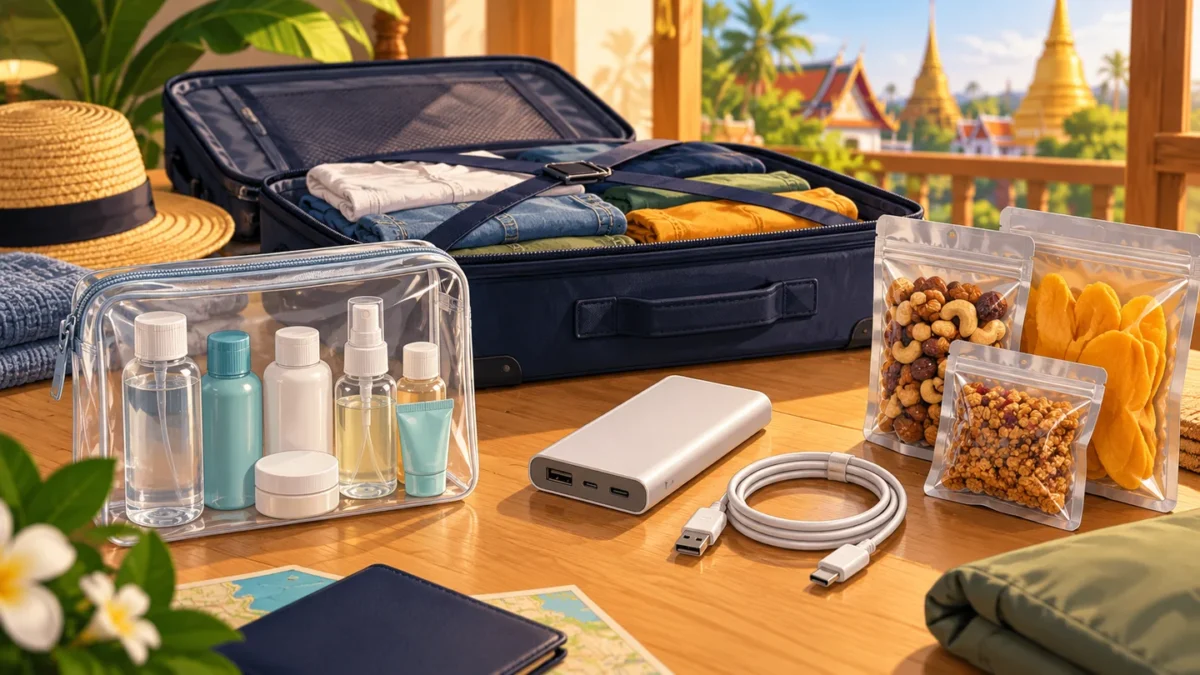
Start with three separate checks
| Check | The question to answer | Where to get the answer |
|---|---|---|
| Airport security | Can this item pass the cabin-baggage checkpoint in this container? | Your departure airport’s current screening guide; any airport where you will be screened again |
| Airline carriage | Will the operating airline accept it, in which bag, and with what approval or protection? | That airline’s dangerous-goods and baggage pages |
| Destination entry | May the food or other purchase enter the country, and must it be declared? | The destination’s customs or biosecurity authority |
Work through the checks in that order when packing. If the airline prohibits an item in both bags, moving it to checked baggage does not solve the problem. If food passes security, you still need the destination check.
For an unusual item, AOT’s Pick and Pack guide is a useful starting point. Its own advice is to contact the airline when your item does not match a listed entry. Describe the actual product and model, rather than asking only whether “electronics” or “food” are allowed.
Read the bottle’s capacity, not the amount left
For ordinary liquids, aerosols and gels, prepare containers of no more than 100 ml each, with capacity markings that can be read. Put them together in one clear, resealable bag of no more than one litre and close it properly. Suvarnabhumi’s current liquids guidance also permits a larger container when it is completely empty of liquids, aerosols and gels.
A nearly finished 200 ml shampoo bottle still fails the ordinary container-size test. AOT’s Phuket packing explainer confirms that the container capacity counts even when less liquid remains. Use a suitable labelled travel-size container, pack the product in checked baggage if otherwise permitted, or leave it behind.
Do the check at the hotel while you can still repack. Place the liquids bag where you can take it out without emptying your entire backpack. Remember the less obvious products: toothpaste, creams and gel cosmetics need consideration too.
Medicines, infant food or milk, and food for medical or special nutritional needs have separate screening provisions. Read the exemptions in the airport guide and ask about the required quantity, label or documentation for your circumstances. Keep these items easy to present to the screener. Do not apply an ordinary toiletries limit to essential items without first checking the exemption process.
Treat sauces and food gifts as individual items
A sealed jar may contain a liquid, a paste or a mixture of solids and liquid. Read the ingredients and look at the consistency. AOT’s current Suvarnabhumi liquids guidance lists sauces, chili paste and foods in sauce or with a high liquid content among liquids, aerosols and gels.
Ask about a specific product if its classification is unclear. Do not assume that every food called a paste will be treated identically, or that vacuum sealing creates an exemption. For a product that cannot travel in your cabin bag, confirm airline acceptance before placing it in the hold. Protect permitted containers against leaks.
Then check the destination separately. For example, Australia’s official food and goods guidance distinguishes products by ingredients and processing, links to detailed import conditions, and explains declaration requirements. That is an Australia example, not a worldwide food allowance.
Keep ingredient and origin labels with purchases. If a gift’s contents are unknown, resolve that before packing it. This guide deliberately does not give a general “food is allowed” verdict or replace the destination authority’s answer.
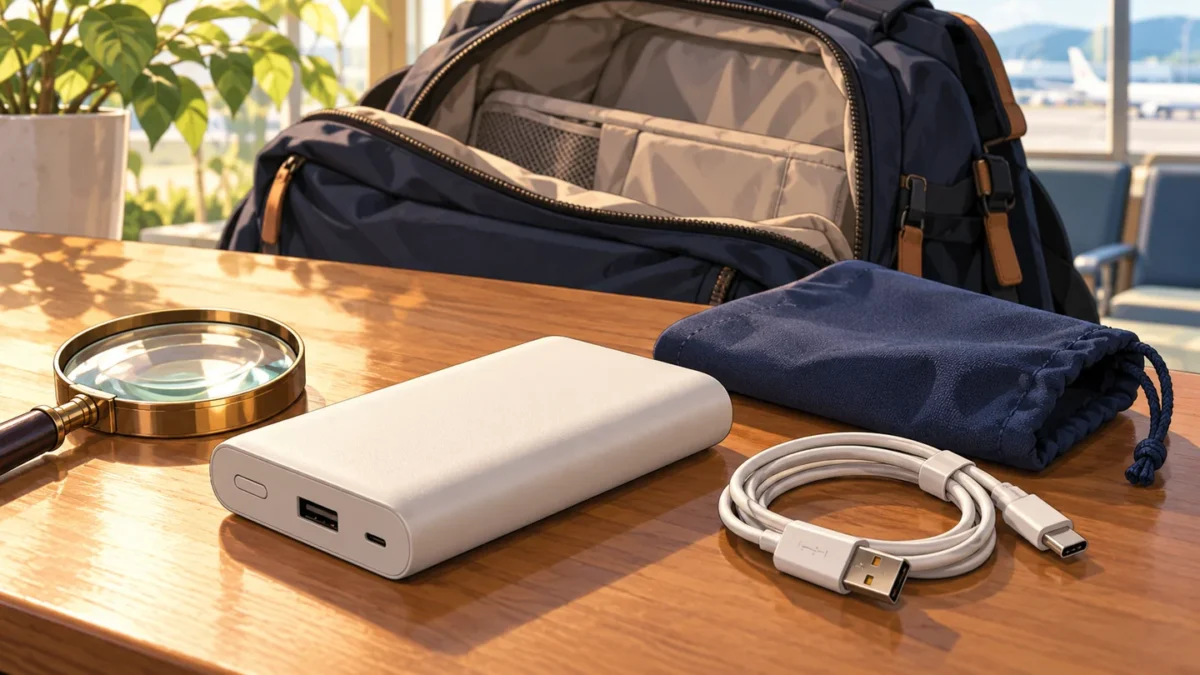
Check the power-bank rule for every operating airline
Find the printed watt-hour rating, written as Wh, and check that the label is readable. Capacity in mAh alone is not enough to compare batteries with different voltages. THAI’s dangerous-goods page gives watt-hours as amp-hours multiplied by voltage. In mAh, multiply by voltage and divide by 1,000: 20,000 mAh at 3.7 V equals 74 Wh. This calculation does not establish acceptance of a device.
The distinction between the regulator’s guidance and an airline’s policy matters. The Thai government’s June 2026 summary discusses airline permission for power banks above 100 Wh and up to 160 Wh. However, THAI’s current dangerous-goods page limits power banks to two per passenger, each no more than 100 Wh, and prohibits power banks above 100 Wh. Its separate spare-battery provisions do not override that power-bank rule.
If you fly with another carrier or connect to a second airline, check each operating airline’s current power-bank entry. Do not use another traveller’s successful trip or an old airport poster as approval. For an unclear or damaged label, ask before travel and have an alternative rather than relying on acceptance at the checkpoint.
Carrying a power bank does not mean using it in flight
The Thai government’s June 2026 summary of the CAAT rules says power banks belong in cabin baggage, with a maximum of two per passenger. It also prohibits using or charging them during flight and storing them in overhead compartments. Keep accepted devices accessible in the location the crew instructs, and protect them from short circuits with appropriate individual packaging or cases.
Charge your phone before travelling and save essential tickets offline. If staff take your cabin bag for loading into the hold, tell them about any power banks or spare batteries and remove the items that must remain in the cabin before the bag is handed over. Recheck every pocket, including the small pouch you normally leave inside the bag.
A phone or laptop with an installed battery, a loose camera battery and a power bank are different entries in airline rules. Identify each one separately. A swelling, damaged or recalled battery is not a candidate for a last-minute packing workaround; THAI’s dangerous-goods page prohibits damaged or recalled batteries, including those inside devices.
Use this packing decision card
These are examples to help you apply the linked rules, not an exhaustive permitted-items list. “Checked baggage” below always means subject to the airline’s acceptance and destination requirements.
| Item in front of you | Decision before leaving for the airport |
|---|---|
| A partly used 200 ml shampoo bottle | The remaining amount does not make the container cabin-compliant. Repack into a suitable travel-size container, use accepted checked baggage, or leave it |
| An empty reusable drinking bottle | Keep it empty for screening; the Suvarnabhumi guide allows larger empty containers |
| A jar of sauce or a food gift with wet ingredients | Check its screening category and container size, then airline carriage and destination entry separately |
| A power bank labelled 74 Wh | Check quantity, condition and each airline’s power-bank policy; keep it out of checked baggage and follow in-flight restrictions |
| A power bank labelled 120 Wh for a THAI-operated flight | THAI’s current power-bank rule prohibits it; the regulator’s approval discussion does not create a THAI exception |
| An electronic device with no readable battery information | Ask the airline using the exact model and specifications before travel; do not guess the rating |
| Essential liquid medicine or infant supplies | Check the airport’s exemption process and documentation before packing them for inspection |
Now make your own short record:
- Item and exact model or ingredients:
- Container capacity or battery Wh rating:
- Departure airport rule and date checked:
- Operating airline rule for each flight:
- Bag or permitted location:
- Approval or documentation required:
- Destination food/import check, if relevant:
- What I will change if it is not accepted:
Photograph the product label for your own reference, but leave the original label visible on the item. A photograph does not guarantee that screening staff will accept an unreadable device.
Buying duty-free liquids before a connection
AOT’s general FAQ describes the sealed security bag and receipt used for duty-free liquids. Keep that bag unopened. Before buying, give the shop your full route and ask about every later screening point.
There is an important Suvarnabhumi-specific warning in the current liquids guide: leaving the security-restricted area to check in for a new flight ends the duty-free exemption described there. Oversize duty-free liquids then cannot pass the checkpoint under that exemption. If you must collect bags and check in again, settle the packing plan before purchase. Check the onward airport’s rules too, rather than assuming that an airport purchase travels through every connection.
A dated change to check before a flight from 16 October
Suvarnabhumi’s checked-baggage inspection notice announces procedures effective on 16 October 2026. Where screening gives grounds for further inspection, it describes opening checked bags without the passenger present, recording the inspection and placing a notice inside the bag. It recommends internationally recognised compatible locks.
TAT’s explanation says existing procedures remain until the change is introduced and that bags will not be routinely opened. On this article’s 8 October check date, the new procedure is still upcoming. For travel on or after 16 October, read the airport and airline’s latest notice again before departure. This is a screening-process update, not a reason to wait until then to remove prohibited batteries from checked bags.
Finish the sorting before check-in. The useful result is a bag you can explain item by item, with unresolved questions answered while you still have time to change what you carry.